PART 1
Marta Ríos felt the soup turn cold when her eldest son dropped the bombshell in front of everyone.
—Look, Mom, in this life, those who don’t produce are a burden. And you’ve been here for months without contributing anything.
The dining table froze.
There were Paola, her daughter-in-law, two of Alejandro's clients, a political cousin who wouldn’t stop bragging about her house in San Miguel de Allende, and even a neighbor invited ‘out of obligation.’
No one knew where to look.
Marta was 68 years old, living in a spacious apartment in the Narvarte neighborhood, with wooden floors, basil pots on the window, and a large photo of her husband Tomás next to the bookshelf.
That apartment was hers.
Tomás had left it in her name before passing, along with a savings account, some investment funds, and enough peace of mind so that Marta wouldn’t depend on anyone.
But Alejandro always talked about that house as if it were already his.
He had always been like that: elegant, ambitious, a great salesman, but with a strange hunger for appearances. He liked expensive watches, restaurants where everyone turned to look at him, and motivational business quotes.
His younger brother, Julián, was different.
He worked as a pediatrician in Guadalajara, didn’t make millions, but called his mother every night. When Tomás was sick, Julián slept for months on hospital couches while Alejandro sent messages saying he was “busy.”
That’s why Marta should have trusted her gut when Alejandro arrived one afternoon with Paola and eleven suitcases.
—Mom, we need to stay with you for a bit —he said—. The house in Lomas Verdes has moisture in the walls. The architect said it could be dangerous.
Paola hugged Marta with expensive perfume and a magazine smile.
—It’ll only be a few weeks, dear mother-in-law. Seriously, you won’t even notice.
But she did notice.
From the very first day.
Paola changed the curtains because “they looked sad.” She removed Tomás' china because “it took up space.” Alejandro turned Marta's study into an office and asked her not to enter when he had video calls.
—My clients shouldn’t see old papers behind me —he told her.
Marta pressed her lips together.
Those “old papers” were invoices, bank statements, and documents from 42 years as a tax auditor.
During the first month, she tried to be patient.
Then the small humiliations began.
Paola filmed videos in the kitchen saying:
—Caring for our elderly is an act of love.
Marta watched her from the table, not understanding.
Caring?
She made breakfast, paid the electricity bill, tended to her plants, shopped for groceries, and even washed the cups Alejandro left lying around.
The Lomas Verdes house was never fixed.
Two months passed. Then three.
Alejandro no longer talked about leaving. Paola hosted friends, ordered sushi, opened bottles of wine, and told Marta, “Don’t tire yourself, sit over there,” as if she were a delicate piece of furniture.
One night, Julián arrived from Guadalajara. Marta prepared red rice, tlalpeño soup, and flan.
She wanted a quiet dinner.
But Alejandro showed up with guests unannounced.
During the meal, a client asked how difficult it was to live with an elderly mom.
Alejandro laughed and raised his glass.
—Well, one sacrifices for family. My mom is all alone, a bit forgetful. We’re supporting her.
Julián set his glass down on the table.
—You’re not supporting her. You’re living in her house.
Paola smiled, uncomfortable.
—Oh, Julián, always so dramatic.
Alejandro straightened up.
—Her house? And what does she do all day? Water pots, watch soap operas, and sort receipts? I actually work. I actually support a family. She lives for free.
Marta looked at him as if she didn’t recognize his voice.
—Alejandro, this is my house.
He let out a dry laugh.
—Mom, please. At your age, you shouldn’t even be handling your accounts. If you want to stay here, at least cook, clean, or do something useful.
Julián stood up, furious.
—You’re despicable.
But Marta didn’t shout.
She just looked at her hands.
Wrinkled hands, yes. But hands that had worked, signed audits, paid for schools, cared for the sick, and buried the man she loved.
That night, when everyone left, Marta didn’t cry in front of anyone.
She entered the study that no longer felt like hers, opened an old blue-covered notebook, and wrote a single sentence:
“When a child forgets who fed him, he also forgets that debts can be collected.”
The next day, Marta began to sift through every paper Alejandro had left on her desk.
And the first thing she found took her breath away.
PART 2
Marta did not confront Alejandro.
She didn’t knock on his door. She didn’t confront Paola in the kitchen. She didn’t call Julián crying.
She simply returned to being what she had always been: a patient woman with an auditor’s eye.
She opened a folder on her computer called “Plant Photos” and began to store everything.
Screenshots of Paola’s videos insinuating that Marta could no longer take care of herself. Audios where Alejandro said his mother “was just pretending to be lucid.” Printed messages he forgot in the printer’s tray.
She also kept receipts for food, electricity bills, purchases made with her card, and deposits she didn’t recognize.
Marta could walk slowly, but her mind was still cutting through lies like a knife.
One afternoon, Alejandro and Paola went out for a meal in Polanco. They said they had an important meeting.
Marta waited for 20 minutes.
Then she entered the study.
In the bottom drawer of the desk, she found a black leather folder. Inside were copies of a rental contract.
The house in Lomas Verdes had no moisture.
There was no architect. There was no danger. There was no repair.
They had been renting it for 52,000 pesos a month for the last three months.
Alejandro and Paola were living for free in Marta’s apartment while collecting rent for their own house.
Marta felt a burning in her chest.
It wasn’t sadness.
It was disgust.
She scanned everything calmly. Returned the papers to their exact place and left the study as if nothing had happened.
That very night, she overheard something worse.
Paola was on the phone in the living room, thinking Marta was asleep.
—The doctor already said she could sign something light, like early cognitive decline —she whispered—. We don’t need her to be crazy, just to seem incapable of managing her assets.
Alejandro replied from the couch.
—And Julián?
—Julián lives far away. Besides, you’re the eldest son. If we put her in a nice home, everyone will say it’s for her own good. We sell the apartment, pay off debts, invest in your business, and that’s it.
Marta leaned against the hallway.
Not because she was weak.
But because if she entered at that moment, she might have said things that shouldn’t be said, even in a tragedy.
They wanted to take her house.
They wanted to lock her up.
They wanted to erase the life she had built with Tomás and sell it as if it were used furniture.
That night, she didn’t sleep.
At 6:30 in the morning, she called Beatriz Landa, an old college classmate now running a financial research firm in Reforma.
—Marta Ríos —said Beatriz, surprised—. I haven’t heard from you in years.
—I hadn’t known much about myself either —Marta replied—. But I think I’ve finally woken up.
They met at a café in the Roma neighborhood.
Marta arrived with a simple bag, her hair tied up, and a folder full of evidence. Beatriz listened without interrupting. She didn’t treat her like an elderly woman. She didn’t give her pitying pats.
She only asked one question.
—Do you still have your professional license active?
Marta blinked.
—Yes. But I’m retired now.
Beatriz chuckled softly.
—Retired from payroll, not from talent. I need someone to review complicated files from home. Someone who knows how to find holes in pretty accounts. You were always the best at that.
Marta lowered her gaze.
For months, they had repeated to her that she was worthless.
That offer sounded like a door opening in the middle of confinement.
She accepted.
In the following weeks, while Paola posted stories of “loving family” and Alejandro occupied the study as if he owned it, Marta worked at dawn at the dining room table.
She reviewed balances, detected suspicious transfers, compiled reports, and sent precise conclusions.
Her first payment arrived on a Thursday.
It wasn’t a fortune.
But Marta cried when she saw it.
Not out of need.
But because that deposit confirmed something they had almost stolen from her: she was still capable, still necessary, still Marta.
With Beatriz’s help, she contacted Raúl Medina, a lawyer specializing in estates and the elderly.
Marta handed over deeds, a will, screenshots, audios, the Lomas Verdes contract, receipts, and the recordings where they talked about declaring her incapacitated.
Raúl reviewed everything for almost two hours.
Finally, he closed the folder with a seriousness that made Marta take a deep breath.
—Ms. Marta, this isn’t a family dispute. This looks like an attempt at dispossession. You can legally evict them and also file a complaint.
Marta didn’t hesitate.
—First, I want my house back.
—Then we’ll formally notify them. They’ll have 15 days to leave. If they don’t comply, we’ll request judicial intervention.
Marta nodded.
She had spent months feeling like a guest in her own living room.
That was about to end.
She chose a Sunday.
Alejandro and Paola returned from Valle de Bravo at noon, wearing sunglasses, carrying designer bags, and with a cooler as if they were coming back from an eternal vacation.
Marta waited for them, seated in the living room.
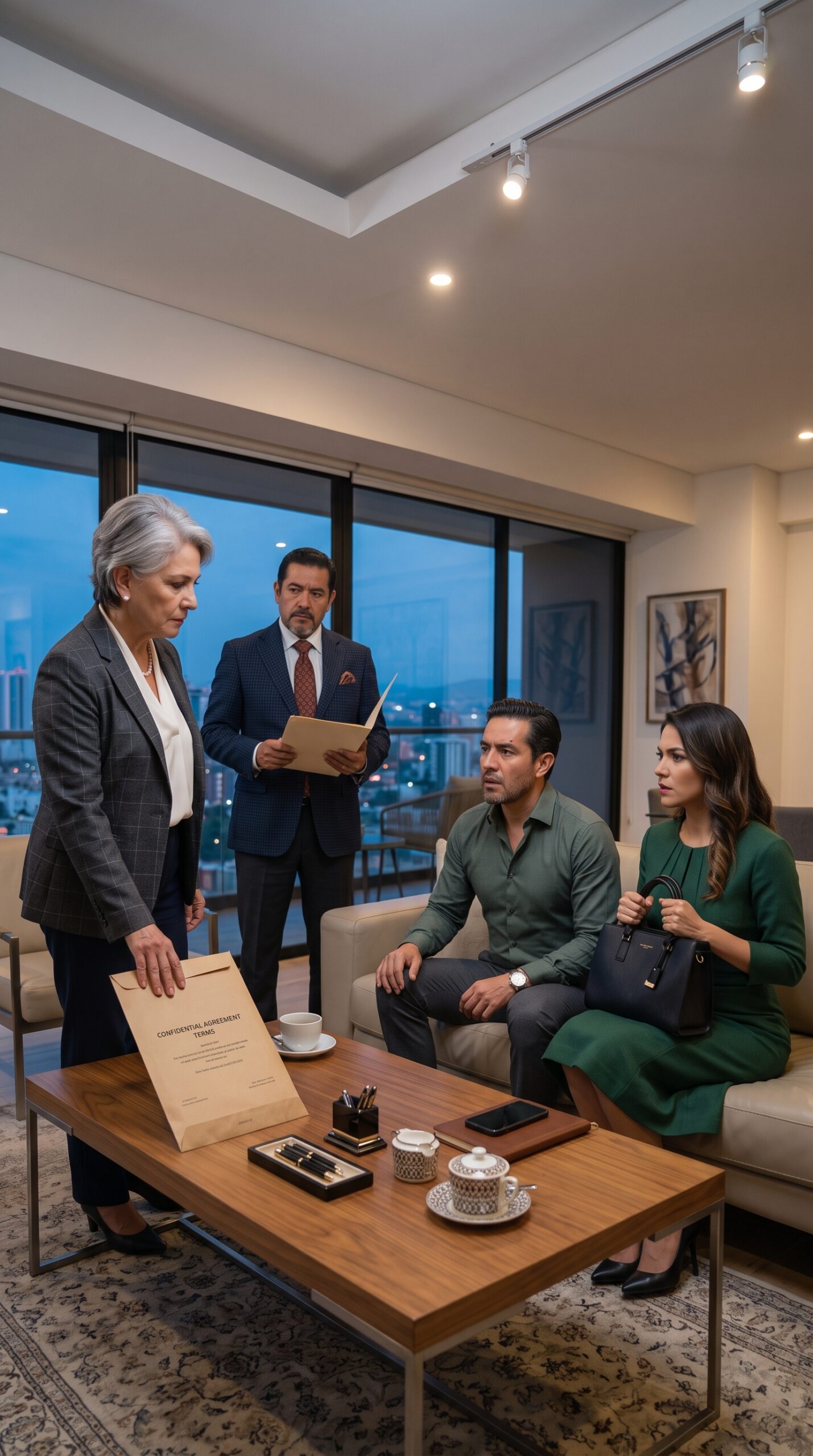
She wore beige pants, a white blouse, pearl earrings, and styled hair. On the table was a yellow envelope.
Paola grimaced.
—Oh, dear mother-in-law, we’re dead. Let’s talk later, okay?
—Now —Marta said.
The voice was so firm that Paola stopped smiling.
Alejandro frowned.
—What’s going on?
Marta pushed the envelope toward him.
—You have 15 days to vacate my apartment.
Alejandro let out a laugh.
—Excuse me?
—It’s a formal eviction notice. This property is mine. You don’t pay rent. You have no contract. You’re leaving.
Paola's eyes widened, and her tone changed in seconds.
—Honey, see? This isn’t normal. Your mom is confused.
Marta turned her laptop toward them.
On the screen appeared the rental contract for Lomas Verdes.
Then the audios.
Then the screenshots.
Then the lawyer's name.
Alejandro’s mouth went dry.
—Did you go through my papers?
Marta looked at him unwaveringly.
—Reviewing papers was my job for 42 years. What’s strange is that you thought having gray hair meant I couldn’t read anymore.
Paola stood up, furious.
—You can’t do this to us. We’re family.
Marta stood up as well.
—Family doesn’t humiliate a mother in front of strangers. Family doesn’t call her useless. Family doesn’t make up stories about her illness to sell her house.
Alejandro looked down.
—Mom, we can talk.
—We’ve talked enough. Now it’s time to obey the law.
At that moment, the doorbell rang.
Paola froze.
Marta opened the door.
In came Julián and Raúl, the lawyer.
Julián carefully hugged his mother, as if he knew she didn’t need to be carried but accompanied.
—I’m here now, Mom.
Alejandro exploded.
—Did you put ideas in her head?
Julián looked at him with sadness.
—No, brother. You put fear in her house.
Raúl placed a recorder on the table.
—With the owner’s permission, this meeting is being documented.
Paola let out a nervous laugh.
—How ridiculous. All this over an apartment.
Marta turned to her.
—To you, it’s an apartment. To me, it’s the life of 40 years with my husband. It’s where my children learned to walk. It’s where I cared for Tomás until his last day. It’s not a business. It’s my home.
Alejandro tried to approach.
—Mom, really, I was under pressure. The business is struggling. I owe money. Paola told me that…
Paola interrupted him.
—Don’t drag me into this! You wanted to sell the apartment long before. You said your mom wouldn’t even notice if we put her in a nice residence.
Silence fell heavily.
Raúl raised an eyebrow.
—Thank you, Ms. Paola. That’s also being recorded.
Paola covered her mouth.
Alejandro turned pale.
The next 15 days were a silent war.
Alejandro first begged. Then shouted. Then offered to pay a ridiculous rent. Paola threatened to post videos claiming Marta was a cruel mother.
Marta didn’t budge.
Every threat went straight to her lawyer.
Every message was stored.
Every attempt at manipulation found a closed door.
On day 13, Paola left with seven suitcases without saying goodbye.
—Bitter old lady —she murmured from the hallway.
Marta heard her.
But it didn’t hurt anymore.
Alejandro left the following day. He no longer looked like the successful man from the dinners. He wore a wrinkled shirt, deep dark circles, and carried a box of documents under his arm.
He stood at the entrance.
—Mom… I’m sorry.
Marta felt her chest break.
She saw the boy who asked her for quesadillas after school. She saw the teenager who cried when he didn’t get into the university he wanted. She saw the son who once hugged her without a care.
But she also saw the man who tried to take her house.
—Maybe one day I can forgive you —she said—. But I won’t confuse you with the boy you were again. Now you are accountable for the man you chose to be.
Alejandro cried.
—Are you going to close the door on me?
Marta took a deep breath.
—No. You closed it when you called me a burden at my own table.
And she closed it.
That night, Marta cried alone.
She cried for Tomás, for the shame of having felt fear in her own home, for the son she lost without having buried him.
Because a mother doesn’t stop loving overnight.
But she also learned that loving doesn’t mean allowing oneself to be destroyed.
At dawn, she opened all the windows.
Fresh air poured in, the scent of bread from the corner bakery, and the sounds of vendors passing on the street.
For the first time in months, her home sounded like hers again.
Marta returned to the study.
She put Tomás' photo back on the shelf. Took out Paola’s artificial plants. Organized her folders. Made coffee.
Weeks later, Beatriz invited her to partner with the firm as an external consultant. Clients began to ask for her by name because “Ms. Ríos sees what no one else sees.”
Julián started visiting her every other weekend.
Not to care for her as if she were broken.
But to eat with her, laugh, tell her about his patients, and bring her bread from Guadalajara.
Alejandro lost two partners when they found out about the attempt at dispossession. Then he lost Paola, who left when the luxurious life couldn’t be sustained.
Months later, Alejandro sent a letter.
He didn’t ask for money.
He didn’t ask to come back.
He asked to see her for 20 minutes.
Marta agreed to meet at a café in Coyoacán.
Alejandro arrived without an expensive watch, without a new truck, without that invincible man’s smile. He looked thinner, more human.
—I’m working at a small company —he said—. I’m going to therapy. I’m paying off debts. I’m not here to ask you to forget. I just wanted to tell you that I’m ashamed.
Marta watched him in silence.
—I’m listening.
—I thought worth was about having more. More money, more things, more power. And I ended up treating my mother like she was an obstacle. I have no excuse.
Marta looked at his hands on the table.
The same hands he had called useless without saying it directly.
Then she said:
—Trust doesn’t return with tears, Alejandro. It returns with years of actions.
He nodded.
—I know.
—Then start by living without hurting anyone.
Marta didn’t hug him.
But she didn’t get up either.
That was her true triumph.
Not recovering a perfect son, because that son may never have existed.
Not winning a family war, because no mother celebrates the fall of her blood.
Her triumph was reclaiming her house, her name, her work, and her voice.
At 68, Marta sat down again in front of her spreadsheets with a newfound tranquility.
And she understood something many families should discuss before it’s too late:
A mother can give everything for her children, but she is not obligated to endure humiliation.
A woman doesn’t lose value by aging.
She doesn’t become useless because she keeps quiet.
Sometimes she’s just watching.
Sometimes she’s just gathering evidence.
And when the moment comes, even the cruelest debt is collected with interest.





