PART 1
A week before the family meal at the grandparents' house, Andrea sensed something was off with her 7-year-old daughter, Sofía.
The little girl no longer raced through the house singing, nor did she show off her stickers, nor did she ask every night how long until the Saturday barbecue.
She just sat in her room, clutching her savings jar as if someone could snatch it away.
Andrea thought it was just a phase.
Kids sometimes latch onto odd objects.
What she didn’t know was that her daughter was already carrying a shame that didn’t belong to her.
On Saturday, Andrea and her husband Daniel arrived at her parents' house in a quiet neighborhood of Guadalajara.
The air was thick with the smell of grilled meat, warm tortillas, roasted salsa, and charcoal. Cousins ran around the yard, uncles discussed politics, and Grandpa Roberto wrestled with the grill because, as always, he was burning the steaks.
Andrea thought that would be the worst part of the day.
She was wrong.
Her younger sister, Patricia, suddenly appeared with several shiny bags from an expensive department store.
Patricia had always been intense, dramatic—one of those people who turned any gathering into a stage. But that afternoon, she outdid herself.
She clapped her hands and shouted:
—Hey, family, gather around! I brought some little surprises.
Everyone moved closer.
Andrea stood beside Daniel, a paper plate in hand, an uneasy feeling churning in her stomach.
Patricia began handing out gifts.
She gave her son Leo a new pair of brand-name sneakers.
To her daughter Camila, she gifted an extravagant tablet case and a sequined backpack.
The children's eyes lit up. The adults gasped in surprise.
—Oh, sweetie, what a thoughtful gesture!
—And look at you being so generous!
Andrea frowned.
A month earlier, Patricia had called her in tears, saying she couldn’t pay for the electricity, the community fund, or the car payment.
Daniel leaned towards Andrea and whispered:
—Since when does your sister have money?
Andrea didn’t respond.
Because just then, Patricia pulled out another small package, wrapped in pink paper.
—And this is for my niece Sofía —she announced loudly, with a smile that was too perfect.
Everyone turned to the girl.
Sofía received the gift but didn’t open it.
She merely placed it on her lap and lowered her gaze to the grass.
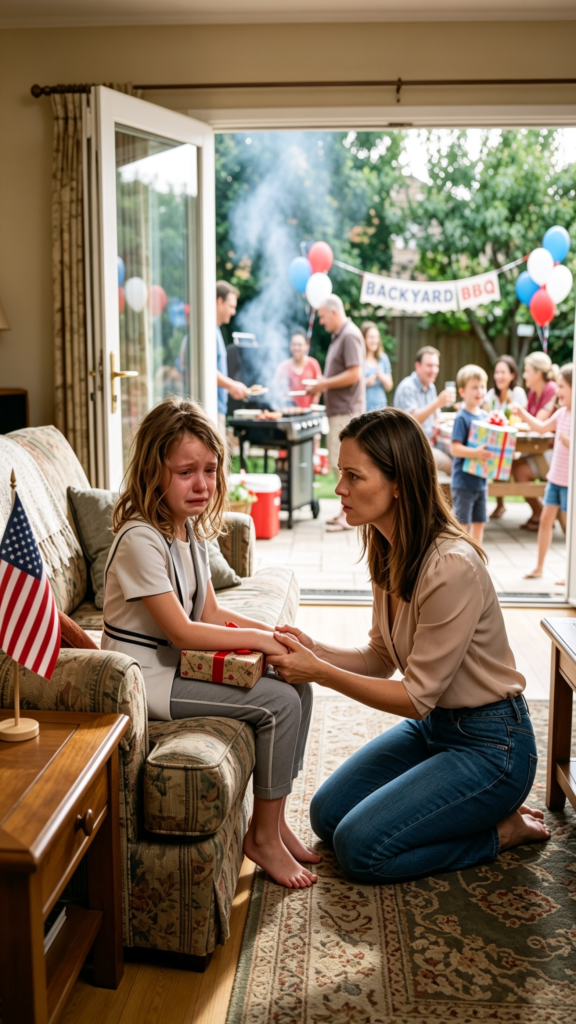
Andrea knelt beside her.
—Open it, sweetheart.
Sofía shook her head.
Her hands trembled.
Before Andrea could ask what was wrong, Patricia produced an elegant envelope and handed it to their parents.
—For you, Dad and Mom. A full day at the spa. Massage, facials, meals included—all paid for.
Doña Carmen placed her hand on her chest as if she’d been gifted a house.
Don Roberto beamed with pride.
—Look at that, Paty. That’s how it’s done.
Murmurs rose.
That Patricia had changed.
That she was finally making it.
How lovely that she thought of everyone.
Then Patricia turned to Andrea.
Her smile sharpened.
—And you, Andrea? What did you bring?
The yard fell silent.
Andrea felt all eyes on her.
She hadn’t brought anything.
Because Patricia herself had told her on the phone:
“Don’t bring gifts, sister. Just come with Daniel and the girl.”
Andrea opened her mouth, but no words came out.
A cousin raised an eyebrow.
Someone whispered:
—Isn’t Andrea always the one who helps?
Patricia leaned back in her chair, a satisfied smile plastered on her face.
She had orchestrated all of it.
And Sofía, her joyful little girl, was curled up in her seat, clutching that package as if it weighed a hundred pounds.
Andrea still didn’t know where the money had come from.
But when Sofía stood up from the table with tears in her eyes and whispered, “I want my jar,” Andrea felt the world freeze around her.
PART 2
Andrea didn’t make a scene in front of everyone.
She didn’t throw plates.
She didn’t shout at Patricia in the middle of the yard.
She didn’t want to give her sister the show she was likely expecting.
She simply took Sofía by the hand and followed her to the living room, away from the noise of the cousins, the false laughter, and the venomous comments.
She found her sitting on the edge of the couch, the gift still unopened on her lap.
Her shoulders slumped, her little face red from holding back tears.
Andrea sat down beside her.
—My love, tell me what happened.
Sofía pressed her lips together.
—I don’t want that gift.
—Why not?
The girl swallowed hard.
—Because she bought it with my money.
Andrea felt a dry hit to her chest.
She didn’t move.
She didn’t raise her voice.
She knew that if she exploded, Sofía would only get more frightened.
—What money, sweetheart?
Sofía looked towards the door, as if Patricia might appear at any moment.
—My jar.
Andrea closed her eyes for a moment.
That jar was sacred to Sofía.
Since she was 5, Andrea and Daniel had taught her something simple: if she received money on her birthday, at Christmas, or from her paternal grandparents, she could spend a part and save the rest.
Sofía took it very seriously.
Each coin was a victory.
Each folded bill was a point of pride.
She had marked the jar with a label that read: “My dreams.”
By 7, she had saved $1,651.26.
She could state the exact amount without error.
She dreamed of buying a purple bicycle, but she also said she wanted to keep saving “just in case one day Mom needed something.”
That’s why Andrea felt her blood boil.
—Tell me everything —she urged.
Sofía began softly.
She said that days before, when Patricia had come to the house with Leo and Camila, she had overheard her talking about the jar.
Patricia told her she didn’t believe her.
—She said to me: “You’re kidding, Sofía. A girl can’t have that much money.”
Proudly, Sofía fetched the jar and showed it to her.
At first, Patricia smiled.
She told her it was a lot of money and what a diligent girl she was.
Sofía thought her aunt was happy.
But then Patricia changed.
She told her that Leo and Camila didn’t have such savings.
That they deserved nice things too.
That a good girl shares with her family.
Sofía said no.
Because that money was hers.
Then Patricia crouched in front of her and whispered:
—If you don’t share, you’re selfish. Your cousins need it more. You don’t even know how to spend.
Sofía started to cry, but Patricia insisted.
She told her that if she told Andrea, she’d be betraying the family.
She told her that her parents would be disappointed.
She told her that “adults know better.”
And in the end, Sofía let Patricia take the entire jar.
Everything.
Even the coins stuck at the bottom.
—She told me I should feel proud —Sofía murmured—. But I didn’t feel proud. I felt bad.
Andrea hugged her as tightly as she could without hurting her.
Inside, she was trembling.
It wasn’t just the theft.
It was the cruelty of making a 7-year-old feel guilty to take away her savings.
It was the same old story, but now it was against her daughter.
Patricia had always been like that since childhood.
Three years younger than Andrea, always with different rules.
If Patricia broke something, Doña Carmen would say:
—She’s little, Andrea. Don’t be so hard on her.
If Patricia took toys that weren’t hers, Don Roberto would say:
—You’re the eldest. Learn to share.
If Patricia cried, everyone rushed to her.
If Andrea stood up for herself, they called her dramatic.
That pattern grew with them.
As adults, Patricia called Andrea every time something got complicated.
—Sister, my card didn’t go through at the supermarket. Lend me $800.
—Andrea, send me your card to buy uniforms. I’ll pay you back on Friday.
—Really, this is the last time.
It never was the last time.
She never paid fully.
And when Andrea complained, Patricia said the same thing:
—You earn more. Don’t be stingy. You can help.
Andrea fell for it many times.
Out of guilt.
Out of habit.
Because their parents had raised her to feel responsible for her sister's disasters.
The worst mistake came a year earlier.
Patricia showed up crying in Andrea’s kitchen, saying she had been accepted into an acting school in London.
She said it had been her dream since childhood.
That she had married young.
That she had had kids quickly.
That she had never been able to pursue her passion.
That if she studied there, she would finally be independent and stop depending on everyone.
Her husband, Martín, refused to pay.
—I maintain the house and the kids —he told her—, but I’m not selling my soul for you to play actress in London.
Patricia came to Andrea.
She cried.
She begged.
She promised to change.
Andrea wanted to believe her.
She thought that if she gave her this chance, maybe her sister would finally stop stretching out her hand.
So she gathered $40,000.
It wasn’t easy.
She took from her savings.
She tightened expenses.
She even took part of the mortgage credit.
That money went into an account in Andrea’s name, intended to cover tuition, accommodation, and fees for Patricia.
While Patricia was in London, the family murmured.
That she had left her children behind.
That Andrea was paying for everything.
That Patricia was living like a queen while everyone else sorted out their problems.
Patricia didn’t feel grateful.
She felt humiliated.
And upon returning to Mexico, she decided to execute her revenge.
The family meal was not generosity.
It was theater.
Leo’s sneakers.
Camila’s backpack.
Their parents’ spa day.
The fake little package for Sofía.
Everything was a message.
“Look at me, I can give too.”
“Look at me, I’m the good one.”
“Look at me, Andrea brought nothing.”
Only Patricia used stolen money from a little girl to buy applause.
Andrea left her parents’ house without saying goodbye.
Daniel followed her in silence.
Sofía got into the car with the closed package.
When they got home, the girl set it on the table.
—It wasn’t even for me —she said with a broken voice—. It’s a shirt in Camila’s size.
Andrea felt another stab.
Of course.
Patricia hadn’t even bought something thinking of Sofía.
The gift was just a prop.
A mockery wrapped in pink paper.
That night, when Sofía fell asleep, Andrea sat in front of the laptop.
She opened the account.
There were the $40,000 meant for Patricia’s grand dream.
Andrea didn’t hesitate.
She transferred every cent back to her personal account.
Then she canceled the authorizations, wrote to the school, withdrew her endorsement from the pending payments, and requested that no future charges be linked to her name.
All in silence.
Without insults.
Without threats.
Without drama.
Three hours later, Patricia received the first email.
“Payment rejected.”
Then another.
“Pending accommodation account.”
After that, an international call.
Her program was at risk if she didn’t cover the next deposit.
That same night, Patricia texted Andrea.
“What did you do?”
Andrea didn’t reply.
The next day, Patricia called 18 times.
Andrea answered once.
—Can you tell me what’s going on? —Patricia shouted—. Is it about that little jar?
Andrea held the phone calmly.
—You stole from my daughter.
—Oh, come on. It was $1,651.26. Don’t exaggerate. I taught her to share.
Andrea felt that phrase erase any remaining compassion.
—Then pay them yourself. But never again with my money.
She hung up.
Two days later, Patricia arrived at her house with a crumpled envelope.
Her eyes were puffy, her makeup smeared, and her voice filled with rage.
—Here’s the money. Done. Happy?
Andrea didn’t take the envelope.
—Don’t give it to me. You stole it from Sofía. You return it to her and apologize.
Patricia entered the living room as if a tooth were being pulled.
Sofía was reading on the couch.
Patricia extended the envelope.
—Take it. I’m sorry.
Nothing more.
No tenderness.
No real shame.
Just annoyance.
Sofía took the envelope, hugged it to her chest, and went to her room without saying a word.
Patricia turned to Andrea.
—Done. It’s settled. Now go back to paying for London.
Andrea let out a dry laugh.
—You didn’t understand anything.
—It’s my dream, Andrea. You can’t destroy it over something trivial.
—I didn’t destroy anything. You did when you decided to steal from a child and humiliate her.
Patricia started to cry.
But Andrea already knew those tears.
They weren’t of regret.
They were fear of losing money.
—Please —Patricia pleaded—. If I don’t finish, everyone will say I failed.
—Then get a job, take out a loan, or sell your speech to someone else. With me, it's over.
Andrea opened the door.
Patricia left trembling with anger.
But the real war began afterward.
Doña Carmen and Don Roberto arrived a week later.
They didn’t even ask about Sofía.
They entered defending Patricia.
—Andrea, this has gotten out of control —her mother said—. Your sister made a mistake, but you can’t ruin her future.
—A mistake? —Andrea asked—. She took her savings from a 7-year-old girl.
Don Roberto huffed.
—The girl said yes, right? Besides, she was family. This is how you learn to share.
Andrea stood up.
For the first time, she didn’t feel small in front of them.
—Sofía said yes because an adult pressured her, threatened her with guilt, and told her she was bad if she didn’t hand over her money. That’s not sharing. That’s abuse.
Doña Carmen pressed her lips together.
—Always so dramatic. You were just like this as a child. Patricia is more sensitive.
Andrea felt a cycle close.
There it was again.
The same phrase.
The same excuse.
The same preference.
But this time she wasn’t defending a broken doll or a borrowed shirt without permission.
She was defending her daughter.
—If you want to pay for London, do it yourselves —Andrea said—. Sell your car, take out a loan, pawn your jewelry. But from me, she won’t receive another cent.
Her parents left furious.
For weeks, the family talked.
That Andrea was cold.
That she was resentful.
That she was punishing her sister out of envy.
But when some cousins called to complain, Andrea simply said one phrase:
—Patricia stole Sofía’s savings.
Then came the silence.
Because there was no pretty defense for that.
As the months passed, everything collapsed under its own weight.
Andrea’s parents tried to pay for Patricia’s school, but London couldn’t be sustained by good intentions.
Soon the debts began.
The cards were maxed out.
Payments were delayed.
And then came the twist no one expected.
Martín, Patricia’s husband, filed for divorce.
At first, the family thought it was about money.
But then the truth came out.
Martín had discovered the jar.
He also found messages where Patricia boasted that she had used Sofía’s money to “silence Andrea” at the gathering.
That broke him.
He said he could tolerate many things, but not that his wife would steal from a child and then feel proud of it.
Patricia tried to demand her emergency fund.
She wanted him to sell a work truck.
She wanted him to take out a loan in his name.
Martín refused.
And when she threatened to use the kids to pressure him, he gathered evidence and sued her.
Patricia didn’t finish her program.
She returned to Guadalajara without a degree, without applause, without a stage, and without the image of a successful woman she so desperately wanted to flaunt.
She ended up living again with Doña Carmen and Don Roberto, working in a makeup store at a mall, fighting for shared custody, and hearing every day that the house was no longer enough to support her.
Her parents, who had defended her so fiercely, now bore the consequences.
And Andrea never rescued anyone again.
Sofía started saving again.
Daniel bought her a new jar, larger, with a purple lid and a label that read: “My dreams are still mine.”
Andrea deposited the $1,651.26 into a child savings account, but not to replace the pain.
That couldn’t be erased with money.
She did it to teach her something more important:
That when someone crosses a line, it’s not enough to return what was stolen.
They must also face what they broke.
Sofía took time to start showing off her savings again.
But one day, while putting away a $10 coin, she looked at her mom and asked:
—Is it okay to say no even if it’s family?
Andrea hugged her.
—Especially when it’s family, my love.
Because there are people who use the word family as permission to abuse.
And there are mothers who, after a lifetime of enduring, understand that protecting their children also means breaking away from those who never respected their boundaries.