PART 1
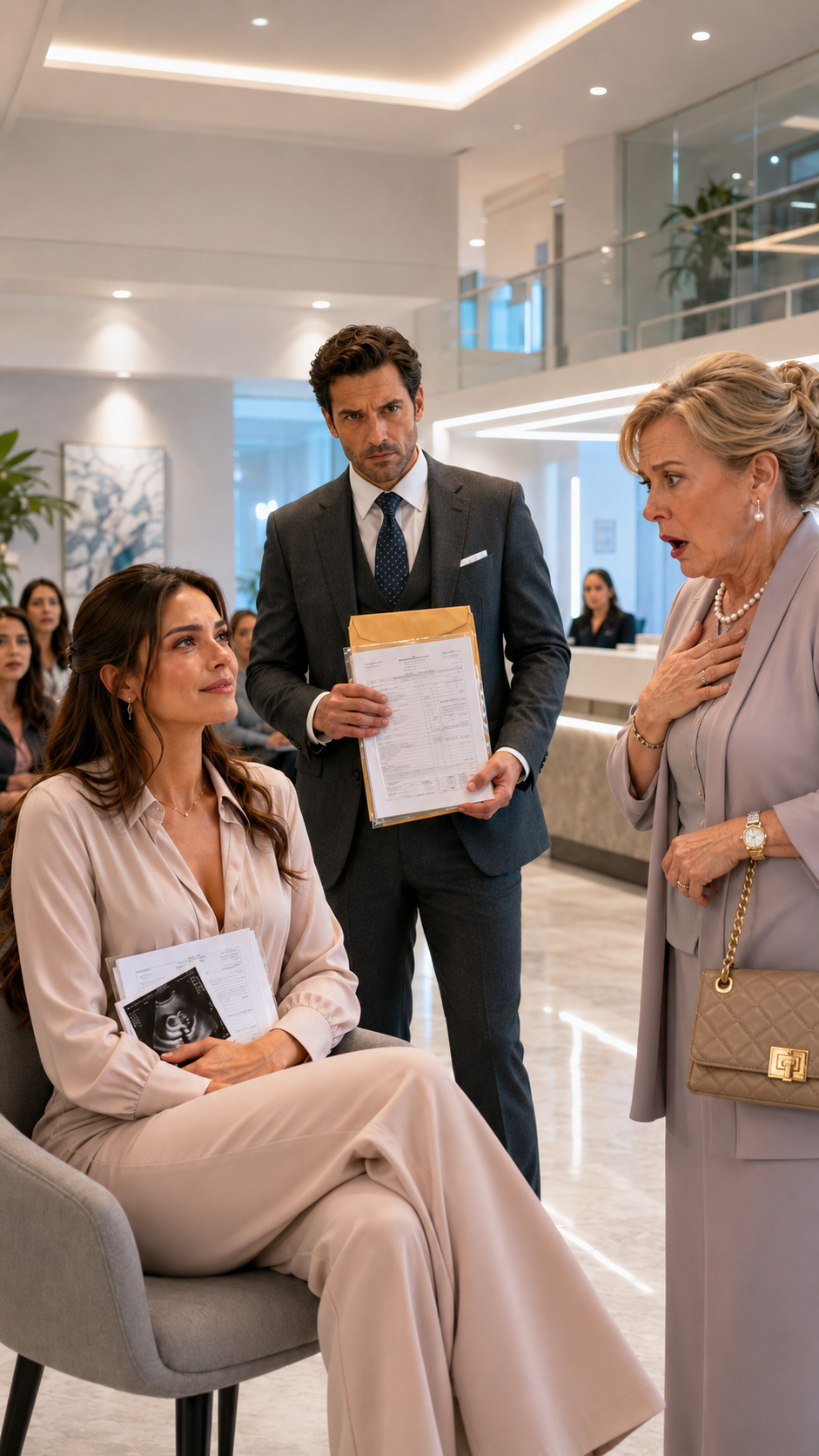
—My son did well to leave you, Lucía. Now he has a real daughter with Fernanda.
Doña Graciela Luján’s voice sliced through the silence of the waiting room like a knife.
Several heads turned.
Lucía Robles, seated with a blue folder on her lap, lifted her gaze slowly. She wasn’t surprised to see her. What hurt was the cruel pleasure that woman still took in humiliating her.
It had been one year since the divorce.
One year since Andrés Luján, a businessman from Polanco, left her after six years of marriage, four fertility treatments, two losses, and a depression that no one in the family dared to name.
To everyone, Lucía had been “the wife who couldn’t give him children.”
For Doña Graciela, it had been worse: a disgrace.
That morning, Lucía was at the Santa Emilia Clinic in Mexico City, waiting for a meeting with the medical director and her lawyer. She wasn’t there for a consultation. She wasn’t there to cry over the past.
She was there to demand accountability.
But Doña Graciela didn’t know that.
The woman appeared with her expensive purse, perfect pearls, and that smile of someone who believes money can buy even the truth. She stood before Lucía as if she had found a defeated enemy.
—It’s quite a shock to see you here —she said, lowering her voice a bit—. Are you still trying? Oh, honey… some women are born to carry babies, and others only carry sorrow.
Lucía tightened her grip on the folder but did not respond.
For years, those phrases had destroyed her from the inside out. Every family gathering, every Christmas, every meal at the Luján’s home ended with comments disguised as concern.
“¿And when’s the baby coming?”
“Poor Andrés, he really wanted to be a dad.”
“Fernanda looks so maternal, doesn’t she?”
Fernanda Rivas had been her best friend since university. The one who accompanied her to appointments, the one who hugged her after the losses, the one who swore she would never betray her.
Then she started responding late.
Then she stopped visiting.
And in the end, she showed up pregnant with Andrés.
—Camila is beautiful —Doña Graciela continued—. She has my son’s eyes. Fernanda really gave him a lovely family. Honestly, it’s so good that Andrés opened his eyes.
Lucía took a deep breath.
Four months after the divorce, she accidentally received an email from the clinic.
It read: “Confirmation of embryo transfer.”
The date was clear.
Two weeks after Andrés filed for divorce.
The embryo was not Fernanda’s.
It was Lucía’s.
A frozen embryo that could never be used without her signature.
And she never signed anything.
Doña Graciela leaned closer.
—That girl proves you were unnecessary.
Lucía smiled with a calmness that unsettled her.
—Is that what you think?
The automatic door opened.
A tall man in a dark suit entered, a sealed folder under his arm.
Doña Graciela went pale when she recognized him.
It was Commander Javier Ocampo, from the Prosecutor’s Office.
He stopped next to Lucía and looked at her ex-mother-in-law.
—Mrs. Luján, I’m glad to find you here. We’re here regarding the case of Camila Luján Rivas.
The room fell silent.
—Everything indicates that the minor was conceived with an embryo from Mrs. Lucía Robles, using falsified documents.
Lucía held Doña Graciela’s gaze.
And no one could believe what was about to happen.
PART 2
Doña Graciela stood so still that her purse slipped slightly from her arm.
For the first time since Lucía had known her, she didn’t have a cutting phrase ready. No mockery. No look of superiority. No refined voice that she always used to crush others without getting her hands dirty.
Just fear.
Commander Ocampo placed the sealed folder on a low table. The receptionist approached nervously, but he raised a hand.
—The medical director is on his way —he said—. No one touches the file until legal arrives.
Lucía didn’t take her eyes off Graciela.
For months, she had imagined this moment. Sometimes with rage. Sometimes with tears. Sometimes with a desire to scream at the world what Andrés had done to her.
But that day, she didn’t scream.
Because what was in the folder weighed more than any scandal.
Dr. Mauricio Beltrán, the clinic director, appeared down the hall, his face pale. Behind him came an internal lawyer, a security officer, and Licenciada Valeria Mena, Lucía’s attorney.
—Let’s move to the private room —the doctor requested.
—No —Lucía said, firmly—. This humiliation started here. The truth can start here too.
The doctor swallowed hard.
Finally, Doña Graciela reacted.
—This is a family matter. You have no right to make this show.
Licenciada Valeria looked at her without raising her voice.
—Using genetic material without consent is not a family matter, ma’am. It’s a crime.
That word landed like a stone.
Crime.
Graciela looked toward the exit as if she could escape, walking elegantly.
The commander opened the folder.
Inside were copies of the thawing consent, the transfer order, the laboratory records, the signature attributed to Lucía, and a preliminary handwriting analysis.
The signature read: Lucía M. Robles.
Similar.
Almost perfect.
But false.
—Mrs. Robles always signed her medical documents with her full two last names —Valeria explained—. Lucía Marcela Robles Aranda. That’s how she appears in all the files since the first treatment.
Dr. Beltrán put a hand to his forehead.
Lucía remembered every signature. Every page. Every authorization. Every hope she had placed in those frozen embryos because, after two losses, they had told her there was still a chance.
Andrés had told her to wait.
Then he said he no longer recognized her.
Then he said he wanted a divorce.
He never told her he planned to use one of those embryos with another woman.
—I don’t know anything —Graciela murmured.
The commander pulled out a printed photograph.
—Then explain this.
The image was from the clinic’s parking lot camera. A silver Lexus, Luján family plates, parked in front of the entrance.
Date: the day of the transfer.
Time: 9:17 a.m.
Doña Graciela looked at the photo and lost the remaining color in her face.
—I only brought her.
—Who did you bring?
Graciela opened her mouth but didn’t answer.
Lucía felt a blow to her chest. Not from surprise, but because a suspicion that had lived as a shadow now had a face.
Fernanda.
Her ex-best friend.
The woman who hugged her when she lost her second baby.
The woman who knew exactly how much those embryos meant.
The woman who agreed to carry one as if it were an opportunity that had fallen from heaven.
—Say it —Lucía pleaded—. You brought Fernanda.
Graciela looked at her with eyes full of rage.
—Fernanda loves that girl.
—I loved her too before she was born —Lucía responded—. I loved her when she was still a frozen possibility in a laboratory. I loved her when Andrés told me not to lose hope.
The room fell silent.
At that moment, Andrés Luján entered like a storm.
He came with his jacket open, cell phone in hand, and the face of a man used to fixing everything with a call. Behind him appeared Fernanda, wearing dark glasses and a pink diaper bag slung over her shoulder.
She wasn’t carrying Camila.
Lucía silently thanked that.
The girl was not to blame for anything.
—What the hell is going on? —Andrés demanded.
The commander turned to him.
—Mr. Luján, we are investigating the use of an embryo without consent and the forgery of medical documents.
Andrés let out a dry laugh.
—This is ridiculous. Lucía abandoned those embryos.
Valeria opened another folder.
—The cryopreservation contract states that any transfer required authorization from both parties. There’s no waiver. There’s no abandonment. And there’s no valid signature.
Andrés looked at Lucía with contempt.
—You didn’t want to be a mom anymore.
The phrase pierced her soul.
Lucía took a few seconds to respond.
—After losing two pregnancies, I said I needed to breathe. I said I couldn’t inject hormones again while still bleeding inside. That doesn’t mean I gifted my embryo to you so you could play house with my friend.
Fernanda took off her glasses.
Her eyes were red.
—He told me you had agreed.
Lucía let out a small, broken laugh.
—You weren’t a stranger, Fer. You knew. You saw me cry in your bathroom. You accompanied me to buy a little blanket I never got to use. You knew those embryos were all I had left of that hope.
Fernanda looked down.
—I thought if Andrés was the dad…
—You thought what suited you —Lucía interrupted—. That’s different.
Doña Graciela tried to approach her son.
—Andrés, don’t say anything.
But it was too late.
The commander pulled out copies of messages recovered from a phone handed over by a former administrative employee of the clinic.
One was from Andrés:
“I need the process to go through without questions. My wife is no longer in this.”
Another was from Graciela to Fernanda:
“Sign as Andrés instructed. When the girl is born, no one will be able to undo it.”
Fernanda covered her mouth.
Andrés looked at his mother with fury.
—Why did you keep that?
—Because you told me everything was arranged! —Graciela yelled, finally losing her composure.
That’s when the twist no one expected arrived.
The former employee hadn’t just handed over messages.
She had also provided an audio recording.
The commander played it.
Andrés’s voice filled the room:
“Lucía will never get over the babies. Fernanda can give us a daughter without all that drama. My mom says that if we use the embryo, in the end, it will be Luján blood. No one has to find out.”
Lucía closed her eyes.
It wasn’t just betrayal.
It was theft.
Theft of motherhood. Theft of grief. Theft of a story that belonged to her.
Fernanda started to cry.
—I didn’t know Lucía hadn’t signed, Andrés. You promised me…
—Shut up! —he yelled at her.
That scream changed everything.
Because until that moment, Fernanda still seemed complicit. But seeing him lose control, something broke in her.
She opened the diaper bag and pulled out a folded envelope.
—I kept this because I was scared.
Andrés turned pale.
It was a sheet with instructions written by him: how to sign, what to say at reception, which name to use, and which employee to ask for.
Graciela sat down abruptly.
Valeria took a photo of the document.
The commander requested it to be submitted as evidence.
Andrés tried to snatch it away, but security stopped him.
—Honestly, Andrés —Lucía said in a low voice—. You destroyed two families to flaunt one that was born from a lie.
He didn’t respond.
Because for the first time, he had no way to play the victim.
The following weeks were hell.
The news didn’t break in the media because Lucía asked to protect Camila. She didn’t want a baby growing up with her name turned into Facebook gossip.
But legally, everything progressed.
The clinic suspended two employees. The Prosecutor’s Office opened a case for forgery and misuse of documents. Andrés was summoned to testify. Graciela was marked as a possible accomplice. Fernanda, pressured by her own guilt, handed over more messages.
The judge ordered a genetic test.
The result was conclusive.
Camila was the biological daughter of Andrés and Lucía.
When Lucía read the ruling, she didn’t smile.
Her legs buckled.
Because gaining that truth hurt too.
She didn’t get back the stolen pregnancy. She didn’t recover the first ultrasound. She didn’t get back the day the girl was born and others held her before she did. She didn’t get back the nights she cried believing her chance to be a mother had been frozen forever.
She only regained the right to exist in her daughter’s life.
The first meeting was in a family reunion center in Coyoacán.
Lucía arrived wearing a simple dress, her hands trembling, and a fabric doll she didn’t dare take out of the bag. She didn’t want to buy affection. She didn’t want to scare the girl.
She just wanted to see her.
Fernanda entered with Camila in her arms.
The baby was ten months old, had dark hair, round cheeks, and a serious gaze that broke Lucía’s heart.
For a second, the world stood still.
The social worker placed Camila on a mat with toys.
Lucía knelt a few steps away.
She didn’t open her arms.
She didn’t say “come here.”
She just left her hand on the floor.
Camila looked at her.
Then she crawled toward a yellow cube, pushed it, giggled a little, and looked back at Lucía.
Then she moved slowly.
Clumsily.
Curiously.
Innocently.
When she reached her, she touched her index finger with two little fingers.
Lucía broke down.
She cried silently.
She cried for the lost friend, for the cruel husband, for the mother-in-law who called her useless, for the years of treatments, for injections, for the baby names she kept in a notebook, and for that girl born of a lie, but who wasn’t a lie.
Camila squeezed her finger.
And that gesture meant more than any ruling.
Months later, the judge recognized Lucía’s right to spend time with Camila while the genetic motherhood trial progressed. Andrés was linked to the case. Graciela deleted all her posts boasting about “the granddaughter God sent her.” Fernanda had to publicly accept she wasn’t the only mother in the girl’s story.
Lucía didn’t celebrate anyone’s downfall.
She wasn’t interested in seeing Andrés humiliated.
She wasn’t interested in watching Graciela walk with her head down when she left mass.
She wasn’t interested in seeing Fernanda lose the false smile she once posed with in family photos.
All she wanted was for Camila to grow up knowing the truth.
That no one would tell her she was a mistake.
That no one would use her as a trophy.
That no one would force her to choose between women wounded by the lies of a selfish man.
One year after the divorce, Doña Graciela thought she could destroy Lucía with a phrase in a clinic.
She thought she would see her cry.
She thought she could flaunt a granddaughter as if it were a victory.
But that day, in front of everyone, it became clear that no one in the Luján family could hide any longer:
Andrés had not formed a new family after leaving Lucía.
He had stolen the last piece of the family he himself had destroyed.





