PART 1
Emiliano Cruz returned to San Miguel del Llano with 31 million pesos in the bank, two bags of freshly baked conchas, and the hope of embracing his parents before anyone could deliver the news.
For fourteen years, he had worked installing floors and building houses in Monterrey. He had slept in shared rooms, endured abusive bosses, and sent money back home to Don Tomás and Doña Clara every month.
They always replied the same way:
—We’re fine, son. You keep moving forward.
When he won the Melate lottery, Emiliano didn’t think about expensive watches or a mansion. He thought about replacing the tin roof on his parents’ house, paying for his father’s cataract surgery, and hiring someone to tend to the small family garden.
He arrived unannounced, driving a rented truck. However, as he entered the town, he noticed the neighbors looking at him with a mix of surprise and pity.
Doña Meche, the owner of the store, dropped a box of soda when she saw him.
—Emiliano… didn’t anyone tell you?
—Tell me what? I’m here to see my folks.
The woman lowered her voice.
—Go to the house. But brace yourself, kid.
Emiliano walked to the property where he had grown up. He remembered a blue gate, clay pots, and a bougainvillea that covered half the facade.
Now there was a black fence, new cameras, and a metal sign:
“Zamora del Valle Residence.”
He knocked hard. An employee opened the door just a crack.
—I’m looking for Don Tomás Cruz and Doña Clara.
—No one by those names lives here. This house belongs to Mrs. Rebeca Zamora.
Rebeca.
His mother’s younger sister.
Emiliano felt his chest tighten.
—Where are my parents?
The employee glanced toward the canal path.
—in an old warehouse, behind the Ramírez barn.
Emiliano ran, ignoring the ache in his legs.
He found his parents in a damp room, with two cots, a rusty stove, and a bucket under a leak. Doña Clara was breaking a hard tortilla. Don Tomás was breathing heavily, wrapped in a blanket.
—Mom… Dad… what have they done to you?
Doña Clara covered her mouth to stifle a scream. Don Tomás looked down.
—Forgive us, son. We trusted your aunt.
—Did she take the house?
The old man nodded, ashamed.
Before Emiliano could ask more, an eight-year-old girl appeared in the doorway, clutching a doll with one arm missing.
—Are you Emiliano? —she asked—. My dad says Don Tomás is my grandpa too.
PART 2
Silence dropped like a stone.
The girl had two twisted braids, worn sandals, and an innocent gaze that made it impossible for Emiliano to unleash the boiling rage inside him onto her.
Doña Clara quickly stood and draped a sweater over the girl’s shoulders.
—This is Marisol —she explained—. She comes by some afternoons.
—Who’s your dad? —Emiliano asked.
—His name is Saúl. He says he’s Don Tomás’s son and that he lived here a long time ago.
The girl pulled an old photograph from her backpack. In it, a young man who resembled Don Tomás stood next to a woman at a feast.
She also showed a medal of the Virgin of San Juan.
Don Tomás took it with trembling hands.
—This medal belonged to my mother.
Doña Clara began to cry.
Emiliano looked at his parents and understood that they hadn’t just lost a property. They had been stripped of their security, their pride, and even their willingness to ask for help.
That night, he heard the whole story.
Rebeca had begun by offering to pay the property taxes and check for supposed old debts. She assured them the land had irregularities and that they could lose it if they didn’t sign a power of attorney for her to “fix everything.”
Don Tomás could see little. Doña Clara suffered from high blood pressure.
Rebeca exploited every medical visit, every hurried signature, and every fear.
The papers didn’t protect the house.
They were handing it over.
First, she transferred the garden to her name. Then, two shops the family rented along the highway. Finally, through a sham sale, she also took the house.
When the elderly protested, Rebeca arrived with a notary, a lawyer, and two local police officers.
—You signed —she told them—. Don’t play the victims.
Weeks later, she ordered them to leave.
—Why didn’t you ever call me? —Emiliano asked, eyes blazing.
Doña Clara clutched the edge of her shawl.
—you lived far away, working like a mule. We didn’t want to become a burden.
—You’re not a burden! —he shouted—. You are the reason I endured fourteen years.
Don Tomás cried silently.
The next morning, Emiliano took his parents to a private clinic. He paid for tests, medications, and a clean room in a small inn downtown.
Then he sought out attorney Irene Valdés, known for defending landowners and the elderly.
Irene reviewed the deeds for hours.
—At first glance, they seem legal —she said—. But there are dates that don’t match.
One of the powers of attorney had been signed the same day Don Tomás was hospitalized for pneumonia.
Another deed contained a perfect thumbprint, even though the medical record indicated he had both hands bandaged due to burns.
Moreover, the declared price for the house was ridiculous: 190,000 pesos for a property valued at over 4 million.
—This wasn’t a sale —Irene concluded—. It was a masked theft.
—Then let’s go after it.
—Anger isn’t enough. We need to prove who orchestrated the deceit, who forged the documents, and who received the money.
Emiliano went to confront his aunt.
Rebeca had turned the family house into an ostentatious residence. She removed Doña Clara’s adobe oven, cut down Don Tomás’s orange tree, and built a fountain with lights in the middle of the yard.
She came out dressed in white linen, wearing earrings that had belonged to their grandmother.
—Look who’s back —she said—. The successful son.
—I’m here for my parents and for what you stole from them.
Rebeca let out a dry laugh.
—I didn’t steal anything. They signed.
—You tricked them when they were sick.
—Oh, nephew, here the one who signs without reading gets screwed. That’s how the world works.
Emiliano took a step toward her.
—They’re your family.
—My sister always had everything. The house, the hardworking husband, the son who sent money. I was the one who took care of the old folks and got nothing. It was about time.
—You didn’t care for anyone. You threw them out like dogs.
For the first time, Rebeca lost her smile.
—Back off, dude. Having money doesn’t make you the owner of the town.
Before closing the gate, she added:
—And be careful with that girl. When someone flaunts millions, children, grandchildren, and even unknown saints appear.
The phrase unsettled Emiliano.
That same afternoon, Saúl, Marisol’s father, arrived.
He was a 40-year-old man, dressed in a pressed shirt, new boots, and a rehearsed smile. He carried more photographs, a copy of a birth certificate, and a supposed DNA study.
—My mother worked here years ago —he explained—. Don Tomás had a relationship with her. I’m not looking for trouble. I just want my daughter to meet her family.
Doña Clara paled, but didn’t get angry.
—If it’s true, the girl is not to blame.
Don Tomás claimed not to remember the woman in the photo, though he recognized the fair and the medal.
Marisol hugged him.
—Can I call you grandpa?
The old man, broken by loneliness, replied yes.
Emiliano watched Saúl. Something about how he monitored the reactions didn’t sit well with him.
He reviewed the DNA study with Irene.
The lab had an address in León, but the location was vacant. The phone number didn’t exist, and the chemist’s name appeared on other fraudulent documents reported years before.
—It’s a fabrication —the lawyer said—. Quite shabby, by the way.
Emiliano felt a surge of rage.
—He’s using his own daughter.
—Or someone is using him.
The answer came two nights later.
Leaving a pharmacy, Emiliano found a young man waiting for him by a motorcycle.
—I’m Julián —he said—. I’m Rebeca’s son.
Emiliano clenched his jaw.
—I have nothing to discuss with you.
—Well, you should. My mom hired Saúl.
Julián pulled out a USB drive and a blue folder.
Inside were screenshots of conversations, transfers, and audio. In one message, Rebeca wrote:
“Make the old folks grow fond of the girl. Emiliano will get distracted investigating the supposed family, and we’ll close the sale.”
Another message read:
“The DNA doesn’t matter. Clara will believe what she wants to believe.”
There was also a private contract to sell the house and the two shops to a real estate company in Guadalajara.
The operation was to close in eight days.
—Why are you betraying your mother? —Emiliano asked.
Julián took a deep breath.
—Because this is no longer about defending her. It’s about covering up a mess.
He revealed that Rebeca had been resentful toward Doña Clara for years. She claimed their parents favored the elder daughter and that the house was hers by “justice.”
Julián had tolerated renovations, lies, and threats. But when he saw Marisol rehearsing the word “grandpa” following Saúl’s instructions, he realized how far his mother had gone.
—The girl thinks she finally found a family —he said—. Honestly, she knows nothing.
Irene immediately requested precautionary measures to prevent any sale. She filed complaints for fraud, forgery, abuse of trust, dispossession, and property violence against the elderly.
However, they needed a direct confession from Saúl.
Emiliano arranged to meet him at a diner across from the bus station. Irene and Julián sat at a nearby table.
A recorder lay hidden inside a backpack.
Saúl arrived anxious.
—Where’s Marisol? —Emiliano asked.
—With a neighbor.
Emiliano placed the printed messages on the table.
—The play is over.
Saúl scanned the papers and lost color.
—I didn’t know Rebeca was going to sell everything.
—But you knew the DNA was fake.
The man fell silent.
—How much did she pay you?
—She promised me 120,000 pesos.
—For using your daughter?
Saúl slammed the table.
—I wasn’t using her! I wanted to give her a family.
—You taught her to call a stranger grandpa to collect money.
Saúl lowered his head.
He confessed that Marisol’s mother had disappeared three years earlier. He was working seasonally, behind on rent, and had agreed to the plan when Rebeca assured him no one would get hurt.
The medal had been stolen from a box stored in the house. The photographs were montages made with old images.
The birth certificate and the DNA analysis were also fake.
—Marisol believed every word —he admitted—. She asked me every day when she could live with her grandparents.
Emiliano felt an urge to hit him, but thought of the girl.
—You’re going to testify.
—Rebeca is going to destroy me.
—you’ve already destroyed enough.
The recording allowed the prosecution to summon Rebeca and the notary.
She reacted by staging a scene in the plaza, in front of half the town.
—Emiliano wants to take my house because he thinks he’s a millionaire now! —she shouted—. My siblings sold it to me!
Doña Meche came out of her store.
—I saw you take Clara out with two bags of clothes.
Don Hilario, an old neighbor, recounted how Rebeca threatened Don Tomás with sending him to a nursing home if he continued to demand.
A nurse delivered hospital records proving that the old man couldn’t have been in front of the notary on the day of the signing.
The judge suspended any sale and ordered an expert investigation.
Then the unexpected twist occurred.
While reviewing the accounts, Irene discovered that part of the money Emiliano had sent for six years had ended up in an account controlled by Rebeca.
Doña Clara explained that her sister helped her withdraw cash because she didn’t know how to use the banking app.
Rebeca kept almost half.
With that money, she paid for renovations, lawyers, and bribes. In other words, Emiliano had unknowingly financed the dispossession of his own parents.
The revelation shattered him.
For years, he thought sending deposits was enough. He never asked why his parents sometimes stopped answering, why they avoided video calls, or why they always repeated that everything was fine.
Don Tomás took his hand.
—It wasn’t your fault.
—It was my absence —Emiliano replied—. I was building houses for others while ours was falling apart.
Rebeca tried to blame Julián.
—You delivered me! —she yelled outside the courthouse—. I’m your mother.
Julián cried, but didn’t back down.
—And they are my family. Marisol too. You were the only one who chose to forget that.
The notary was suspended while the investigation progressed. Saúl agreed to testify and return the first payment.
The real estate company canceled the operation upon discovering the fraud.
The house would still take time to return, but the sale was frozen, and the documents began to collapse one by one.
Emiliano rented a simple home for his parents near the temple. It had a spacious kitchen, a yard with fertile soil, and a room without dampness.
Doña Clara planted a bougainvillea.
—It’s not our house —she said.
—Not yet —her son replied—. But no one is going to chase you away from here.
Marisol stopped visiting for several days.
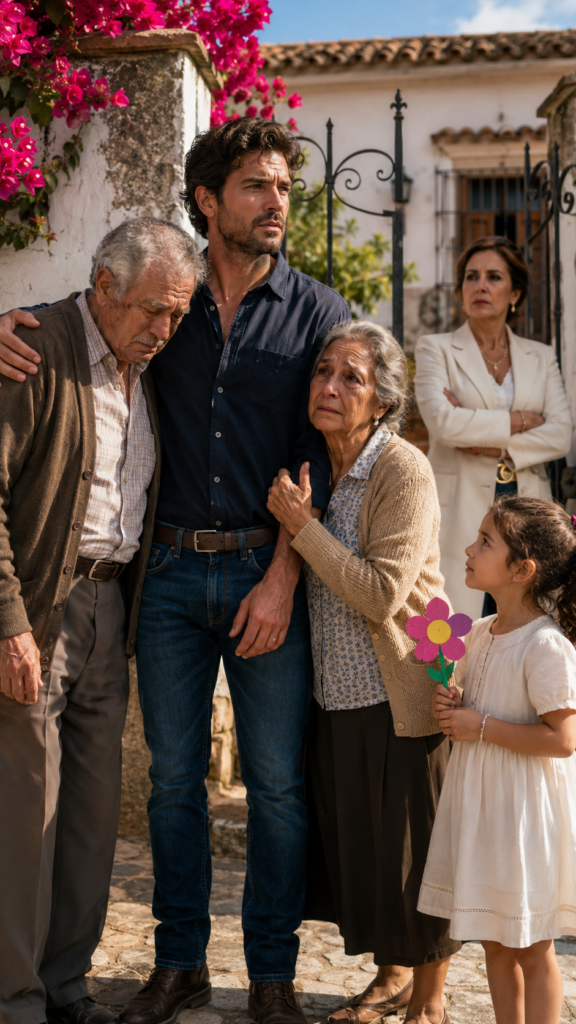
Saúl, ashamed, planned to leave town. However, one afternoon the girl appeared at the gate with a paper flower in her hands.
—Can’t I call Don Tomás grandpa anymore?
The old man stood frozen.
Emiliano knelt in front of her.
—The adults invented the lie, Marisol. You didn’t do anything wrong.
—But I’m not of your blood.
Doña Clara opened her arms.
—Blood doesn’t give permission to love someone.
Marisol ran toward them. Don Tomás hugged her so tightly that they all ended up crying.
Emiliano decided to pay for the girl’s schooling but set a condition: Saúl had to work, attend family therapy, and stop hiding behind his problems.
—Helping doesn’t mean erasing what you did —he warned—. It means preventing your daughter from paying for your mistakes.
Saúl agreed.
Months later, a judge temporarily annulled the most important deeds and recognized clear signs of fraud.
Rebeca faced criminal charges and lost control of the shops.
The day the keys were returned, Doña Clara didn’t enter immediately. She gazed at the black gate, the cameras, and the absurd fountain.
—I lived here for 43 years —she whispered—. And for months I felt I had no right even to touch the door.
Emiliano ripped the sign of “Zamora del Valle Residence” off and left it on the ground.
Julián helped remove the fountain. Marisol planted a new orange tree in place of the cut one.
Rebeca wanted to keep the walls, the last names, and the deeds.
She ended up losing her son, the town's respect, and the trust of the entire family.
Emiliano understood that 31 million could pay for lawyers, medicines, and new roofs, but they couldn’t bring back the years when his parents were silent out of fear of bothering him.
One afternoon, while they drank coffee in the recovered patio, Don Tomás asked for forgiveness again.
—We should have talked to you.
Emiliano shook his head.
—and I should have been closer. Sending money doesn’t always mean being present.
Doña Clara looked at Marisol playing under the bougainvillea and smiled.
The girl had come as part of a cruel lie, but she stayed because two elderly people decided that love didn’t have to obey the frauds of adults.
Emiliano’s fortune saved the house.
But it was the truth that returned to his parents something much harder to recover: their dignity.
And from that day forward, whenever someone in town said that family should forgive everything, Don Tomás would calmly respond:
—Family forgives when it repents. When it uses your love to rob you, first set a limit, and then let justice do its job.





