PART 1
Everything changed in the Arriaga household with a simple question.
—Where did you spend the night, Leonardo?
That was all Mariana Salcedo said.
She didn’t shout. She didn’t demand. She didn’t even raise her voice.
Leonardo Arriaga answered her with the back of his hand.
The blow split her lip against her teeth. For a few seconds, the kitchen was silent, save for the rain pounding against the windows and the low hum of the refrigerator.
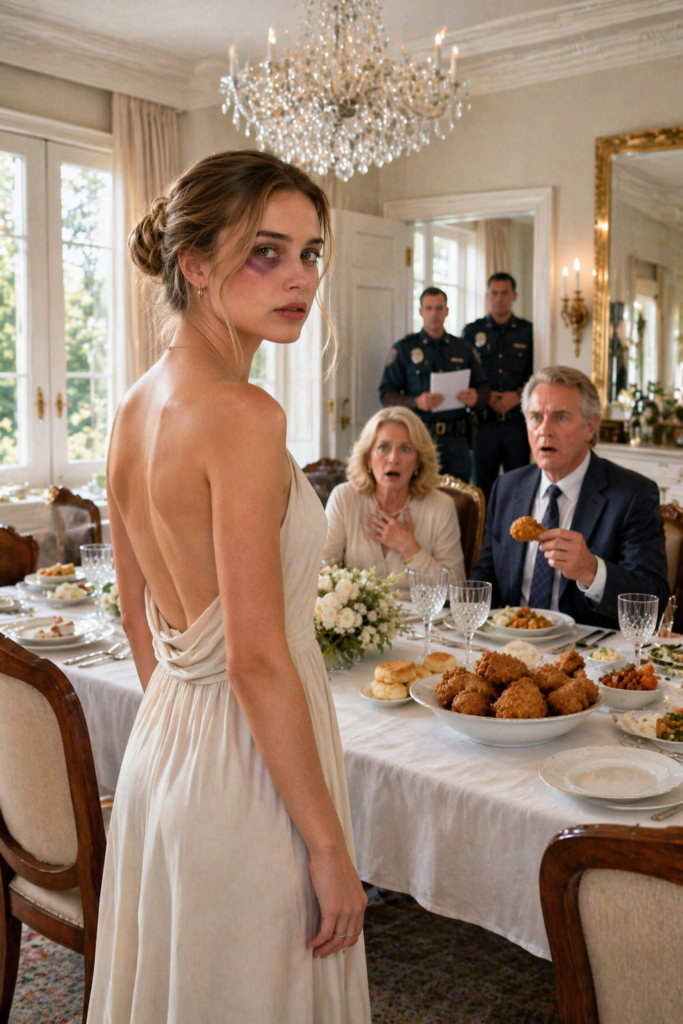
Mariana stood by the marble counter, one hand pressed against her mouth.
She tasted the metallic tang of blood.
Leonardo looked at her as if he had just reprimanded a spoiled child.
He wore a crisp white shirt, a gold watch gleaming on his wrist, and his wedding ring perfectly in place.
—In my house, there’s no questioning me —he said, cold—. Know your place.
Mariana lowered her gaze.
And Leonardo smiled.
That was the part he savored most: seeing her silent.
He mistook her silence for fear.
For obedience.
For weakness.
To Leonardo, Mariana was just the refined, educated wife from a well-known family, the one who organized dinners, smiled at church, and never caused a scene.
What he had forgotten was that Mariana had grown up in the house of a retired federal judge.
What he never valued was that she had worked for seven years as a forensic accountant, reviewing financial fraud before she got married.
And what he didn’t know was that, for six months, Mariana had been keeping copies of every odd transfer, every false invoice, every suspicious call, and every lie Leonardo told when he said he had a “meeting.”
Everything was backed up.
Encrypted.
Protected.
Leonardo adjusted the cuffs of his shirt as if nothing had happened.
—My mom is coming early —he said—. Make breakfast. And please, don’t make me look bad with that face.
Mariana pressed a napkin against her lip.
—Of course.
He loved that.
He thought he had won.
The next morning, the house smelled of green chilaquiles, refried beans, huevos rancheros, cochinita, freshly warmed sweet bread, and pot coffee.
Mariana set the Talavera dishware.
She polished the silverware.
She placed fresh bougainvilleas in the center of the table.
Everything looked perfect.
Exactly as Leonardo demanded.
Doña Amalia Arriaga arrived at 9:10.
Pearls around her neck.
A designer handbag.
Strong perfume.
A gaze that always seemed to pass judgment.
When she saw Mariana’s swollen lip, she didn’t ask if it hurt.
She just smiled slightly.
—A smart wife knows when to keep her mouth shut.
Leonardo laughed heartily.
Mariana served coffee without responding.
Minutes later, mother and son were seated like kings. They admired the food, the order, the house, and the supposed submission of the woman they believed they had broken.
—Now you look like a decent wife —Leonardo said, raising his cup—. A woman as God intended.
Mariana placed the last covered dish in front of him.
Then took three steps back.
At that very moment, the kitchen door swung open.
Leonardo turned with annoyance.
But when he saw who was entering, color drained from his face.
The cup trembled in his hand.
And for the first time in a long time, Mariana saw him truly scared.
PART 2
The man who entered was no guest.
He wasn’t a neighbor either.
It was Don Ernesto Salcedo, Mariana’s father.
The same retired federal judge Leonardo always called “that old nuisance” when he thought no one was listening.
He came in a dark suit, cane in hand, and a calmness that chilled more than any shout.
Behind him entered two district attorneys, a family court clerk, and a woman in a gray suit holding a folder labeled as an asset investigation.
Doña Amalia shot to her feet.
—What does this disrespect mean? —she demanded.
Don Ernesto didn’t even look at her.
His eyes were fixed on his daughter’s broken lip.
—It means you arrived late for breakfast —Mariana said calmly—. But just in time to hear the truth.
Leonardo tried to get up.
One of the agents stepped forward.
—Mr. Arriaga, please remain seated.
The voice was dry.
Without negotiation.
Leonardo blinked several times, as if he still didn’t understand how his perfect dining room had turned into a scene he couldn’t control.
—Mariana, what did you do? —he murmured.
She didn’t answer immediately.
She approached the covered dish she had just placed in front of him.
She uncovered it.
There was no food.
There was a cellphone, three USB drives, a yellow envelope, and several printed photographs.
In the first photo, Leonardo could be seen leaving a hotel in Polanco at 3:42 AM with a woman in a red dress.
In the second, he was entering an office in Santa Fe with a black briefcase.
In the third, he was signing documents next to a man Mariana knew very well: Rogelio Mancera, a businessman under investigation for money laundering and phony public contracts.
Leonardo went pale.
Doña Amalia slammed her hand on the table.
—This is garbage! Just lies from a scorned woman!
Mariana looked at her directly for the first time.
—No, ma’am. The lie was telling me for two years that the family investment account was secure. The lie was using my digital signature while I slept. The lie was putting my inheritance money into shell companies in your nephews’ names.
Doña Amalia opened her mouth, but no sound came out.
Leonardo turned to his mother with fury.
—What did you tell her?
In that moment, Mariana understood something that confirmed the rotten core of it all: Leonardo didn’t know that his own mother had also left a trail.
Amalia had been too arrogant.
She had sent audio messages.
She had given instructions.
She had boasted that Mariana was “so foolish” that she would never check the account statements.
Mariana took the cellphone from the dish and pressed play.
Doña Amalia’s voice filled the kitchen.
—Pass it through your cousin’s construction company. Tell Mariana it’s a banking commission. That girl signs whatever you put in front of her if you talk sweetly.
Leonardo closed his eyes.
Doña Amalia clutched her chest.
—That was taken out of context.
Then another audio played.
Leonardo’s voice emerged, clearer, crueler.
—If Mariana asks again, I’ll put her in her place. After all, who will believe her? Everyone thinks we’re the perfect couple.
The silence that followed was heavy.
Even the agents stood still.
Don Ernesto gripped his cane so tightly that his knuckles turned white.
But he didn’t explode.
That had always been his power: he didn’t need to shout to impose fear.
—Mariana —he said slowly—, continue.
She took a deep breath.
Her lip was still swollen, but her voice didn’t tremble.
She explained that six months earlier, she had noticed a strange withdrawal of 280,000 pesos from an account she used solely for personal expenses.
Leonardo said it was a bank error.
Then another transfer appeared.
Then another.
Then invoices for “logistical consulting” that didn’t correspond to any real service.
Mariana reviewed the RFCs.
The addresses.
The contracts.
And found that four companies were connected to Leonardo’s relatives.
One was co-owned by a cousin of Doña Amalia.
Another was registered in an abandoned warehouse in Naucalpan.
The third had received payments from Leonardo’s office right after he won a municipal bid.
The fourth was the most serious.
It was in Mariana’s name.
With her forged signature.
Leonardo slammed the table.
—That doesn’t prove anything!
The clerk opened her folder.
—It’s enough proof for precautionary measures, Mr. Arriaga.
Leonardo glared at Mariana with hatred.
That hatred was no longer elegant.
No longer disguised as husbandly authority.
It was pure fear, sweating beneath an expensive shirt.
—Are you destroying me over a slap? —he spat.
Mariana took two seconds to respond.
—No. I’m destroying you because you thought a slap was your right.
Doña Amalia lunged at her.
—Ungrateful! My son gave you a name, a house, a position!
Don Ernesto finally turned to the woman.
—My daughter already had a name before she met yours.
The phrase fell like a stone.
Doña Amalia froze.
Leonardo tried to regain control.
—This is a marital issue. No one needs to interfere.
Mariana let out a brief laugh.
Sad.
Almost tired.
—You said the same thing when you paid my gynecologist to let you know if I was pregnant.
The room froze.
Leonardo stopped breathing for a second.
Doña Amalia looked down.
There was the twist Mariana had kept for the end.
For months, Leonardo had pretended he wanted to start a family.
He talked about children at dinner.
He kissed Mariana’s forehead in front of others.
He said he dreamed of a baby Arriaga running through the house.
But secretly, he had been monitoring her medical appointments.
Not out of love.
Not out of hope.
For money.
If Mariana became pregnant, her maternal grandfather’s trust would activate and release a multimillion-dollar share of land in Querétaro.
Land Leonardo had already promised as collateral in a dirty deal.
Doña Amalia began to cry, but not like a remorseful woman.
She cried like someone watching a plan collapse.
—We just wanted to secure the family’s future —she said.
Mariana looked at her with a calmness that hurt more than any insult.
—No. You wanted to use a child that didn’t even exist to pay your debts.
Leonardo shot to his feet.
—Shut up!
This time he raised his hand.
But he didn’t get to touch her.
The agent grabbed him by the arm and slammed him against the table with precision.
Coffee spilled onto the embroidered tablecloth.
Doña Amalia screamed.
Mariana didn’t move.
For the first time, Leonardo was immobilized in the same kitchen where he believed he was the absolute owner just the night before.
—Leonardo Arriaga —the agent said—, you are under arrest for domestic violence, forgery, fraudulent administration, and whatever else results.
—This isn’t going to end like this! —he roared.
Mariana stepped close enough for only him to hear her clearly.
—No, Leonardo. It’s not going to end like this. It’s just beginning.
The woman in the gray suit placed another folder on the table.
She explained that the main accounts had already been frozen.
The movements in the joint account had been reported.
The notary who supposedly validated Mariana’s signature had already declared that he had never seen her in his office.
And the family driver, whom Leonardo had fired three weeks earlier for being a “gossip,” had submitted videos of the night meetings at the hotel.
Leonardo turned to his mother.
—You said you had it under control.
Doña Amalia looked at him in horror.
They were no longer a mother and son united against Mariana.
They were two accomplices looking for whom to sink first.
—I didn’t sign anything —Amalia said immediately—. Leonardo did all of it.
He let out a bitter laugh.
—Now it’s me, huh? Now you don’t know anything?
Mariana watched that scene without satisfaction.
For years, she believed that love could save a home.
That patience could educate a cruel man.
That silence could prevent problems.
But that morning, she understood something many women learn too late: silence doesn’t always protect; sometimes it just gives the abuser more time.
Don Ernesto approached her.
He didn’t hug her immediately because he knew his daughter needed to remain strong until the last second.
He simply said:
—You’re not alone anymore.
Mariana swallowed hard.
There, in front of the coffee-stained tablecloth, the untouched dishware, and the breakfast no one would eat, her eyes filled with tears.
Not for Leonardo.
Not for the lost marriage.
But for the version of herself that had endured humiliation, thinking it was maturity.
The clerk handed Leonardo the notification for protective measures.
He had to leave the house.
He couldn’t approach Mariana.
He couldn’t communicate with her.
He couldn’t dispose of shared assets.
Doña Amalia began to plead.
—Marianita, think about it. This will stain everyone. People talk. What will they say at church? What will your friends say?
Mariana carefully wiped away a tear to avoid touching her lip.
—They will say the truth.
That phrase broke Doña Amalia completely.
Leonardo was taken out through the back door, handcuffed, without a watch, and without that arrogant smile he had lived with for so many years.
The neighbors caught sight of the patrols.
Some filmed from the sidewalk.
In less than an hour, the neighborhood chat was ablaze.
Some said Mariana had exaggerated.
Others said finally, someone from a “good family” was paying for what so often was hidden behind expensive gates.
Mariana didn’t care anymore.
That afternoon, when the house fell silent, she entered the kitchen again.
The breakfast remained on the table.
Cold.
Perfect.
Useless.
She took Leonardo’s cup, still marked with dried coffee, and threw it in the trash.
Then she opened the windows to let out the smell of grease, expensive perfume, and old fear.
Don Ernesto remained in the living room, giving space.
He knew his daughter didn’t need to be rescued like a child.
She needed her identity as the woman who had decided to save herself alone to be respected.
Three weeks later, Leonardo tried to claim that Mariana had provoked him.
But the audios, the videos, the forged documents, and the medical report from the hit told another story.
Doña Amalia also fell.
Not in handcuffs before the cameras, like her son, but with something that hurt her more: social rejection.
She was removed from the charity committee.
Doors were closed to her at dinners.
Her friends stopped answering her.
The same people who once admired her pearls began to murmur that beneath all that luxury, there was only grime.
Mariana didn’t celebrate.
She didn’t post indirect messages.
She didn’t give interviews.
She simply signed the divorce, recovered her accounts, and opened a small financial analysis office for women who suspected their partners were robbing them.
At the entrance, she placed a simple phrase:
“No home is honorable if built on fear.”
Months later, a young woman arrived wearing dark glasses and holding a folder tightly against her chest.
She had the same silence that Mariana had that night.
The silence many confuse with surrender.
Mariana welcomed her with coffee.
But this time, it wasn’t coffee served to placate a violent man.
It was coffee to start a truth.
And as she closed the door to her office, Mariana understood that justice doesn’t always come in shouting.
Sometimes it arrives in silence.
With evidence.
With a calm smile.
And with the kitchen door opening just when the abuser thinks he has won.





