PART 1
—A tired wife stops being a woman. You deserve someone who still knows how to have fun.
Renata Cárdenas said that while trying on diamond earrings at a jewelry store in Masaryk. Julián Alcázar, owner of several auto parts stores in the State of Mexico, let out a laugh and asked them to wrap them up.
He was 39, had a huge house in Ciudad Satélite, and possessed the absurd certainty that he could lie without consequences.
At home, Laura, his wife of 8 years, and Emilia, their 4-month-old baby, awaited him.
That morning, Laura had asked him to stay. Emilia had been running a fever since dawn and she hadn’t slept for more than 2 hours.
—I have a meeting in Puebla —Julián replied—. I can’t cancel everything every time the baby sneezes.
Laura didn’t argue. She hugged the baby and looked at him with such exhausted eyes that he preferred to turn away.
But Julián never went to Puebla.
He picked up Renata and spent the day buying her a handbag, a cellphone, perfume, and a watch that cost more than 6 months of diapers.
In a restaurant in Polanco, Renata raised her glass.
—To the man who will stop living as an employee of his own family.
Julián toasted with her.
By 10 o’clock that night, he returned home smelling of another woman’s perfume. He stashed the bags in the trunk and entered, preparing an excuse.
The house was completely silent.
—Laura?
There was no answer.
The living room was empty. The sofa, the table, the photographs, and even the blanket where Emilia used to spend her afternoons were all gone.
He ran upstairs.
The crib was gone.
So was the baby’s clothing, the stroller, and the monitor Laura checked every 5 minutes.
In the bedroom, he found the closet empty. Laura had taken everything, even the old clay mug she had used since college.
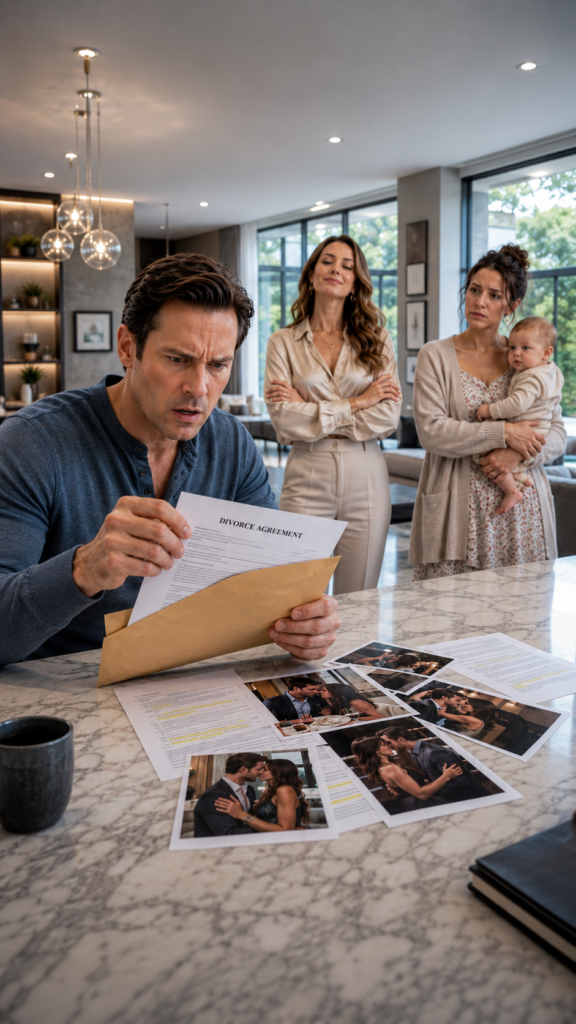
On the kitchen counter was a yellow envelope with his name.
Inside, he found the divorce papers, bank statements, hotel bills, photographs with Renata, and screenshots of deleted conversations.
Each lie was marked in red ink.
On top was a note:
“You chose a life without us. Now you will live it. Don’t try to find Emilia. My lawyer will be in touch.”
Julián felt the air leave his lungs.
At the bottom was a different sheet: the visitor log from the hospital where Emilia was born.
His name appeared at 6:48 PM.
Renata’s at 9:31 PM.
There was also a security image. Renata was kissing him in the maternity hallway while Laura was recovering from the cesarean just a few feet away.
Below, a screenshot of his message:
“Laura is asleep. The baby too. I wish it were you in that bed.”
Julián had to lean against the counter.
Then the door opened.
Mauro, his younger brother, entered with a toolbox.
—Where are they? You know something.
Mauro glanced at the envelope.
—I arranged the move and took Laura where you can’t find her.
—She’s my wife, and Emilia is my daughter!
—That’s why I came —said Mauro, leaving a USB drive—. Laura wanted you to see this before a judge does.
Julián connected the USB.
On the screen, Renata appeared entering Emilia’s room alone 3 nights before, leaning over the crib and pulling something from her purse.
PART 2
Julián stumbled back until he collided with a chair.
The video lasted 42 seconds. Renata looked toward the hallway, approached Emilia, and left an object beneath the mattress. Then she photographed the sleeping baby and left as if nothing happened.
—What did she put there?
—A tracker —Mauro replied—. Laura found it due to interference on the monitor. Renata entered with the spare keys you gave her.
Julián remembered the afternoon he handed them over. Renata had said she wanted to “feel part of his real life.” He accepted, convinced it was a testament of love.
—I didn’t know she would do that.
—Not knowing doesn’t make you innocent, dude. You opened the door.
Mauro pulled out a letter.
Laura explained that the separation didn’t start that night but when Julián stopped accompanying her to appointments, hid money, and called her dramatic for crying from exhaustion.
After the cesarean, Laura woke up alone. As she walked down the hallway, she saw him kissing Renata. She didn’t scream because Emilia began to cry, and she understood she would have to protect her even from her father’s decisions.
“I didn’t leave to punish you,” the letter said. “I left because a woman who sneaks into a baby’s room isn’t just a mistress. She’s a danger. And you were too busy lying to see it.”
Julián read those lines four times.
—Is Laura okay?
—She’s tired, scared, and furious. But she’s safe.
—I need to explain to her.
—Explain what? That you spent Emilia’s money on gifts? That you kissed another woman while Laura could barely walk?
Julián hung his head.
That dawn, he swore he would hear Emilia’s cries. He ran to the empty room and found only the mark of the crib on the floor.
At 9 AM, a lawyer called.
Laura was requesting full provisional custody, an order to conceal her address, and an audit of the marital accounts.
—She doesn’t intend to prevent you from being a father —she clarified—. She intends to prove that you can be one without putting them at risk.
At noon, Renata arrived carrying the handbag he had bought.
She looked at the empty house and smiled.
—Wow, the saint actually had character.
—Did you enter Emilia’s room?
Her smile vanished.
—Who told you?
—There’s a video.
Renata dropped the bag on the counter.
—I just wanted to know where Laura would go when she left you.
—You put a tracker under the mattress.
—It was precaution. Besides, you gave me the keys and said this house would be mine.
—Get out. It’s over.
Renata let out a dry laugh.
—You can’t use me to feel alive and then throw me in the trash.
—I was never going to leave Laura for you.
Renata's face hardened.
—Then you’re going to lose both of them.
That afternoon, Julián received a video recorded in a hotel. He appeared drunk, saying that Laura would “put up with anything” because she had no income of her own. When Renata asked about Emilia, he replied:
—Babies don’t even remember who carries them.
Then came a photograph taken that morning. Laura was leaving a pediatric clinic with Emilia clinging to her chest.
Renata had found the new address.
Julián called Mauro and the police. While he explained everything, an unknown call came in.
It was Laura.
—Don’t speak loudly —she whispered—. Renata is outside.
He heard banging in the background.
—Get into the bathroom with Emilia and lock the door. I’ve already called the police.
—Don’t come. If she sees you, she’ll think I summoned you.
A female voice pierced through the door:
—Open up, Laura. I just want to get back what you stole from me.
Julián closed his eyes. He had allowed Renata to believe that his wife and daughter were possessions that could be contested.
The police arrived in 11 minutes.
During that time, he heard Emilia cry, Laura's held breath, and Renata pounding on the door with something metallic.
The officers found Renata with a duplicate key, pepper spray, photographs of Laura, and a notebook with schedules, license plates, and addresses.
Laura didn’t cry.
She simply said:
—Emilia is fine.
Then she hung up.
Julián declared the relationship, the keys, the hidden money, the hotels, and the messages. Not to seem honorable, but because he understood that every lie of his could become a weapon against them.
In family court, Laura appeared in a blue dress and a pale face.
In front of the judge, she explained that for 4 months, she felt like a single mother within her marriage. She talked about sleepless nights, appointments Julián never attended, and unpaid bills while he bought jewelry.
—I don’t want to erase her father —she said—. I want my daughter to learn that love doesn’t force a woman to endure humiliation or danger.
When it was Julián’s turn, he didn’t seek excuses.
—Laura tells the truth. I betrayed her and stopped seeing my daughter even while living under the same roof. I put Renata close to them. I’m not asking for forgiveness. I’m asking for strict conditions to learn to be a safe father.
The judge granted provisional custody to Laura. Julián received supervised visits, mandatory therapy, a parenting course, and was prohibited from approaching his ex-wife’s home.
He would have called that humiliation.
That day he understood it as mercy.
On his first visit, a social worker placed Emilia in his arms. The little girl looked at him without recognizing him.
That hurt him more than any sentence.
For 1 hour, he learned to prepare a bottle, change a diaper, and hold her when she cried. When it ended, Laura appeared, took Emilia, and left.
—Thanks for bringing her —he managed to say.
Laura didn’t respond.
For months, his life became one of consequences.
He sold the truck he used to pick up Renata and deposited the money into an account for Emilia. He settled hidden expenses, attended therapy, and stopped saying he was “helping” with his daughter. Caring for her wasn’t a favor.
Renata was charged with harassment, breaking and entering, and threats. She received supervised release, psychological treatment, and a restraining order.
Still, Laura kept changing routes, checking locks, and looking behind her when entering a clinic.
Then Julián understood something brutal: infidelity doesn’t end when the guilty party confesses. Sometimes it continues to live in the fear of the betrayed person.
After 6 months, his visits increased.
He carried a notebook where he noted everything about Emilia: she hated cold wipes, laughed when someone sneezed, and calmed down with Cri-Cri songs.
One Saturday, Emilia heard Julián's voice, turned her head, and smiled.
—She recognizes you —Laura said.
He felt his throat close.
—I’m going to keep coming.
Laura looked at him firmly.
—Don’t promise that. Let the calendar speak.
And the calendar spoke.
It spoke with punctual visits, full deposits, respectful messages, medicine bought without boasting, and birthdays where Julián didn’t demand the spotlight.
Laura began sending him photos.
“Emilia hates avocado.”
“Emilia said ‘water.’”
“Emilia took 4 steps.”
Julián cried upon seeing that last video outside a pharmacy. He had missed the moment, but Laura chose to share it.
It wasn't reconciliation.
It was generosity with boundaries.
The divorce was finalized 15 months after the night of the yellow envelope.
As he left the courthouse, Laura stopped on the sidewalk.
—I don’t hate you, Julián.
—You would have every right to.
—Yes. But I don’t want to raise Emilia in a house where hatred has its own bedroom.
He nodded.
—Thank you for not complicating the divorce further.
—My life began to clear up when I left —Laura replied.
The phrase hurt him, but it was fair.
She offered him her hand.
It wasn’t love or a return. It was a clean goodbye.
Julián returned to the empty house and turned the old bedroom into a room for Emilia. He painted one wall yellow, bought storybooks, and assembled a small bed.
Not to pretend they were still a family.
But to show he could be present without possessing anyone.
At 3 years old, Emilia began spending some weekends with him. At 4, Laura and Julián could sit together at kindergarten festivals. At 5, they celebrated her birthday in Laura's yard, with dinosaur cake and Mauro grilling meat on the barbecue.
Emilia ran toward them.
—All the important people came!
Laura and Julián exchanged glances.
They hadn’t forgotten anything. Trust doesn’t return in a rush. It comes back, when it comes back, drop by drop.
After the cake, Laura was left alone with Julián in the kitchen. She had frosting on her cheek.
He pointed to his own face.
—you have something there.
Laura wiped the wrong side and laughed.
Emilia came running in, hugged both of their legs, and showed a drawing with 3 houses connected by a yellow road.
—This is mom’s house, this one’s dad’s, and this one’s mine when I grow up.
Julián understood that he never recovered the family he had destroyed.
They had built another one.
One where Laura no longer needed him to survive, Emilia didn’t have to choose between her parents, and he learned that loving wasn’t about coming in whenever he wanted, but deserving to have the door opened for him.
Laura brushed his hand for a moment.
It wasn’t obligation, fear, or habit.
It was a small, free choice.
And for a man who once believed he could buy everything, discovering that trust had no price was the most painful consequence… and also the only true opportunity for change.





