PART 1
—If you don’t sign right now, stop playing the martyr and accept that you no longer have a say in this family.
That was the phrase that Ricardo Salgado heard as he pushed open the door to his home in Del Valle, CDMX, three days earlier than planned.
He had come from Guadalajara, his shirt wrinkled from the flight, a bag of sweet bread from a bakery that his wife, Laura, adored, and a bouquet of white calla lilies because they were celebrating 31 years of marriage that day.
Ricardo hadn’t warned her he was coming back.
He wanted to surprise her.
But the surprise froze in his throat.
Outside was his son Adrián's black SUV parked across the entrance as though the house was already his. There was also his daughter-in-law Fernanda’s red car, and a gray sedan that Ricardo recognized immediately: Bruno’s, Adrián’s partner in a restaurant in Roma Norte.
The front door was ajar.
A smell of bleach wafted out.
And beneath that scent, there was another.
Blood.
Ricardo dropped the bag of bread in the foyer and walked toward the living room.
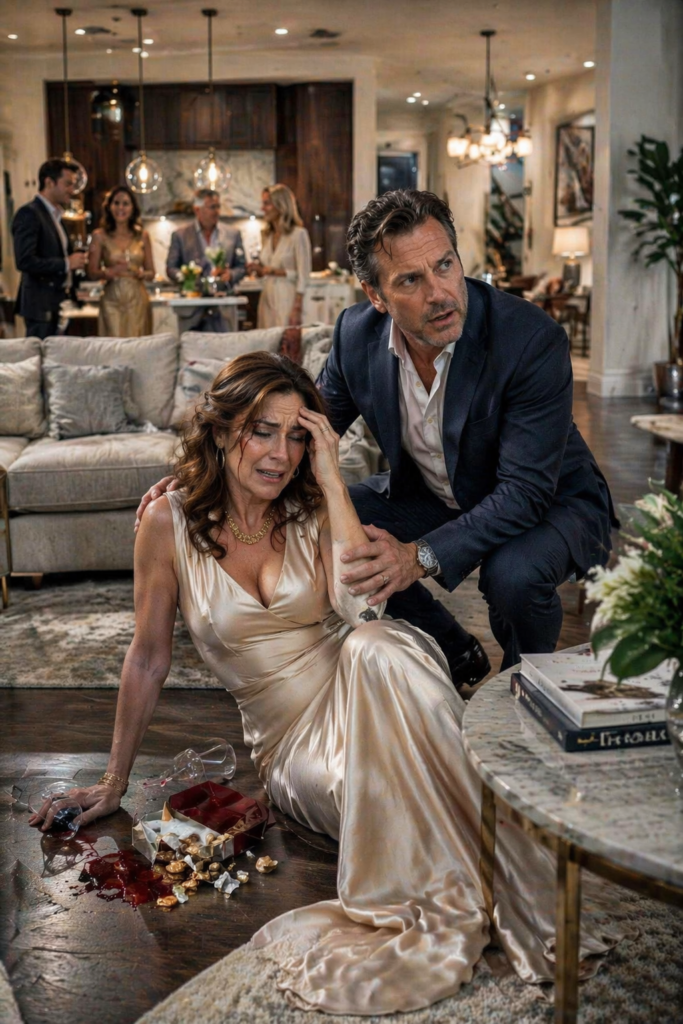
Then he saw Laura.
She was on the floor, leaning against the couch, one hand pressed to her forehead. Blood trickled down her eyebrow, ran down her cheek, and stained the collar of her blue blouse. Her lips were dry, her eyes glassy, and the expression on her face was one that Ricardo had never seen before.
It wasn’t just pain.
It was shame.
It was betrayal.
—Lau…
Ricardo knelt beside her.
—Who did this to you?
Laura tried to speak, but a burst of laughter rang out from the kitchen.
It was Adrián.
Then Bruno’s voice followed:
—Come on, dude, your mom put on quite a show.
Fernanda let out a nervous laugh, as if she wanted to disappear but didn’t have the courage to get up.
Ricardo felt his chest shatter.
His wife was bleeding less than five feet away.
And his own son was sitting in the kitchen, laughing.
Laura gripped Ricardo’s sleeve.
—I didn’t sign —she whispered—. They tried to force me… but I didn’t sign.
Ricardo turned his head.
On the coffee table lay an open green folder. Inside, he saw copies of deeds, papers stamped from a notary in Coyoacán, and a sales contract ready to be signed.
The house in Boca del Río.
The house that Laura's mother had left her when she died.
The house where Laura had learned to walk, where she still kept her mother's clay pots, an old hammock in the yard, and a china set that no one could touch because “it belonged to Grandma.”
Ricardo picked up a sheet.
It wasn’t a proposal.
It was a complete sale.
And the money wasn’t going into Laura’s account.
It went straight to a business account for Adrián and Bruno’s restaurant.
From the kitchen, Adrián said:
—Mom always exaggerates. She’ll say we beat her up.
Laura closed her eyes.
—He pulled me by the arm. I tried to let go. I hit the corner of the table.
Ricardo looked at the blood on the carpet, the folder, the cups laid out, the plates of cookies as if it had all been a normal family gathering.
He wanted to storm into the kitchen and smash his son’s face.
But he didn’t.
He pulled out his cellphone.
He photographed Laura’s injury.
He photographed the blood.
He photographed the documents.
Then he called 911.
Laura looked at him in fear.
Ricardo thought she would ask him to hang up.
But she simply said:
—Don’t let them take my mother’s house.
Ricardo took her hand.
—They won’t touch it.
Then he stood up and walked toward the kitchen.
Adrián held a glass of wine in his hand. Bruno was poring over some papers next to his plate. Fernanda was pale, her fingers trembling around her cellphone.
When Adrián saw his father, he didn’t look toward the living room.
He didn’t ask about his mother.
He just froze because Ricardo had returned early.
Ricardo placed his cellphone on the counter, the call still active.
—Nobody moves.
Adrián gulped.
—Dad, you really don’t get it. This is a family matter.
Ricardo looked at him with a calmness that was terrifying.
—My wife is bleeding on the floor and you’re celebrating. This is no longer family.
From the living room, Laura shouted with a broken voice:
—Check the last page.
Ricardo went back to the folder.
Beneath the contract, he found a power of attorney.
With a forged signature.
And then he understood that they didn’t just want to sell the house.
They wanted to erase her from her own inheritance.
PART 2
Adrián jumped up so fast he knocked over the glass.
The wine spread across the table like another stain of blood.
—That wasn’t for you! —he shouted, trying to snatch the paper from Ricardo.
Ricardo lifted it out of his reach.
—Since when do you forge your mother’s signature?
Adrián opened his mouth, but no words came out.
Bruno intervened with a false smile.
—Mr. Ricardo, calm down. No one forged anything. The lady had already agreed to sell, she just got sentimental at the last minute.
Laura, still from the living room, replied with a strength that surprised them all:
—I never agreed to sell my mother’s house.
Fernanda covered her face with one hand.
Adrián turned to her.
—Don’t say anything.
That tone made Ricardo look at her more closely. Fernanda didn’t seem like a proud accomplice. She looked scared. Her eyes were red, her hands trembling, and there was a purple mark near her wrist, as if someone had held her too tightly.
Sirens sounded in the street minutes later.
When the police entered, Adrián spoke first, quickly, with the confidence of a son used to getting his way with his mother.
—My mom fell. My dad came in upset and is making things up. We came to talk about a sale she had already authorized.
Ricardo displayed his cellphone.
—The call is active. There are photos before anyone touched anything.
A paramedic attended to Laura while an officer separated everyone.
When they sat her on the stretcher, Laura took Ricardo’s hand.
—In my sewing box —she whispered—. There’s a USB drive.
Ricardo went to the living room furniture. Inside a box with threads, buttons, and needles, he found a small black memory stick.
Adrián saw it.
—Dad, give me that. It’s private.
Ricardo looked at him steadily.
—Private was leaving your mother bleeding while you laughed.
In the ER, Laura received six stitches.
The wound wasn’t severe, but her silence was.
Ricardo watched her stare at the ceiling for almost an hour, as if counting all the times she had allowed things “to avoid conflict.”
—He told me that if I didn’t sign, he would bankrupt the restaurant —she said finally—. That a mother doesn’t abandon her son. That I was selfish for clinging to an old house.
Ricardo pressed his lips together.
—It’s not old. It’s yours.
That night, back at home, they connected the USB drive to the computer.
Laura had been recording conversations for weeks.
In the first audio, Adrián said:
—Mom, a property sitting idle is worthless. My restaurant can give us a future.
In another, Bruno said:
—If the lady gets difficult, we sign the simple sheet first and then attach the rest. Big people don’t even check.
Ricardo felt coldness creep down his spine.
But the last audio was worse.
It recorded Adrián talking on the phone.
—My dad will be gone until Friday. If my mom signs tomorrow, we’re set. The restaurant’s account will be the destination and she won’t even notice.
Then Fernanda’s voice came:
—Adrián, that’s fraud. And your mom doesn’t want to sell.
Adrián replied without hesitation:
—Fraud is when my own mother prefers a house full of useless memories over saving me.
Laura closed the laptop.
She didn’t cry right away.
First, she sat still.
As if her body needed permission to break.
Then she bent over the table and released a deep, quiet sob, one of those that seeks no comfort because it is born where no one can enter.
Ricardo held her without saying anything.
The next day, they went to a lawyer recommended by a neighbor, Licenciada Rebeca Sandoval. She reviewed each document patiently and asked for copies of the audios, photos, and messages.
—The house is still yours —she said—. But this is attempted fraud, misuse of notarial documents, and, furthermore, there are injuries.
Laura breathed for the first time.
But Rebeca found something else.
Adrián had already promised the Boca del Río house as collateral to a private lender from Puebla. There was no valid document, but there were messages, deposits, and threats.
If Laura didn’t sign in 48 hours, Adrián would lose the restaurant, the apartment, and possibly more.
Bruno had secured the money.
And now Bruno wasn’t answering.
That very afternoon, Adrián appeared at the house.
He didn’t come alone.
He brought a man in a gray suit, dark glasses, and a calm voice. Too calm.
—Mrs. Laura —the man said—, your son assured us that you were already in agreement.
Ricardo stepped in front of her.
—She’s not signing anything.
Adrián's face was sunken, lacking the swagger of the previous night.
—Mom, please. If you don’t sign, they’re going to take everything from me.
Laura looked at him as if she were seeing a stranger wearing her son’s face.
—And that’s why you were going to take away the only thing my mother left me?
—It was an emergency.
—No —Laura said—. An emergency is asking for help. What you did was a plan.
Adrián lost his patience.
—Seriously, mom! Are you going to destroy your son over an old house?
That shout killed something.
Laura didn’t take the pen.
She took her cellphone and called the lawyer on speaker.
—Licenciada, my son is here with the lender. He wants me to sign again.
Rebeca’s voice sounded firm:
—Do not sign anything. The preventive notice has already been submitted. Any movement regarding that property is halted while the documents are investigated.
The lender turned to Adrián.
—Did you offer me collateral that wasn’t yours?
Adrián lowered his gaze.
The man slowly put away his papers.
—Then the problem is no longer with your mom. It’s with me.
For the first time, Adrián seemed to understand the dimension of what he had done.
Not because he saw Laura’s pain.
But because fear knocked at his door.
Fernanda arrived twenty minutes later. She had a backpack and swollen eyes.
—I’ll testify —she said—. I’m not carrying this anymore.
Adrián tried to stop her.
—Fer, don’t be ridiculous. We’re married.
She looked at him sadly.
—Your mom was also your mom and you left her bleeding.
Fernanda’s statement changed everything.
She told how Adrián had been pressuring Laura for months. That Bruno had obtained fake papers with the notary’s logo. That the restaurant’s account was in debt. That the afternoon of the injury, Adrián had grabbed Laura by the arm to sit her down in front of the documents, and when she broke free, she fell against the table.
—I didn’t push her —Adrián repeated when he was summoned.
Maybe not.
But he had cornered her.
He had humiliated her.
He had left her on the floor.
And he had kept laughing.
The notary denied any transaction. The seal was fake. The business account existed and was in Adrián and Bruno’s name. Bruno tried to disappear, but they located him in Querétaro with part of the money that was still left from the loan.
Over the next few weeks, Adrián called 31 times.
First, he apologized.
Then he cried.
After that, he insulted.
Later he sent audios saying that Laura was cruel, that no mother sends her son to the hole, that everything could be fixed “without involving lawyers.”
Laura listened to each message sitting in the kitchen.
Ricardo wanted to block him.
She shook her head.
—I need to understand if he’s remorseful or if he’s just desperate.
The answer came in a voice message:
—If I lose everything, remember that you could have prevented it.
Laura set the cellphone on the table.
—I understand now.
That day, she didn’t respond.
Nor the next.
She only wrote one phrase when Adrián insisted again:
—I can’t call love a threat just because it comes from my son.
Then she changed the locks.
When Ricardo removed the old key of Adrián from the keychain, Laura broke down.
—Here he learned to walk —she said, looking at the door—. Here I healed his fevers. Here I baked him cakes. Here he promised me that when he grew up, he would take care of me.
Ricardo embraced her.
—He can still be your son without having permission to hurt you.
That phrase lingered in the house.
Like an uncomfortable truth.
Like a bitter medicine.
Months later, the restaurant closed. Bruno was charged for the fake documents. Adrián sold his SUV and Fernanda filed for divorce. The lender recovered part of the money through other means but made it clear that Adrián had lied from the start.
The legal process continued slowly, like almost everything that mixes family, money, and shame.
But Laura no longer walked hunched.
She no longer said “yes” to avoid problems.
She no longer apologized for setting boundaries.
In December, she traveled alone to Boca del Río. Ricardo wanted to accompany her, but she asked to do it her way.
The house was filled with dust. The hammock still hung in the yard. Her mother’s pots were dry. In the kitchen hung a yellow cup with a small crack.
Laura opened the windows.
The salty air rushed in.
She walked through the rooms touching the walls, remembering her mom, the rainy afternoons, the mangos sliced on tin plates, the nights she slept listening to the sea.
For years, she thought that house was an inheritance.
That day she understood it was also a border.
A line that no one had the right to cross.
In March, she returned with Ricardo. They painted the facade, changed the lock, and planted bougainvilleas by the entrance. Laura placed a chair facing the sea and stayed there until dusk.
—Now I really feel it’s mine —she said.
Ricardo smiled.
He didn’t need to respond.
Some time later, Adrián sent a handwritten letter.
He didn’t ask for money.
He didn’t ask for the house.
For the first time, he didn’t blame Bruno, nor the restaurant, nor the crisis.
He wrote that he had confused need with right. That he lost his wife, his business, and his mother’s trust because he thought his problems were worth more than her dignity.
Laura read the letter twice.
Then she tucked it away in a drawer.
She didn’t run out to forgive him.
Nor did she hate him.
She simply decided not to confuse herself again.
Forgiveness, if it ever came, would not be a key.
It would not be a signature.
It would not be an open door to repeat the harm.
One night, back in Del Valle, Laura stepped out onto the porch. The street was quiet. Ricardo was beside her. From the neighboring house came the smell of coffee and toast.
Laura took a deep breath.
—I’m not signing anything I don’t want to sign —she said—. Not out of guilt. Not out of fear. Not for being a mother.
Ricardo took her hand.
She looked at the closed door.
Then at the dark sky.
—Not now. Not ever.
And that was the sound that stayed in Ricardo’s memory.
Not the laughter from the kitchen.
Not the glass shattering.
Not the sirens.
But Laura’s voice.
Clear.
Serene.
Final.
Because sometimes justice doesn’t start in a courtroom.
It begins the day a mother stops asking for permission to protect herself.





