PART 1
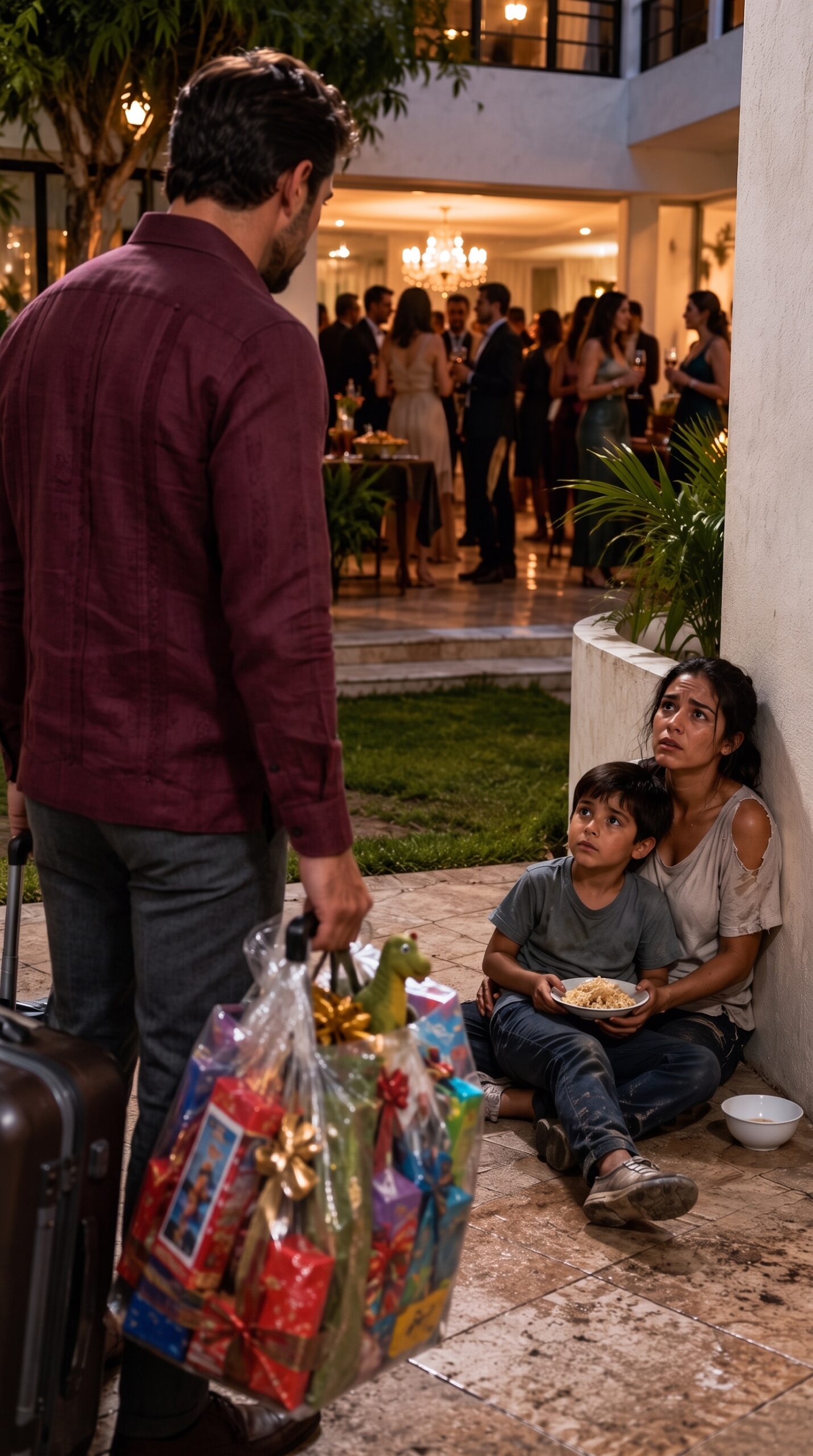
Eduardo Santillán arrived in Guadalajara three weeks earlier than planned, with two suitcases full of gifts and an excitement that barely fit in his chest.
He had spent five years working on oil platforms in Qatar, enduring heat, loneliness, and shifts that seemed never-ending.
Every month, he sent $8,000 back to Mexico.
The money went straight to his mother's account, Doña Mercedes, because she had sworn to take care of his wife Mariana and their son Emiliano, just six years old.
—You just work easy, son —she always told him on the phone—. Mariana and the boy want for nothing. They live better than many.
His sister Lorena repeated the same.
—Really, Ed, stop worrying. Mom treats them like royalty.
Eduardo believed.
Not because he was foolish, but because no one wants to imagine their own mother could lie with such a sweet voice.
With years of sacrifice, Eduardo had bought a house in a private neighborhood in Zapopan. It had a garden, a huge kitchen, a terrace, and a bedroom for his son decorated with dinosaurs.
To him, that house was not luxury.
It was a promise.
That’s why he decided not to announce his return. He wanted to see Mariana’s face. He wanted Emiliano to run into his arms. He wanted to walk in like the men who return home after leaving life behind.
But upon arrival, something clenched in his stomach.
The music was blaring.
There were trucks outside, guests with drinks, tables piled with food, barbecued meat, seafood, cakes, and expensive bottles.
Eduardo frowned.
It wasn’t anyone’s birthday.
It wasn’t Christmas.
It wasn’t any special date.
He entered through the side hallway, suitcases in hand, thinking maybe his mother had organized a surprise welcome.
Then he heard a small voice.
—Mom… can I grab a taco? My stomach hurts.
Eduardo stopped.
It was Emiliano.
Mariana’s voice responded softly, almost fearfully.
—No, my love. If your grandmother sees us, she’ll get mad. Eat this quickly. I took out the bad parts.
Eduardo pushed the patio door open.
And there, his world shattered.
Mariana was sitting on the floor, next to an old bucket, wearing a worn-out shirt and her hair in disarray. In front of her, Emiliano held a plastic plate with cold rice, crushed, mixed with dry pieces of tortilla.
The boy saw his father.
But he didn’t run.
First, he hid the plate behind his back, as if being hungry were a shame.
Eduardo dropped the suitcases.
Inside, Doña Mercedes was toasting in front of her guests.
Outside, his grandson trembled while eating leftovers.
The door slammed against the wall with such force that the music cut off abruptly.
Mariana lifted her face and froze.
—Eduardo? —she whispered, as if she had seen a ghost.
Emiliano let go of the plate.
—Dad?
Then he ran.
Eduardo crouched to hug him, but as he felt him in his arms, he went cold. His son was too thin. Too light. He touched his back and felt the little bones beneath the shirt.
Five years in the desert sun.
Five years sending money.
Five years believing his family was doing well.
And his son seemed to have learned to ask for food in fear.
—What’s going on here? —Eduardo asked, without raising his voice.
Mariana looked down.
She didn’t answer.
She only pressed her lips together, like someone who had already cried too much.
At that moment, Doña Mercedes appeared in the kitchen doorway, a glass in hand and a smile that vanished the moment she saw her son.
—Eduardito! Why didn’t you let us know, son?
She tried to hug him.
He stepped back.
—Don’t touch me.
The silence fell heavy.
The guests began to look at the floor.
Eduardo pointed at the broken plate.
—Explain to me why my son was eating old food in the yard while you all have a feast inside.
Doña Mercedes let out a dry laugh.
—Oh, come on. The boy already had dinner. Mariana always makes dramas.
Emiliano lifted his face.
—I didn’t have dinner, grandma.
Mariana tried to stop him.
—My love, no…
But the boy continued.
—I didn’t have dinner yesterday either. You said the children of the freeloaders don’t eat meat.
A murmur swept across the terrace.
Eduardo looked at his mother.
—Freeloaders?
Doña Mercedes changed her expression.
—That child repeats anything.
Then Mariana trembled.
She pulled out from under her shirt a small notebook, covered in blue plastic.
She held it against her chest as if it were the only thing she had left.
Eduardo looked at it.
—What is that?
Mariana took a moment to answer.
—What I could never tell you.
And when Eduardo opened the first page, he couldn’t believe what he was about to discover.
PART 2
The first page had a date written in small handwriting.
“February 14. $8,000 arrived. Doña Mercedes gave me 400 pesos for food and said it should last the whole week.”
Eduardo felt a blow to the chest.
He turned another page.
“March 3. Emiliano asked for milk. Doña Mercedes said to drink water, that the milk was for her friends’ coffee.”
Another.
“April 19. They sold the gold chain that Eduardo left me. They said it was to pay a debt of Lorena.”
Another.
“May 8. They locked me in the yard during the meeting. Emiliano cried because he smelled the meat.”
The guests stopped murmuring.
Now no one said anything.
Eduardo continued reading.
There were receipts, photos, dates, transfer captures, supermarket tickets, and notes made with painful patience.
Every month showed the same pattern.
Eduardo sent money.
Doña Mercedes withdrew it.
Then she bought jewelry, clothes, trips, renovations, expensive bags, beauty treatments, and even a new truck for Lorena.
Meanwhile, Mariana noted:
“We ate instant soup.”
“Emiliano went to school with broken shoes.”
“She wouldn’t pay for a check-up.”
“She told me that if I spoke up, Eduardo would leave me.”
Eduardo lifted his gaze.
—Why didn’t you tell me?
Mariana let out a broken laugh.
—Because you never answered.
—I wrote to you every week.
—I never received anything.
Eduardo shook his head.
—That can’t be true.
Mariana stood slowly and walked toward a large pot. She reached behind some bags of soil and pulled out a black plastic bag.
Inside were opened envelopes.
Dozens.
More than 50 letters.
Eduardo recognized his handwriting immediately.
Letters where he told Mariana he loved her.
Letters with drawings for Emiliano.
Printed photos.
Promises.
Words that never arrived.
Mariana took one of them.
—Your mom told me you had another woman there. That you only sent money out of obligation. That if I insisted, you would take Emiliano away from me.
Doña Mercedes slammed the table.
—Enough! You’re ungrateful! Everything you have is thanks to me!
Eduardo turned slowly.
—Everything she has, Mom, I earned.
Lorena tried to intervene.
—Ed, calm down, you’re making a scene in front of everyone.
—A scene? —he said—. My son was eating leftovers in my own house.
Mrs. Rebeca, the neighbor from across the street, stepped forward.
—I saw things too.
Doña Mercedes shot her a furious look.
—You stay out of it.
—I’m getting involved because I regret staying quiet.
The woman took a deep breath.
—I saw Mariana asking for credit tortillas at the store. I saw the boy waiting outside while you ate. I saw your mom take bags full of groceries and give Mariana a small bag with old rice and beans.
The gardener spoke up too.
—I was ordered to throw away food before giving it to the lady and the boy.
A cleaning staff member lowered her head.
—Doña Mercedes said Mariana had to learn her place.
Eduardo clenched his fists.
—Her place?
Mariana rolled up her sleeve.
She had old marks on her arm.
Small burns.
Bruises that were already turning yellow.
Eduardo’s face changed.
—Who did that to you?
Mariana couldn’t speak.
Emiliano answered for her.
—My grandma. When mom hid food for me.
One guest took his coat and left without saying goodbye.
Then another.
Then another.
The party began to empty as if everyone wanted to erase their presence from that shame.
But the night had only just begun.
Eduardo’s accountant, Ramiro Salas, arrived at that moment with a folder. Eduardo had scheduled him to review some tax papers the next day, but Ramiro rushed the visit upon seeing lights and movement in the house.
—Engineer —he said with a serious voice—, I think you need to see this today.
He opened the folder on the dining table.
Account statements.
Transfers.
Withdrawals.
Purchases.
Payments in Lorena’s name.
Trips to Cancun, Los Cabos, and New York.
A down payment for an apartment.
Additional cards.
The total amount made Mariana cover her mouth.
During five years, nearly 22 million pesos had disappeared from Eduardo’s remittances.
Lorena began to cry.
—Mom said it was her money.
Eduardo looked at her with a cold sadness.
—And didn’t you ever wonder why my son wore broken shoes?
Lorena didn’t answer.
Doña Mercedes, cornered, dropped the glass.
The glass shattered on the floor.
—I raised you! —she shouted—. You owed me everything! That woman came to take my son from me. I only managed what was the family’s.
—Mariana and Emiliano are my family —Eduardo replied.
—She’s not your kind!
The phrase fell like poison.
Mariana closed her eyes.
There lay the truth.
It wasn’t just money.
It was contempt.
Doña Mercedes never forgave Eduardo for marrying a simple woman, the daughter of a seamstress from Tonalá, without a fancy last name or connections.
That’s why she humiliated her.
That’s why she took the letters away.
That’s why she made her believe she was alone.
But the final blow was yet to come.
Ramiro pulled out another document.
—There’s something else.
Eduardo looked at him.
—What?
—Six months ago, they tried to change the deeds of the house.
Eduardo froze.
Ramiro placed a copy in front of him.
Doña Mercedes and Lorena had taken a notary a supposedly signed power of attorney by Eduardo, authorizing the property to be put in his mother’s name.
The signature was fake.
Mariana paled.
—That’s why they wanted to throw me out.
Ramiro nodded.
—If they managed to register this, they could legally evict her with the child.
Eduardo felt nauseous.
His mother hadn’t just stolen.
She hadn’t just abused.
She had planned to take his house from his wife and leave his son on the street.
Doña Mercedes tried to come closer.
—Son, listen to me...
—No.
Eduardo pulled out his cell phone.
He called the police.
Then he called his lawyer.
And for the first time in five years, Mariana didn’t have to hide.
That night, in front of neighbors, employees, and guests, Eduardo took his wife’s hand and walked in with her through the front door.
Not through the yard.
Not through the kitchen.
Through the front door of the house he had built for her and their son.
Emiliano walked between them, hugging the new dinosaur his dad had brought him.
Doña Mercedes was escorted from the house amidst screams, still claiming everything was unfair.
Lorena remained crying on the sidewalk, calling friends who no longer answered.
In the following weeks, the truth became impossible to hide.
The bank confirmed the withdrawals.
The notary was investigated.
The employee, the gardener, and the neighbor testified.
Mariana handed over the blue notebook, the hidden letters, the photos of the bruises, and messages where Doña Mercedes threatened her.
Eduardo canceled all shared accounts.
He sold Lorena’s truck.
He recovered part of the money.
But there was something that couldn’t be recovered so easily: the years when Mariana slept in fear, the nights when Emiliano quietly asked for food, and the letters that never arrived in time.
A month later, Eduardo organized a small dinner.
Only Mariana, Emiliano, Mrs. Rebeca, the gardener, the cleaning lady, and two friends who had truly shown their hearts were present.
There was no expensive music.
There were no luxury glasses.
There was pozole, fresh water, and a chocolate cake that Emiliano chose.
Before cutting it, the boy asked:
—Dad, can we eat inside now?
Eduardo broke down.
He hugged him tightly.
—Yes, champ. This has always been your home.
Mariana looked at the blue notebook on the table.
For years, she had hidden it out of fear.
Now it was there, open, as proof that the truth takes time, hurts, burns… but when it comes out, no one can ever lock it up again.
And in Guadalajara, many began to ask the same:
Does a mother who destroys her son’s family life for money still deserve to be called mother?





