PART 1
Alonso Cárdenas had spent years being one of those men whom everyone greeted with respect and few dared to look in the eye. In Guadalajara, his name carried weight in warehouses, transportation routes, restaurants, and even in meetings where no one spoke the truth out loud. To many, he was a tough businessman; to others, a dangerous man. To Nico Robles, his trusted driver for twelve years, he was simply "the boss."
On Tuesday morning, Alonso's armored truck lost its brakes on the road to Chapala and crashed into a concrete barrier. Nico died before the ambulance arrived. Alonso was rushed to Santa Regina Hospital with three broken ribs, a shattered leg, and a head injury that led doctors to speak of coma, neurological damage, and an uncertain prognosis.
The news spread quickly. Outside the hospital, there were reporters, partners, curious onlookers, and family members who suddenly remembered they loved him dearly. Camila Luján, his fiancée, cried in front of the cameras wearing dark glasses, white pearls, and a trembling voice. "Alonso is a warrior," she said. "I only ask God to bring him back to me."
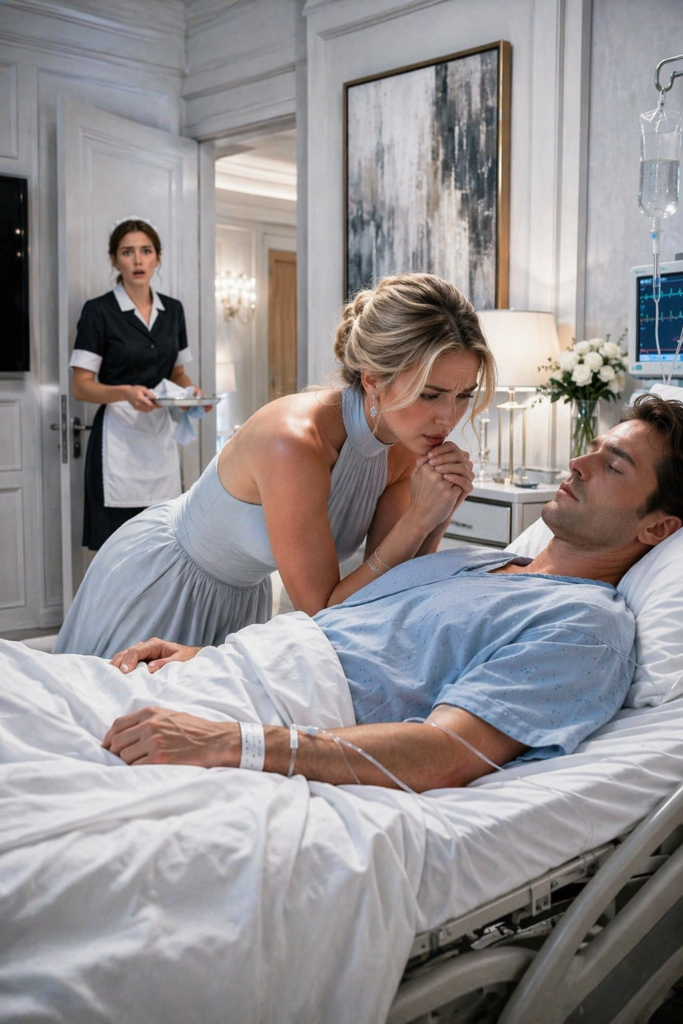
But inside the VIP suite, when the cameras disappeared, Camila stopped crying. She removed her glasses, checked messages on her phone, and spoke with Darío Cárdenas, Alonso's cousin, as if the man connected to the monitors were nothing but an awkward formality.
No one knew that on the third day, Alonso had awakened. He couldn’t speak well, pain burned through his body, and Dr. Salazar had asked him not to move. But Alonso understood something before everyone else: if those around him believed he was still unconscious, they would tell the truth.
And they did.
Maribel Santos, the cleaning lady on the VIP floor, entered that afternoon to change the wilted flowers. She was thirty-four years old, wearing a gray uniform, blue gloves, and that way of walking silently that women learn when no one looks at them. As she arranged the vase, she heard Camila say:
"Let him die before Friday, please. We can’t wait any longer."
Maribel froze.
In the room, Esteban Rivas, a lawyer in an expensive suit with a soft voice, was explaining that the medical power could be activated if the doctor certified prolonged incapacity. Darío asked about the family trust, the routes, the accounts. Camila answered without hesitation that everything had to be signed by Friday.
"Alonso isn’t going to wake up," she said. "And if he does wake up, it’ll be too late."
Maribel lowered her gaze, pretending to clean a table. Then she saw something impossible: under the sheet, Alonso's index finger moved ever so slightly. It wasn’t a spasm. It was a signal.
When Camila and the others left, Maribel carefully closed the door and approached the bed. Her mouth went dry before she asked softly:
"Mr. Cárdenas… can you hear me?"
The finger pressed once against the sheet.
Maribel felt her stomach drop.
"One press is yes. Two presses are no. Are you awake?"
Alonso pressed once more.
She looked toward the door, her heart pounding in her chest. Outside, the nurses walked as if the world continued normally. Inside, the man everyone was mourning in life had just answered.
Maribel swallowed hard.
"Does Camila know?"
One press.
"Does the doctor know?"
One press.
Alonso tried to move his hand again, but pain crossed his face even though he didn’t open his mouth. Maribel understood he wanted to speak, but couldn’t. She left with the vase in her hands and returned twenty minutes later with a folded magazine. Inside, she had hidden a printed letter board from reception.
"Attention, sir," she whispered. "I’ll point to letters. You press when you touch the right one."
It took nearly fifteen minutes to form the first name.
P A U L.
Maribel frowned.
"Paul Mendoza?"
One press.
Paul was Alonso's head of security, a graying mustached man who had aged watching his back. Maribel had seen him several times at the Puerta de Hierro house: serious, distrustful, with a face that didn’t forgive even a single mistake.
"Do you want him to come?"
One press.
"Now?"
One press.
Then Alonso formed another name.
N I C O.
Maribel's throat tightened. Nico was the dead driver. He always greeted everyone, even those whom no one acknowledged. He bought coffee for the nurses and called Maribel "boss" even though she only passed with a mop.
Alonso continued spelling.
N I C O S A B Í A.
Maribel felt cold.
"Did Nico know something?"
One press.
Before leaving, Alonso wrote one last word.
C U I D A D O.
Maribel tucked the napkin where she noted everything into her sleeve. Then she looked at him with a serenity she didn’t know she possessed.
"I’ve spent my whole life being careful, sir. People like them don’t look at women like me. That, no matter how ugly it sounds, helps us right now."
Alonso pressed once.
That night, while Camila smiled in front of reporters and asked for prayers, Maribel went down to the employee parking lot with her cell phone hidden in her pocket. She sent a message from a borrowed number:
"Mr. Paul, Alonso is awake. Camila wants to sign something on Friday. Nico knew. Come by service. Don’t trust anyone."
For six minutes, there was no response.
Then came a single word:
"On my way."
Maribel rode the elevator with a tight throat, unaware that upon arriving at the VIP floor, she would find Camila standing by Alonso's bed, holding his hand with fake tenderness and whispering in his ear:
"If you can hear me, my love, you better stay still… because now I really can’t let you live."
PART 2
Maribel almost dropped the towel tray. She stood at the entrance, head down, pretending she hadn’t heard anything. Camila slowly turned, as if she could smell the fear.
"You again?"
"Sorry, ma’am. I brought clean towels."
"Just leave them and go."
Maribel obeyed. She walked to the bathroom, left the towels, and caught a glimpse of Alonso's closed eyes. He didn’t move. He didn’t breathe differently. He looked dead in life. But Maribel already knew he wasn’t.
At 12:15 a.m., Paul Mendoza entered through the service elevator wearing a maintenance jacket over his suit. Maribel went ahead with a bucket and a mop, as if she were simply accompanying someone to check for a leak. Upon reaching the suite, she closed the door and wedged the cart to buy a few seconds if anyone tried to enter.
Paul approached the bed. When Alonso pressed once with his finger, the chief of security's face broke.
"Boss," he murmured.
There were no hugs or speeches. Alonso didn’t have the strength for that, and Paul wasn’t a man to cry where others could see him. Maribel placed the letter board in front of Alonso’s hand and began the message.
C A M I L A. D A R Í O. V I E R N E S.
Paul gritted his teeth.
"I know. They called a trust meeting. They say you authorized a transition if you became incapacitated."
Alonso continued.
F R E N O S. N O F U E P R I M E R A V E Z.
Paul stood still.
"Three weeks ago, the Tlaquepaque warehouse," he said almost inaudibly. "The fire wasn’t an accident."
Alonso pressed once.
Maribel felt the story grow larger than an accident. Nico hadn’t just died driving. Nico had died because he knew too much.
Alonso spelled:
C A R P E T A R O J A. R E S P A L D O C E L U L A R.
Paul understood immediately. Camila had taken the adjoining family room as her private office. There she kept mourning dresses, expensive bags, contracts, false signatures of Alonso, and a laptop that was never turned off.
"I’m going in," Paul said.
Alonso pressed twice.
Then he wrote:
M A R I B E L.
Paul turned to her.
"No. Not a chance."
Maribel raised her chin.
"I’m here."
"Precisely because of that. You don’t belong in this world."
Alonso pressed once hard. Paul understood the message, even though it bothered him. If they caught him checking things of Camila, a war would start. If they found Maribel in that room, she would only be an employee making a mistake.
At 1:10 a.m., Maribel entered Camila's room with clean towels and a garbage bag. The place smelled of expensive perfume, white wine, and dead flowers. There was a black dress on the couch, a white jacket hanging on the door, and a glass marked with lipstick next to the computer.
Maribel cleaned as always: trash first, table next, bathroom last. No one suspects a woman who cleans. No one thinks that a woman in gloves can read, understand, and keep evidence.
She found the red folder under a cream coat. Inside were medical powers, authorizations for corporate control, sheets with Alonso's forged signatures, and a prepared statement:
"With deep sorrow, Camila Luján will temporarily assume the presidency of the Cárdenas Foundation while Darío Cárdenas ensures family continuity."
On the back of the folder was a black memory stick taped down. Maribel ripped it off and slipped it into her shoe.
Then a voice pierced through her.
"Are you looking for something?"
Camila was in the doorway.
Without glasses. Without tears. Without an audience. Just a woman dressed in white, looking at her as if she had finally noticed a stain on the wall.
Maribel lowered her head.
"Sorry, ma’am. I was sent to change the towels."
"I didn’t request anything."
"They must have confused it at reception."
Camila closed the door. The click sounded soft but definitive.
"You also work at Alonso's house, right?"
"Yes, ma’am."
"You’re very quiet."
"That’s how they prefer us."
Camila smiled, but her eyes didn’t.
"The quiet ones hear things."
Maribel felt the memory stick pressing against her heel.
"Not if they want to keep their job."
Camila moved so close that Maribel could smell mint and wine. For a few seconds, neither of them spoke. Then Camila's phone buzzed on the table. That split second of distraction was enough.
Maribel grabbed the garbage bag, nodded her head for permission, and walked out slowly. She didn’t run. She didn’t touch her shoe. She didn’t breathe until she reached the service elevator, where Paul was waiting two floors down.
"She saw me," she said as she handed him the memory stick.
"Did she know?"
"No."
"Are you sure?"
Maribel swallowed hard.
"No."
By dawn, the memory stick was already in the hands of the Prosecutor's Office. It contained audios, messages, transfers, and document photos. It also revealed payments of 85,000 pesos to Beto Ruelas, a mechanic from Tonalá who had worked on the truck's brakes. The company that paid him was in the name of a friend of Camila's.
There was a voice note that Paul played next to Alonso's bed.
"Nico suspects," Camila said. "If he changes the route again, everything falls apart. I don’t need Alonso to die beautifully. I need him to be cut off."
A man asked:
"And the driver?"
Camila replied:
"An extra dead man makes the accident more believable."
Paul turned off the phone.
Maribel covered her mouth.
Alonso stared at the ceiling with a stillness that was frightening. Nico hadn’t been collateral damage. He had been sacrificed to make the lie look clean.
Then Alonso moved his finger.
F I S C A L Í A.
Paul looked at him as if he didn’t understand.
"Boss, we can fix this ourselves."
Two presses.
Paul leaned in, furious.
"Camila wanted to kill him. She killed Nico. This is our business."
Alonso spelled slowly, letter by letter.
L A S H I J A S D E N I C O M E R E C E N J U I C I O.
Paul didn’t respond.
For years, Alonso believed that justice was something powerful men did when the law was too late. But hearing Camila call Nico "an extra dead man" changed something inside him. Revenge would be easy. A trial would be worse for her: she would have to explain her ambition in front of a widow, two daughters, and an entire country.
"Fine," Paul finally said. "We’ll do it your way."
Alonso pressed once.
Then he wrote:
V I E R N E S. Q U E C R E A Q U E G A N Ó.
On Friday morning, Camila arrived at the hospital dressed in white. Not in black. White. Paul, watching from the security room, murmured:
"She wants to crown herself."
Darío arrived nervous but excited. Esteban Rivas entered with a leather portfolio. A sweating notary appeared before sitting down. Camila took Alonso's hand and placed it over the documents.
"A touch," she whispered. "It’s all I need from you."
Alonso waited.
He let Camila feel the room was hers. He let Darío imagine the chair. He let Esteban believe that legal words could hide blood.
Then he opened his eyes.
Camila saw him first. Her smile shattered abruptly. Her hand loosened, the color drained from her face, and the document dropped to the floor.
Alonso turned his head. Everything hurt. His throat scraped like glass. But he spoke.
"Take your hand off me."
Darío made a ridiculous noise.
"Alonso…"
Alonso looked at him.
"You make me feel ashamed."
The door opened. In walked Paul, Dr. Salazar, two judicial agents, Prosecutor Julia Nájera, and Maribel with a pitcher of water, because even when an empire crumbles, someone has to look like they’re just doing their job.
Esteban tried to pick up the papers.
An agent stopped him.
"Leave them."
The prosecutor looked at Camila.
"Camila Luján, you are arrested for attempted murder, fraud, forgery of documents, and possible responsibility in the death of Nicolás Robles."
Camila let out a dry laugh.
"My lawyer is here."
The prosecutor turned to Esteban.
"Lawyer Rivas signed a collaboration agreement at 7:40 this morning."
Camila looked at him. He lowered his head.
Then her eyes found Maribel. For the first time, she truly saw her. Not as an employee, not as furniture, not as someone meant to clean and stay quiet. She saw her as the invisible hand that had pulled the right thread to unravel the entire lie.
"You," she spat.
Maribel held the pitcher with both hands.
"Yes, ma’am."
The politeness hurt more than an insult.
Camila took a step toward her, but Paul and the agents moved at the same time. Alonso spoke before anyone could touch her.
"No."
Camila stopped.
Alonso's voice was weak, but the room obeyed.
"Maribel did what we all should have done long ago," he said. "She listened when someone without power was destined to hear nothing."
Camila clenched her jaw.
"She’s a servant."
"No," Alonso replied. "She’s the reason you lost."
The phrase fell heavy. Camila wanted to hold onto her dignity, but fear had already broken her face. As the agents handcuffed her, she still tried to look at Alonso with disdain.
"I would have built something bigger than you."
Alonso closed his eyes for a second.
"Maybe," he said. "But Nico's daughters would still be without a father."
There it was, a crack. No remorse. Not enough. Just a crack.
Then they took her away.
Darío began to speak as soon as they closed the door.
"I didn’t know about Nico, cousin. I swear. Camila said everything was legal, that you wanted a blood transition, that Paul was hiding things from you…"
Alonso looked at him without anger.
"Did you want my place?"
Darío looked down.
"Yes."
"Did it matter to you if I woke up?"
Darío didn’t respond.
That was enough.
"Then start by telling the truth," Alonso said. "It’s ugly, but at least it doesn’t move when you stand on it."
Darío agreed to cooperate. Not out of nobility, but out of fear. Still, justice also knows how to enter through miserable doors.
Two weeks later, Alonso attended Nico's funeral in Zapopan. He walked with a cane, pale and weak, but he stood in front of Elena, the widow, and her two daughters. He didn’t give a pretty speech. He didn’t want to insult the pain with the phrases of a regretful businessman.
"Nico suspected before anyone else," he said. "He changed routes twice to protect me. He died for being loyal to me. I am responsible for the life I built around him and for what I didn’t see."
Elena cried without covering her face.
"My husband said you were very lonely," she murmured.
Alonso looked down.
"He was right."
She handed him Nico’s driving gloves.
"He would have wanted you to have them. I don’t know why. Men are strange with those things."
Alonso received them as if they weighed more than all his warehouses.
Months later, the burned warehouse in Tlaquepaque reopened as the Nico Robles School, a workshop for young people without connections, without an important surname, and without anyone promising them opportunities with tricks. Nico's daughters cut the ribbon. Elena cried and laughed at the same time.
Maribel returned to studying nursing. Alonso didn’t buy the school, although he was tempted. He funded public scholarships without putting his name on them. When Maribel found out, she looked at him in a diner in the Americana neighborhood until he said:
"It wasn’t just for you."
"That’s why I’m not leaving," she replied.
At the trial, Camila appeared dressed in gray. No more pearls, no dark glasses, no theatrical tears. When they read Nico’s name, Alonso closed his eyes, and Maribel touched his sleeve. Not his hand. Not yet. But it was enough.
Alonso then understood that Camila hadn’t just wanted power. She had wanted everyone to accept that power was the only thing that mattered. Maribel showed the opposite. That was why the invisible woman had defeated her: not by stealing a memory stick, not by calling Paul, not by hiding in bathrooms with clean towels, but by continuing to be decent in a room designed to punish decency.
And in a country where it is often said, "it’s family business" to cover up sins, Maribel did the most dangerous thing of all.
She listened.
She believed.
And she didn’t stay silent.





