PART 1
"Your mom makes things up, Alejandro. Seriously, she can't tell reality from fiction anymore. She falls on her own, hits herself, and then blames me."
Mariana said this in front of three neighbors, her voice so sweet it almost seemed concerned.
Captain Alejandro Vargas had just stepped out of a taxi outside his home in Juriquilla, Querétaro, after sixteen grueling days on a mission in the mountains. His shirt was wrinkled, his beard unkempt, and his heart brimmed with the desire to embrace his mother.
But before he could knock on the door, he heard a sharp thud from the second floor.
Then another.
And then the cracked voice of Doña Teresa, his mother, pleading from a locked room:
"Son! Alejandro, please! Don’t leave me locked up!"
The neighbors stood frozen.
Mariana pressed her lips together but quickly feigned a sad smile.
"See? This is how she gets. That’s why the doctor said she needs to go to a clinic. Poor thing, she doesn’t even know who I am anymore."
Alejandro gazed at his mother’s window.
The curtain barely stirred.
Mariana walked toward him, wanting to hug him.
"My love, you arrived early. You didn’t give me a heads-up."
Alejandro accepted her embrace without squeezing too tightly.
She smelled of expensive perfume, hand cream, and something he knew all too well: fear masquerading as control.
"I wanted to surprise you," he said calmly.
"Well, you did surprise me," she replied, laughing nervously. "But your mom is having one of her episodes right now. It's better if you don't go upstairs, babe. She gets agitated with you around."
Alejandro smiled.
He didn’t shout.
He didn’t kick the door.
In the Army, he had learned that those who feel cornered make mistakes if given space to talk.
So, he greeted the neighbors, hefted his suitcase, and walked in as if he believed everything.
The house was immaculate.
Too immaculate.
There were no photos of his mother in the living room, no shawl draped over the armchair, no coffee mug in the kitchen. It was as if Mariana had tried to erase all traces of Doña Teresa without moving the property an inch.
When the neighbors finally left, Alejandro ascended to the second floor.
Mariana followed him.
"I told you it’s not advisable."
"I just want to see her."
"The psychiatrist will see her tomorrow. I have everything arranged."
That phrase stopped him.
"Arranged?"
Mariana blinked.
"The appointment, love. Don’t be intense."
Alejandro looked down at the lock.
It wasn’t the usual one.
It was a new lock, installed to open only from the outside.
"Where are the keys?"
"I put them away for safety."
"Where?"
Mariana crossed her arms.
"Alejandro, I've been taking care of your mom while you play hero outside. Don’t talk to me like I’m a criminal."
He stared at her.
Said nothing.
He went down to the kitchen, drank some water, waited twenty minutes, and pretended to be tired. Mariana relaxed just a bit.
That night, while she showered, Alejandro opened the little red box where Mariana kept her gold bracelets.
There were the keys.
He crept upstairs quietly.
Opened the door.
The smell of confinement hit him hard in the chest.
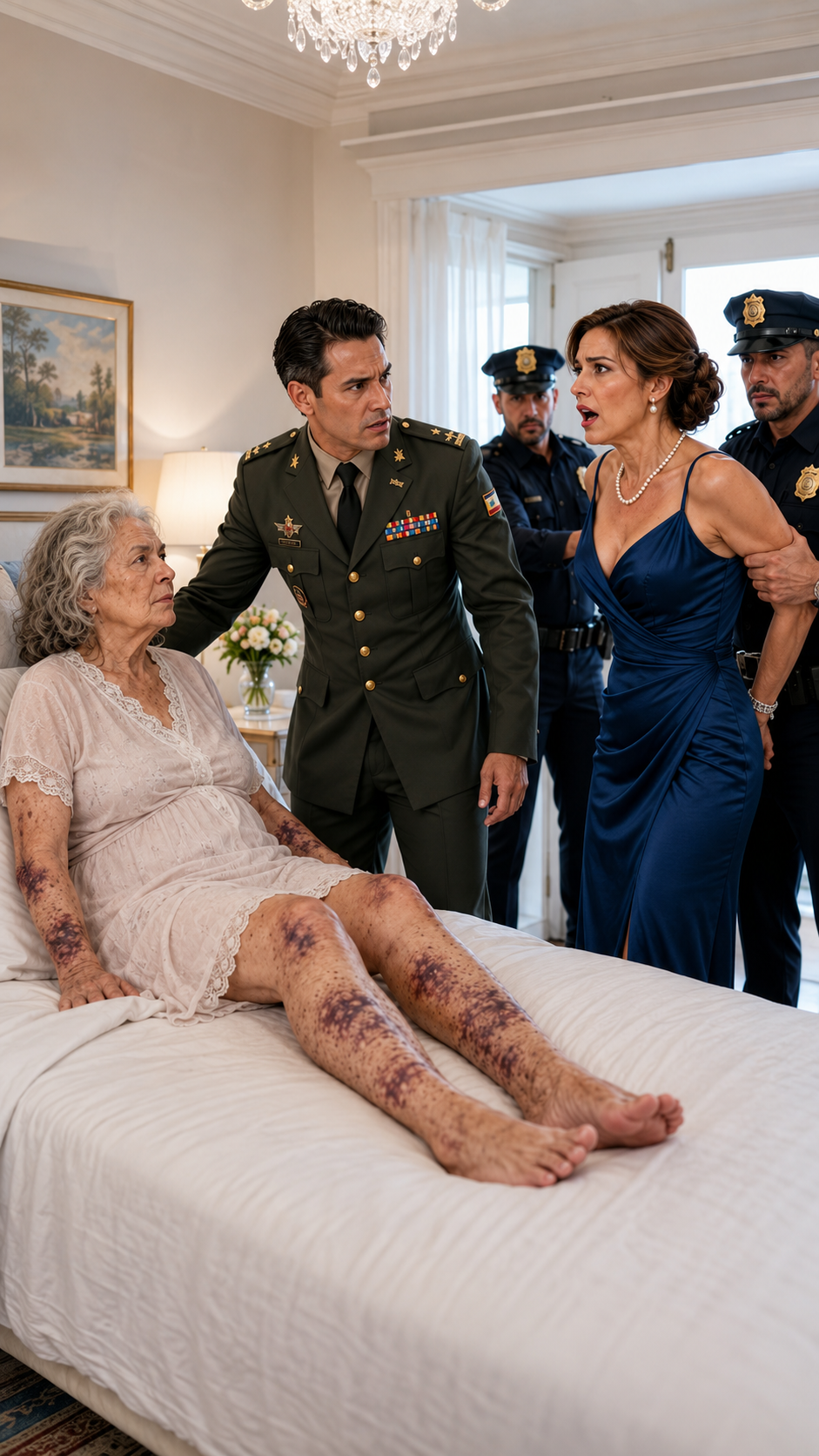
Doña Teresa sat on a mattress without sheets, a glass of lukewarm water in hand, her arms bruised.
She lifted her face.
Her eyes weren’t lost.
They were furious.
"I’m not crazy," she whispered.
Alejandro felt something fracture inside him.
"I know, Mom."
Doña Teresa tried to get up, but she heard footsteps.
Immediately, her expression changed, as if a switch had flipped.
"Not yet," she murmured. "She checks everything."
Alejandro understood.
He closed the door again, though it hurt as if he were sealing a tomb.
Later, while Mariana slept, he checked the security cameras.
Three months had been erased.
But the cloud storage records remained.
Everything had been deleted from Mariana’s computer.
Then he entered his mother’s email and found redirected bank statements.
Then he saw the pending request: a transfer for 1,480,000 pesos.
And when he reviewed Mariana's documents, he discovered a power of attorney ready to sell Doña Teresa’s house in downtown Querétaro.
Before dawn, Alejandro returned to the room.
"Mom, I need you to act confused tomorrow."
Doña Teresa looked at her bruised wrists.
Then smiled with a coldness he had never seen before.
"How confused, son?"
Alejandro knew then that Mariana had no idea who she had locked away.
He couldn’t believe what was about to happen…
PART 2
The next morning, Doña Teresa came down to the kitchen wearing a blue robe that Alejandro had passed through the window before dawn.
Mariana was preparing coffee, made up, hair done, perfect.
Too perfect for a woman claiming to be worn out from looking after an elderly sick person.
"Good morning, Teresita," she said with that cheap-novel voice. "Did you sleep well?"
Doña Teresa looked at the fridge.
Then at the stove.
And asked:
"Is this where I buy my ticket to go to Celaya?"
Mariana’s eyes widened slightly.
Then she let out a theatrical sigh.
"See, Alejandro? This is what I deal with daily. Your mom doesn’t even know if she’s in her kitchen or a bus station."
Alejandro lowered his gaze to his plate.
"We need to have patience."
Doña Teresa picked up the ceramic sugar bowl and let it drop to the floor.
The crash shattered the calm.
Mariana lost her mask for two seconds.
She gripped Doña Teresa’s wrist hard and leaned toward her.
"Enough of playing the poor thing. You’re not going to ruin this for me, you ridiculous old woman."
Alejandro watched as Mariana’s fingers dug into his mother’s bruised skin.
Under the table, a recorder kept running.
"Mariana," he said, without raising his voice, "let her go."
She released her instantly.
"That’s why she needs professional help. The doctor will confirm it today."
After breakfast, Mariana opened a folder.
It contained medical notes, behavior reports, a letter from Dr. Paredes, and several papers signed by Doña Teresa.
"The appointment is at 9:00 with Dr. Laura Cárdenas," she explained. "If she confirms incapacity, you sign as responsible, and I can handle the paperwork. It’s for the best."
"What paperwork?"
Mariana hesitated for a moment.
"The residency, the accounts, the downtown house. There’s already an interested buyer."
That "already" dropped like a stone.
Alejandro smiled.
"How efficient."
Mariana relaxed, believing she had convinced him.
But while she changed, Alejandro made four calls.
The first was to a colleague from the Querétaro Prosecutor's Office.
The second to a military doctor.
The third to a certified locksmith.
The fourth to the Public Property Registry.
In less than two hours, the mask began to fall.
The lock had been modified to prevent Doña Teresa from leaving.
The bruises on her wrists looked less like falls and more like forced restraints.
The downtown house had an alert for an attempted transfer of ownership via power of attorney.
And the supposed buyer was Ricardo Saldaña, a developer known for buying old properties from "incapacitated" seniors and reselling them as luxury apartments.
But the most shocking turn came when Doña Teresa whispered to Alejandro:
"Your dad left something in the study. Bottom drawer. In a black box."
Alejandro searched.
He found a USB drive.
His father, who had passed away five years ago, had installed a small camera disguised as a smoke detector after two houses were robbed in the neighborhood.
That camera didn’t rely on modern systems.
Mariana never knew it existed.
When Alejandro plugged in the USB, he saw everything.
Mariana taking Doña Teresa’s phone.
Mariana pushing her into the room.
Mariana saying to her in front of the mirror:
"As long as you look crazy, no one will believe you."
Then came Ricardo Saldaña sitting in the kitchen, sipping expensive tequila.
"Once they declare her incapacitated, we sell it for four million, even though it’s worth ten," he said. "You keep your part, and your soldier won't understand the papers."
Mariana laughed.
Then kissed him.
Alejandro turned off the screen.
For a moment, he stopped being a husband.
He became an investigator again.
He copied the videos onto three USB drives. One for the doctor. Another for the Prosecutor's Office. The third was programmed to send itself automatically if anything went wrong.
That night, Mariana drank more wine than usual.
"Your mom has always hated me," she said. "Now look at her. Old, useless, locked in her own story."
Alejandro held his glass.
"Maybe she’ll recover."
Mariana burst into laughter.
"From dementia? Don’t be ridiculous."
"No," he replied. "From the bruises."
The silence became sharp.
Mariana looked at him as if she were just starting to suspect.
"No one will believe a confused old woman. I’ve already told everyone she screams, makes things up, falls, and hits herself. The doctor will write it down tomorrow."
The recorder captured every word.
Alejandro raised his glass.
"Then let’s toast to tomorrow."
Mariana clinked her glass with his.
She didn’t know she had just toasted to her own downfall.
The next day, Dr. Laura Cárdenas’s office was in the Álamos neighborhood. White, quiet, cold.
Mariana entered wearing a light gray dress, pearls, and a smile of a sacrificed wife.
"Doctor, I brought all the paperwork," she said. "My mother-in-law has episodes of aggression, disorientation, paranoia, attempts to escape…"
Alejandro let her talk.
Then placed a folder on the desk.
"I also brought information."
Mariana turned toward him.
Her smile shattered.
The doctor opened the folder and reviewed the photos of the bruises, the locksmith's report, the erased accesses, the transfer request for 1,480,000 pesos, the redirected emails, and the property alert.
Then she saw the USB drive.
She didn’t say anything for almost a minute.
Then she picked up the phone.
"Rosa, please close the entrance to the consultation area. No one leaves yet."
Mariana let out a dry laugh.
"Excuse me? What does that mean?"
"It means this assessment needs to be done correctly," the doctor replied.
Doña Teresa lifted her face.
"My full name is Teresa Morales, widow of Vargas. I am 68 years old. Today is Thursday, September 14. I am in Dr. Laura Cárdenas's office in Querétaro. I take losartan in the morning and calcium at night. My house is at 47 Madero Street. And no, doctor, I do not have dementia."
Mariana went pale.
"She memorized that!"
The doctor demanded silence.
For forty minutes, she evaluated Doña Teresa.
She asked her to repeat words, draw a clock, remember numbers backward, explain recent news, name medications, routes, dates, and details of her accounts.
Doña Teresa answered everything.
She even corrected the date of her husband's death.
"He died on May 3, not the 5th," she said. "And before he left, he installed a hidden camera because he said decent people also needed proof."
Alejandro connected the USB.
On the screen, Mariana was seen dragging Doña Teresa by the arm.
"You’re hurting me," the old woman said.
"It’s going to hurt more when they take you to a clinic," Mariana responded.
Then came the video of Ricardo.
Then the kiss.
Mariana shot up suddenly.
"That’s edited!"
Alejandro placed his phone on the desk.
"There’s also audio."
Mariana’s voice filled the office:
"No one will believe a confused old woman. I’ve told everyone she screams, makes things up, falls, and hits herself."
Mariana stopped breathing for a moment.
Then she tried to cry.
"Alejandro, my love, I was tired. Your mom provoked me. You always left. You left me alone with her. Ricardo pressured me."
"Ricardo didn’t force you to close the door," he said.
"I’m your wife!"
"And she’s my mother."
At that moment, two agents from the Prosecutor's Office entered through a side door.
The first showed his ID.
"Mariana Ríos Santillán, you are under arrest for your probable involvement in illegal deprivation of liberty, violence against an elderly person, forgery of documents, and attempted patrimonial fraud."
Mariana recoiled.
"This is madness."
Doña Teresa stood up.
She didn’t scream.
She didn’t cry.
She just looked at her as one looks at someone who is finally no longer frightening.
"Madness was thinking that a closed door could erase my memory."
At the same hour, Ricardo Saldaña arrived at the Public Registry wearing dark glasses and carrying a notarized folder.
He didn’t get to submit it.
He was arrested with the fake contract in hand.
In his briefcase, they found documents for two more houses, both belonging to seniors declared incapacitated under dubious circumstances.
Doña Teresa’s case wasn’t an accident.
It was a method.
Dr. Cárdenas issued a clear statement: Teresa Morales was lucid, competent, and capable of managing her life and assets.
A judge ordered protective measures.
The accounts were frozen.
The powers of attorney were suspended.
The property was blocked.
Dr. Paredes and the notary were called to testify.
When Alejandro and Doña Teresa returned home, the neighbors were outside.
Doña Carmen was crying.
"Doña Tere, forgive me. Mariana said you hit yourself…"
Doña Teresa looked at her calmly.
"Next time you hear an elderly person asking for help, don’t ask the one who has the key. Ask the one who is locked inside."
No one said anything.
Because everyone had heard something at some point.
And everyone had preferred to believe the more comfortable version.
Months later, Mariana pleaded guilty.
She lost her marriage, her money, the house she wanted to steal, and the perfect image she had built.
Ricardo received a greater sentence when other frauds against vulnerable families came to light.
But Alejandro didn’t feel victorious.
He felt weary.
A heavy weariness, as if he had returned from a war only to find another within his own home.
Eight months later, the room where they locked up Doña Teresa was a reading room.
Light blue walls.
Open window.
A comfortable armchair.
A lamp.
A new cell phone on the table.
And no lock that shut from the outside.
One afternoon, Alejandro found his mother staring at the door.
"Do you want me to remove it completely?" he asked.
Doña Teresa shook her head.
"No. Doors aren’t bad, son. What’s bad is someone who thinks they can use one to silence another person."
He bowed his head.
"I failed, Mom."
She touched his hand.
"No. You arrived."
"Late."
"On time. Those who arrive late are the ones who listen and do nothing."
Weeks later, when Alejandro returned to work, Doña Teresa saw him off on the porch with coffee and sweet bread.
"Go in peace," she said. "This house no longer has closed doors from the outside."
He hugged her long.
Not as a captain.
Not as an investigator.
As a son.
And when the taxi drove away, Doña Teresa closed the door to her home.
This time, it didn’t sound like a prison.
It sounded like peace.
Because they had tried to steal her house, her money, and her name.
But they couldn’t steal her memory.
Nor her dignity.





