PART 1
Diego Ramírez thought divorce would save them.
At 34, he worked at an insurance company in Mexico City, convinced that some wounds, when they didn’t heal, were better left untouched.
Mariana had been his wife for five years.
To anyone watching them at family gatherings in Coyoacán, they seemed like a quiet couple, the kind that didn’t make noise but understood each other with a glance. She brewed coffee for him when he came home late. He bought her flowers on Fridays, even if they were the cheap ones from the market.
They dreamed of a small house in Querétaro.
They dreamed of children running in the yard.
They dreamed of growing old together.
But after the third year, life ripped away two pregnancies from them.
The first left them in silence.
The second left them shattered.
Mariana began to fade little by little. She no longer sang while cooking. She no longer felt excitement seeing baby clothes in store windows. She no longer cried in front of Diego, as if even that brought her shame.
Instead of holding her tighter, Diego hid in his office.
He said he had meetings.
He said he had things to take care of.
He said he was tired.
The truth was different: he didn’t know how to look at Mariana without feeling that they had both lost something that would never return.
There were no screams.
There were no broken dishes.
Just a cold distance that crept between them like dampness in the walls.
One night, after arguing over something trivial — an unpaid bill, a call he didn’t answer, a dinner that went cold — Diego let slip the phrase he had been biting back for months.
—Mariana… I think we should get divorced.
She looked at him with dry eyes.
She wasn’t surprised.
She only asked:
—You decided this before saying it, didn’t you?
Diego lowered his gaze.
That gesture was enough.
Mariana didn’t plead. Didn’t shout. Didn’t ask if there was another woman.
She just went to the bedroom, pulled out an old suitcase, and began folding her clothes with a calm that was terrifying.
The divorce went through quickly.
Too quickly.
Diego rented an apartment in Narvarte, bought plates for one, and filled his nights with television, reheated food, and a loneliness he pretended not to feel.
He told himself he did the right thing.
That separating was healthier.
That Mariana deserved to start anew.
Until two months later, when everything crashed down on him.
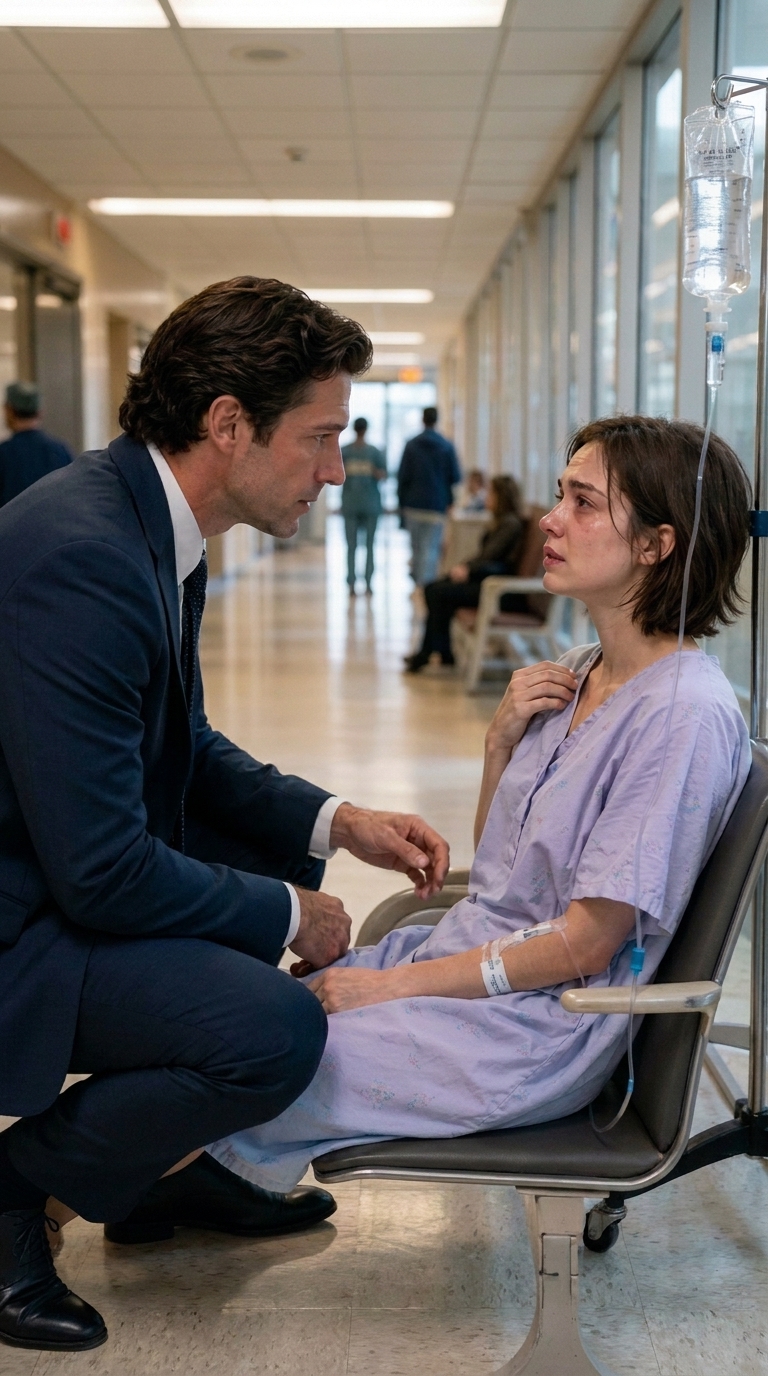
Diego went to Hospital Ángeles Mexico to visit his best friend, who had undergone emergency surgery. Exiting the elevator, he took the wrong hallway and ended up in the oncology area.
Then he saw her.
Mariana was sitting alone by a window, in a patient’s gown, an IV in her arm, and her brown hair cut almost to the nape.
Her face was thinner.
Her lips, pale.
Her eyes, sunken.
Diego felt the floor drop out from beneath him.
He took a step.
Then another.
Mariana lifted her gaze and recognized him instantly.
She didn’t smile.
She didn’t get angry.
She only tightened her grip on the hospital bracelet with trembling fingers and said a phrase that split his life in two:
—They didn’t tell you, did they? Your mom made me swear you would never know about this.
PART 2
Diego stood frozen.
The hospital noise continued around them: stretchers passing, nurses talking, the distant beeping of a machine. But for him, everything turned into a hum.
—My mom? —he barely asked—. What does my mom have to do with this?
Mariana turned her gaze to the window.
Outside, the evening fell over the city with that rain-gray hue that makes everything sadder.
—Let it go, Diego. It doesn’t matter anymore.
—Of course it matters. You’re in a hospital, alone, in a gown, with an IV… and you’re telling me my mom knew.
Mariana swallowed.
She looked so exhausted that even speaking seemed to hurt her.
—Your mom came to see me three days after we signed the divorce.
Diego felt a dry blow to his chest.
His mother, Doña Beatriz, was an elegant, tough woman, the kind who smiles at church and judges everyone on the way out. She never liked Mariana much, though she pretended to be polite in front of Diego.
She said Mariana was “too sensitive.”
She said a strong woman didn’t crumble from losing a pregnancy.
She said horrible things in a soft voice.
—What for? —Diego asked.
Mariana let out a sad laugh.
—To tell me that if I really loved you, I should disappear.
Diego opened his mouth but couldn’t say anything.
—She told me she’d already destroyed you enough. That because of me, you were living in the dark. That a woman who couldn’t give you children had no right to keep holding you.
—No… —he whispered—. Mariana, no.
—Yes, Diego. And I was so broken I believed her.
The nurse approached to check the IV bag. She looked at Diego with suspicion, as if she knew he was part of that woman’s pain.
—Is everything okay, Mrs. Mariana?
—Yes, Lupita. Thank you.
The nurse left, but not without shooting Diego a sharp look.
Diego sat in front of Mariana.
—What illness do you have?
She closed her eyes.
For a moment, it seemed she would go silent again. But maybe she was too tired to keep secrets.
—Leukemia.
Diego felt the air leave his lungs.
—Since when?
—I was diagnosed one month before you asked for the divorce.
The phrase pierced him like a knife.
Diego remembered that month.
He remembered seeing her vomit in the mornings and thinking it was anxiety.
He remembered her dizziness.
He remembered the bruises on her arms.
He remembered that she tried to talk to him several nights, and he always said, “Tomorrow, Mariana, I can’t right now.”
He felt shame.
A shame so great it couldn’t fit in his body.
—Why didn’t you tell me?
Mariana looked at him then. Not with rage. That would have been easier. She looked at him with a clean, exhausted sadness.
—I tried.
Diego shook his head, confused.
—No. I didn’t…
—I called you 11 times the week after I went to the doctor. I sent you messages. I went to your office one afternoon, but your secretary said you were in a meeting. Then your mom called me and told me to stop humiliating myself.
Diego felt something inside him break.
He took out his phone with clumsy hands and searched for old messages. There was nothing.
Nothing.
No calls.
No audios.
No texts.
Mariana guessed his thought.
—Your mom had access to your iPad, right?
Diego froze.
Doña Beatriz used his old iPad to look at recipes, family photos, and talk to her friends. He never imagined she was also connected to his messages.
—She erased everything —Mariana said—. Then she went to my apartment with two envelopes.
—What envelopes?
Mariana took a deep breath.
—One had the clinic’s receipt. The diagnosis. She already knew because she found a copy at the house when I went for my things. The other had money.
Diego’s eyes burned.
—Money?
—50,000 pesos. She said it was for me to go to Puebla with my aunt and not look for you anymore. That if I loved you, I shouldn’t make you carry a sick woman.
Diego shot up.
—That’s crazy!
Several people turned.
Mariana lowered her voice.
—Well, I thought so too. But then she said something worse.
Diego looked at her.
—What?
Mariana tightened the blanket over her legs.
—She told me that if I told you, she would convince you I was using my illness to blackmail you. That you were starting to heal. That I would only drag you back into the pit.
Diego rubbed his face with both hands.
His mother.
His own mother.
The woman who brought him soup to his apartment and said, “Son, you did the right thing.”
The woman who repeated that Mariana was cold, that she hadn’t even cried when she left.
The woman who told him, “Don’t look for her, Diego. That girl always knew how to play the victim.”
Everything fit together with unbearable cruelty.
—Mariana, I’m sorry.
She looked down.
—I didn’t come here for you to apologize.
—But I abandoned you.
—Yes.
The word was simple.
Without drama.
And that hurt more.
—You did abandon me, Diego. But not because of my illness. You abandoned me before, when I was left crying in the bathroom after the second baby and you went to sleep on the couch. You abandoned me when you told me we should “stop talking about it” because it hurt you. You abandoned me when you turned my pain into an uncomfortable problem.
Diego had no defense.
None.
He just sat down again, destroyed.
At that moment, a young doctor appeared in a white coat.
—Mrs. Mariana López.
Seeing Diego, he hesitated.
—Family?
Mariana opened her mouth to say no, but Diego spoke up.
—Ex-husband.
The doctor nodded seriously.
—We need to talk about the donor.
Mariana paled.
—Doctor, no…
—Mariana —the doctor said carefully—, time is important.
Diego looked from one to the other.
—What donor?
The doctor checked the file.
—The lady needs a bone marrow transplant. We couldn’t find compatibility in the national registry. Her aunt wasn’t compatible. Neither was her cousin.
Diego felt the world closing in.
—And can I get tested?
Mariana lifted her head, alarmed.
—You don’t have to.
—Of course I do.
—You’re no longer my husband.
—But I was the man who promised to take care of you.
She pressed her lips together.
—Promising isn’t the same as fulfilling, Diego.
He received the blow in silence.
—Then let me fulfill it now, even if it’s late.
The doctor intervened.
—We can do an initial test today. But I must be clear: the probability of compatibility between non-related people is low.
Diego nodded.
—Do it.
Mariana wanted to protest, but a dizziness forced her to lean against the chair.
Diego stepped forward to help her.
She didn’t reject him.
Nor did she fully accept him.
She just allowed him to hold her arm.
That minimal trust hurt her more than any insult.
While a nurse took blood from Diego, his phone began to vibrate.
It was his mother.
1 call.
2 calls.
3 calls.
He didn’t answer.
Then came a message:
“Son, my cousin told me you’re in the hospital. Don’t get close to Mariana. That woman just wants your pity.”
Diego looked at the screen with disgust.
For the first time, he read his mother without the filter of a son’s love.
He saw her.
He saw her whole.
Controlling. Cruel. Capable of leaving a sick woman alone just to keep her son “free.”
Diego wrote a single response:
“I’ll talk to you when I get out. And this time you won’t lie to me.”
Minutes later, Doña Beatriz appeared in the hospital.
She strode down the hallway like a perfumed storm, with an expensive bag, immaculate hair, and that offended look she wore when someone disobeyed.
—Diego, let’s go.
Mariana closed her eyes, exhausted.
—Mom, what did you do? —he asked.
Doña Beatriz feigned surprise.
—Are you going to blame me for protecting you now?
—Did you erase the messages?
The woman hardened her jaw.
—That girl was obsessed with you.
—Did you offer her money to disappear?
—I offered her help. Which is not the same.
—Did you know she had leukemia?
The silence that followed was the answer.
Diego felt nauseous.
—You knew.
Doña Beatriz lowered her voice.
—I knew you were already destroyed. I knew that if you went back to her, you would sink. I did what any mother would do.
Mariana let a silent tear fall.
Diego looked at his mother as if he didn’t recognize her.
—No. What you did was not motherly. It was cowardly.
Doña Beatriz put a hand to her chest.
—Are you going to talk to me like that for her? For a woman who couldn’t even give you a child?
The entire hallway seemed to stop.
Mariana froze.
Diego felt the blood rush to his face.
—Don’t ever say that again.
—It’s the truth, Diego.
—No. The truth is that we lost two children. Both of them. Not just her. And while she was dying inside, I played dumb because I didn’t know how to face my own pain.
Doña Beatriz tried to respond, but Diego continued.
—And you took advantage of that. You saw her sick, alone, vulnerable, and pushed her further down.
Nurse Lupita, who had overheard part of the conversation, approached.
—Ma’am, if you’re here to disturb the patient, I will call security.
Doña Beatriz shot her a glare.
—Stay out of it.
—I’m getting involved —Lupita replied—. Here patients are not trash for family to come and finish off.
Several relatives in the waiting room murmured.
Doña Beatriz, humiliated, pointed to Mariana.
—You’re manipulating him.
Mariana lifted her gaze for the first time with firmness.
—No, ma’am. I let him go two months ago. You were the one who couldn’t let go of control.
The phrase fell like a slap.
Diego took a deep breath.
—Mom, leave.
—What?
—Leave. And don’t come looking for me again until you understand what you did.
Doña Beatriz paled.
—I’m your mother.
—And she was my wife. The woman you left alone with cancer.
Security appeared at the end of the hallway.
Doña Beatriz walked away slowly, offended, but for the first time, without winning.
That night, Diego didn’t leave the hospital.
He didn’t sit next to Mariana as if he owned a place that no longer belonged to him. He sat across from her, at a respectful distance, with cold coffee in his hands and red eyes.
Mariana slept off and on.
Sometimes she woke up confused.
Sometimes she looked at him as if she didn’t know whether to hate him or be grateful he was there.
At 3 in the morning, she murmured:
—I don’t want you to come back out of guilt.
Diego swallowed hard.
—I don’t know if I have the right to come back.
—You don’t.
He nodded.
—I know.
Mariana watched him in silence.
—Then why are you still here?
Diego looked at his hands.
—Because leaving again would confirm that I didn’t learn anything.
She didn’t respond.
But she didn’t ask him to go either.
The next day, the preliminary result arrived.
The doctor appeared with an expression neither of them could decipher.
—There’s something unexpected.
Diego stood up.
Mariana tightened the blanket.
—What happened?
The doctor looked at the file.
—The initial compatibility of Mr. Diego is high. It’s not common, but it can happen. We need deeper tests, but… you could be a donor.
Mariana covered her mouth.
Diego felt his legs tremble.
For the first time in months, a small possibility entered the room.
But the twist didn’t end there.
The doctor looked at Mariana carefully.
—Also, reviewing old studies, we found an important note. One of the miscarriages may have been related to the illness she was already developing, not due to any reproductive incapacity on her part.
Mariana froze.
Diego understood the weight of those words.
For years, Mariana had carried the guilt.
For years, she had heard indirect comments.
For years, she believed her body had failed.
And maybe her body had only been asking for help.
She began to cry.
Not like before, in silence.
She cried with the pain of someone who finally understands she was unjustly condemned.
Diego knelt in front of her.
—I’m sorry for leaving you to carry that alone.
Mariana cried so much she could hardly speak.
—I thought I was defective, Diego. I thought everyone was right.
—You weren’t defective.
—Your mom made me feel like I killed our children.
Diego closed his eyes, devastated.
—I also made you feel alone. And no test will erase that.
The operation wasn’t immediate.
More studies, authorizations, risks, consents came. Diego missed work, sold his car to pay for medications that insurance wouldn’t cover, and faced his family when they told him he was exaggerating over “an ex.”
His sister told him:
—Dude, she’s not your wife anymore.
Diego replied:
—But she’s still a person. And one I hurt.
News spread through the family like wildfire.
Some said Mariana was interested.
Others said Diego was paying for karma.
Others, the cruelest, asked if it was worth saving a woman he wouldn’t have children with anymore.
When Mariana heard that, she smiled with a tired sadness.
—People think a woman is worth what she can give birth to.
Diego didn’t know what to say.
She did.
—And the worst is that many times other women are the first to repeat it.
The transplant took place six weeks later.
Diego woke up in pain, weak, but calm.
Mariana was isolated for several days. There were fevers, fear, nights when the doctors spoke softly, and Diego felt his heart stop.
Doña Beatriz tried to visit him twice.
He didn’t let her in.
The third time, she left a letter.
It didn’t say “sorry.”
It said: “I did what I thought was best for you.”
Diego tore up the letter.
Because he understood there are apologies that are just excuses with perfume.
Months later, Mariana left the hospital wearing a mask, taking slow steps, and with a different strength in her eyes.
Diego waited outside, dressed in a blue jacket and holding a bag of sweet bread.
She looked at him.
—Don’t think this means we’re back together.
He smiled slightly.
—I don’t think so.
—Don’t think that by donating marrow everything is erased.
—I don’t think so.
—Don’t think I’m going to forgive you quickly.
Diego lowered his head.
—I don’t expect that either.
Mariana took the bag of sweet bread.
—But you can walk me to the taxi.
They walked together, slowly.
Not as spouses.
Not as strangers.
As two people who had survived a cruel version of themselves.
Arriving at the hospital entrance, Diego saw his mother across the street.
Doña Beatriz didn’t approach.
She just looked at Mariana, then at her son, and for the first time, she had no words.
Mariana saw her too.
She didn’t raise her voice.
Didn’t insult.
She just said:
—I hope one day she understands that protecting a child doesn’t mean destroying the woman he loved.
Diego nodded.
—And I wish I had understood sooner that pain isn’t abandoned, it’s accompanied.
Mariana got into the taxi.
Before closing the door, she looked at him one last time.
—Diego.
—Yes?
—Thank you for staying this time.
The taxi moved forward through the city traffic.
Diego remained standing on the sidewalk, with his chest full of something that wasn’t complete hope, but neither was it punishment.
It was responsibility.
It was memory.
It was a second chance that perhaps didn’t mean going back to being a husband, but finally learning to be human.
Because sometimes love isn’t shown by reclaiming someone.
Sometimes it’s shown by accepting that you arrived late, paying for the damage without expecting a reward, and understanding that no mother, no marriage, and no forgiveness is worth more than the dignity of a woman who survived when everyone left her alone.





