PART 1
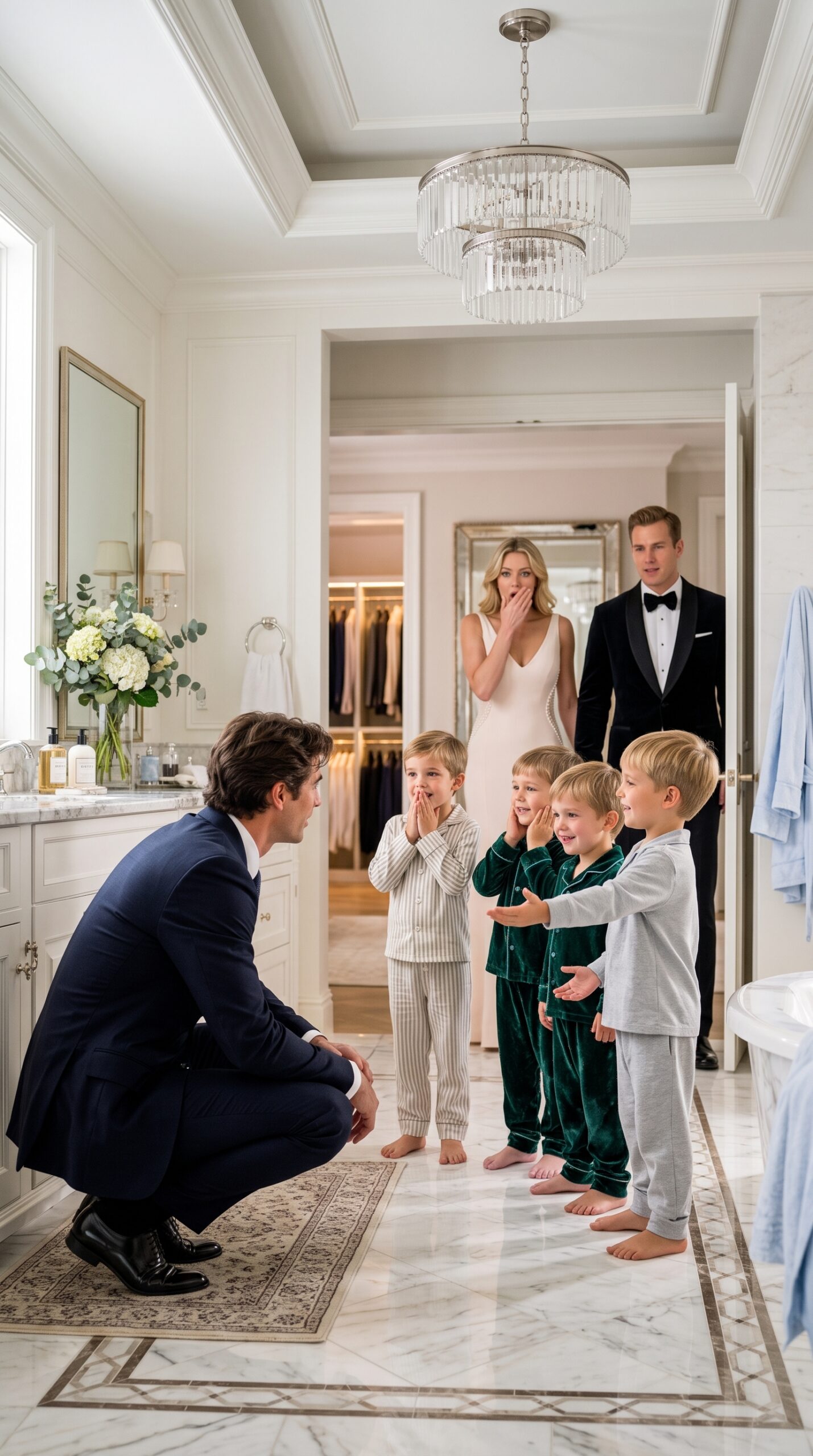
Three weeks from marrying Regina Alcázar, Gonzalo Whitmore stepped into a hotel bathroom in Polanco, seeking a moment of silence.
Outside, his mother argued about flowers, while guests talked about the wedding as if it were the merger of two corporations. Inside, four children were trying to scrub chocolate stains from their white shirts.
They were identical.
One was chattering non-stop. Another stared at his shoes. The third was wrestling with the hand dryer. The fourth sat by the sink, reading a book.
When that boy looked up, Gonzalo felt as if he were staring at his six-year-old self.
—What are your names?
—Milo, Mateo, Máximo, and Miqueas. We’re quadruplets.
Then Mariana Brooks entered with an empty tray.
Six years had passed, but Gonzalo recognized the woman he had secretly loved at the Whitmore residence in Las Lomas. Mariana had worked in the kitchen while studying management at night.
One day, she disappeared.
Doña Elena, Gonzalo’s mother, assured him that she had taken money and left with another man. Gonzalo searched for her for months.
Then he stopped.
Mariana paled at the sight of him with the children.
—Let’s go.
Gonzalo followed her to the parking lot.
—Tell me they’re not mine.
—You have no right to ask.
—They’re six years old.
—Your family decided long ago that we didn’t exist.
That same night, Gonzalo canceled his engagement in front of both families.
Regina dropped her glass. Elena stood up, furious.
—Are you going to destroy your future for a maid and four kids?
Gonzalo fixed his gaze on his mother.
—I’m stopping a wedding because someone hid a family from me.
In the following days, he waited for Mariana outside the public elementary school in Portales. He didn’t bring expensive toys or envelopes filled with cash.
He brought four sandwiches marked with names because he already knew Mateo hated avocado and Máximo couldn’t stand melted cheese.
He discovered that Mariana lived with the children in a rented room, with four narrow beds behind a curtain and an electric stove. Still, each task was checked, and every uniform appeared clean.
Little by little, the children began to wait for him.
Milo told stories with his whole body. Mateo fell asleep when he felt safe. Máximo argued when he was scared. Miqueas watched as if he could hear thoughts.
One afternoon, another student mocked:
—Here come the kids without a dad.
Milo froze. Mateo lowered his gaze. Máximo clenched his fists. Miqueas closed his book.
Gonzalo stepped forward.
—I’m their dad.
The yard fell silent.
Mariana confronted him under the rain.
—Never say that again!
—They deserve the truth.
—You don’t know the truth.
—Then tell me.
She let out a bitter laugh.
—Now you want to ask.
Days later, Regina arrived at the room Mariana rented with her children and placed an envelope on the table.
—Leave Mexico City. I’ll pay for housing, school, and work.
—In exchange for disappearing?
—The Whitmores will eat them alive.
Mariana pushed the money away.
—My kids are not the price of your broken heart.
Terrified, Mariana sent Gonzalo a manipulated DNA test.
“There’s no match,” it stated.
He replied:
—I asked for the truth, not a piece of paper.
On Monday, a friend leaked the story to the press, believing it would prevent another cover-up. By noon, reporters were already surrounding the school.
At 9:17, the principal called.
—Mrs. Brooks, three of your children have arrived. Miqueas never crossed the door.
Mariana dropped her phone.
One of the four children had disappeared.
PART 2
When Mariana arrived at the school, Milo was stiff in a chair, Mateo was crying silently, and Máximo was staring out the window as if he could bring his brother back.
Gonzalo appeared twelve minutes later.
He knelt in front of them.
—I’m going to find Miqueas. I’m not saying this to calm you. I’m saying it because it will happen.
Milo looked at him and nodded.
Mariana approached.
—Regina.
Gonzalo had already thought of her.
The Metrobús cameras showed a woman dropping a bag of oranges. While the passengers helped, a man exited through the back door with Miqueas.
The van was located near a closed printing shop in Azcapotzalco. Gonzalo insisted on driving there.
Halfway, a black van ran a red light and hit his car on the driver’s side.
Mariana received the news in the principal’s office.
—Mr. Whitmore is unconscious but stable. You are listed as the emergency contact.
Mariana had spent six years telling herself she could live without him. In that moment, she understood she had survived because she knew Gonzalo was still alive somewhere.
She left the three children with the counselor and ran to the hospital.
Gonzalo had a wound above his eyebrow, his arm in a sling, and his face covered in bruises. He seemed less powerful and more like the young man who once burned an entire dinner to impress her.
Mariana took his hand.
—I’m angry with you. For believing your mother. For accepting my disappearance. For showing up six years late.
Her voice broke.
—But if you die, I’ll never forgive you.
An hour later, her phone rang.
The police had found Miqueas in an apartment above the printing shop. He was unharmed, wrapped in a blanket, clutching a gray button in his fist.
He had ripped it from the man who held him.
When Mariana returned, her four children embraced on the sidewalk, crying and laughing at the same time.
Miqueas opened his hand.
—Mom, I saved evidence.
The button allowed them to identify one of the kidnappers. During the interrogation, he confessed that Regina had paid to hold the boy for two days.
According to her, no one was to hurt him. She only wanted to scare Mariana and show her that a woman without money couldn’t compete against a powerful family.
But the intermediary's messages revealed something worse.
Regina had also ordered the crash.
“Make it look like an accident. I don’t need a dead body, just a few hours,” she had written.
It wasn’t a fit of jealousy.
It was a plan.
While Miqueas remained locked up, Regina pretended to take Gonzalo out of the country under the pretense of protecting him from the scandal. Then she would pressure him to restore the engagement.
She was arrested that night at a private airstrip in Toluca.
Gonzalo visited her before she was transferred to jail. He arrived with his arm in a sling.
—I told them not to hurt you —Regina murmured.
—He’s six years old. He spent five hours believing no one would come for him. That’s already harm.
She broke down in tears.
—I loved you.
—No. You loved what marrying me was going to prove.
Gonzalo stood up.
—My children will never hear your name from me again.
As Regina faced charges of kidnapping and attempted murder, Doña Elena called Gonzalo to the family residence.
She was waiting for him in the dining room, with tea untouched and trembling hands.
—Tell me everything —he ordered.
For the first time, Elena stopped pretending to control the situation.
She confessed that six years earlier, she had discovered the relationship with Mariana and fired her. Later, she learned of the pregnancy and sent a lawyer to her apartment.
They offered her money to terminate it. If she continued, she would receive no support, recognition, or a single penny.
They also warned her that Gonzalo would lose his place in the company if she sought him out again.
Mariana was 26 years old, expecting four babies, and didn't know anyone capable of standing up to the Whitmores.
She fled to Puebla, gave birth, and later returned to the capital. She survived by cleaning offices, cooking in restaurants, and working double shifts.
—I thought she had accepted —Elena said.
—You believed what suited you.
Gonzalo walked to the window.
—My children slept in shelters. They were evicted on their birthday. One was kidnapped because of the scandal you created.
He turned back to her.
—And I spent six years thinking that Mariana had abandoned me.
Elena cried.
—I wanted to protect your future.
—You wanted to control my life.
Gonzalo ordered her to go to Mariana and confess everything without lawyers, gifts, or excuses.
—If you ever decide anything about my children without their mother’s permission again, you’ll also lose me.
Elena arrived at Mariana’s room without a driver or jewelry.
The children’s drawings covered the walls. Every stroke seemed to accuse her.
She recounted the threat, the money, the firing, and the lie.
Mariana remained silent for nearly a minute.
—She won’t come near my children until I decide. She won’t send gifts, won’t talk to the school, and won’t try to buy forgiveness.
—I understand.
—No. Not yet. Maybe someday.
Elena accepted because it was more than she deserved.
Gonzalo left the hospital three days later. Mariana insisted she was only going for him because the doctor said he shouldn’t be alone.
Not even she believed that.
The children welcomed him back to the apartment.
Milo examined his bruises and said they were “gross but heroic.” Mateo hugged him without letting go. Máximo asked if the person responsible for the crash had insurance.
Miqueas handed him the gray button.
—For your evidence collection.
Gonzalo closed his fingers around the button.
—Thank you.
That night, Mariana laid a blanket on the sofa.
—You can stay until you’re better.
Gonzalo looked at the four beds behind a curtain, the wobbly table, and the drawings that turned that room into a home.
—I should have found you.
—You didn’t know.
—I accepted not knowing. That was a decision too.
The phrase hung between them.
Mariana sat in front of him.
—I changed the DNA sample.
—I know.
—How?
—Milo sneezes like my father. Máximo argues just like me. Mateo sleeps with one hand under his cheek, like I did as a child.
Gonzalo smiled sadly.
—And Miqueas looks at people as if he could read what they’re still afraid to say.
His voice broke.
—I didn’t need a lab to understand what my bones already knew.
Mariana covered her face.
—I was afraid they would need you and you would leave again. And I was afraid I would need you too.
Gonzalo reached out his hand, but stopped before touching her.
—I’m not asking for trust because I came back. I’m asking for the chance to earn back what I should have protected from the beginning.
—On my terms.
—On yours.
—My rules with the kids.
—Always.
—And if your mother crosses a line...
—She will answer to you before she answers to me.
Nothing magically fixed itself that night.
Real wounds don’t work that way.
But by morning, Gonzalo made coffee, Máximo burned the bread, and Milo said his father’s snoring sounded like a broken lawn mower.
—More like a truck with emotional problems —Miqueas corrected.
Mateo sat on Gonzalo’s lap and fell asleep before breakfast.
Mariana watched them from the sink.
For the first time in six years, she didn’t feel like the only wall between her children and the world.
Three months passed before Mariana took the kids to the Whitmore residence.
It was her decision.
Elena received them in the garden, keeping her distance. She had learned that regret wasn’t the same as repair.
Milo ran to the fountain. Mateo followed. Máximo asked how much the house cost. Miqueas sat under an ash tree and opened a book.
—Gonzalo used to sit there —Elena whispered.
Mariana didn’t respond.
But she didn’t leave either.
It wasn’t forgiveness.
It was a beginning.
Six months later, Mariana was studying management at night, and Gonzalo had learned that being a father wasn’t about speeches or gifts.
It was about searching for lost socks, signing homework, remembering who hated blueberries, and listening seriously to the conflicts of recess.
One afternoon, Mariana was trying to study while her children built a fort with cushions.
—Mom, you should call Dad —Milo said.
—I don’t need to call him.
—You checked your phone seven times —Máximo teased.
—Eight —Miqueas corrected.
Mateo smiled.
—And you get happy when his name pops up.
All four burst into laughter.
Gonzalo arrived twenty minutes later.
—I’m sorry I took so long.
Mariana stood up too quickly.
—You’re here.
The children exchanged victorious glances.
—What did I miss? —Gonzalo asked.
—Nothing —Mariana replied.
—Everything —Miqueas corrected.
The children announced they were going to their grandmother’s and prepared their backpacks in ninety seconds.
—Have fun, Mom and Dad —Máximo shouted before slamming the door.
The apartment fell silent, but it no longer felt empty.
Gonzalo stood in front of Mariana, still cautious.
She recalled the hotel bathroom, the false report, the cameras, the hospital, and the gray button.
She thought of the six years they had been robbed of.
Then she thought of all the years they could still build.
—You can ask me again —she said.
Gonzalo stopped breathing for a moment.
—Mariana...
—I’m not saying everything will be easy. I’m just saying you should ask.
He moved closer slowly.
—Can I stay?
—For everything?
—For everything.
Mariana took his hand.
—Yes. But when you snore, you’re going to the sofa.
Gonzalo laughed and rested his forehead against hers.
In that small apartment filled with drawings, books, and mismatched chairs, Mariana realized that some stolen things can return.
Not intact.
Not without pain.
But with truth.
And this time, no one would make them disappear again.





