PART 1
—If you don’t sign right now, Mom, don’t come crying later that no one considered you. You’re ruining this family all by yourself.
That was the first thing Gabriel Salazar heard when he opened the door to his home in Del Valle, two days earlier than planned.
He had just returned from Mérida, his shirt wrinkled from the flight, a bag of sweet bread in his hand, and a jar of artisanal cajeta he had bought for Elena, his wife. After 27 years together, he still loved surprising her.
But that afternoon, the surprise turned to ice in his chest.
Outside was his son Mauricio’s truck, badly parked, blocking the street as if it belonged to him. Also, there was Renata’s white car and a gray Jetta that Gabriel recognized immediately: it was Bruno’s, Mauricio’s partner.
The front door was ajar.
Inside, the strong smell of lemon-scented bleach filled the air.
And beneath that odor, there was another.
Blood.
Gabriel set the bag down on the entryway and moved forward slowly.
Then he saw her.
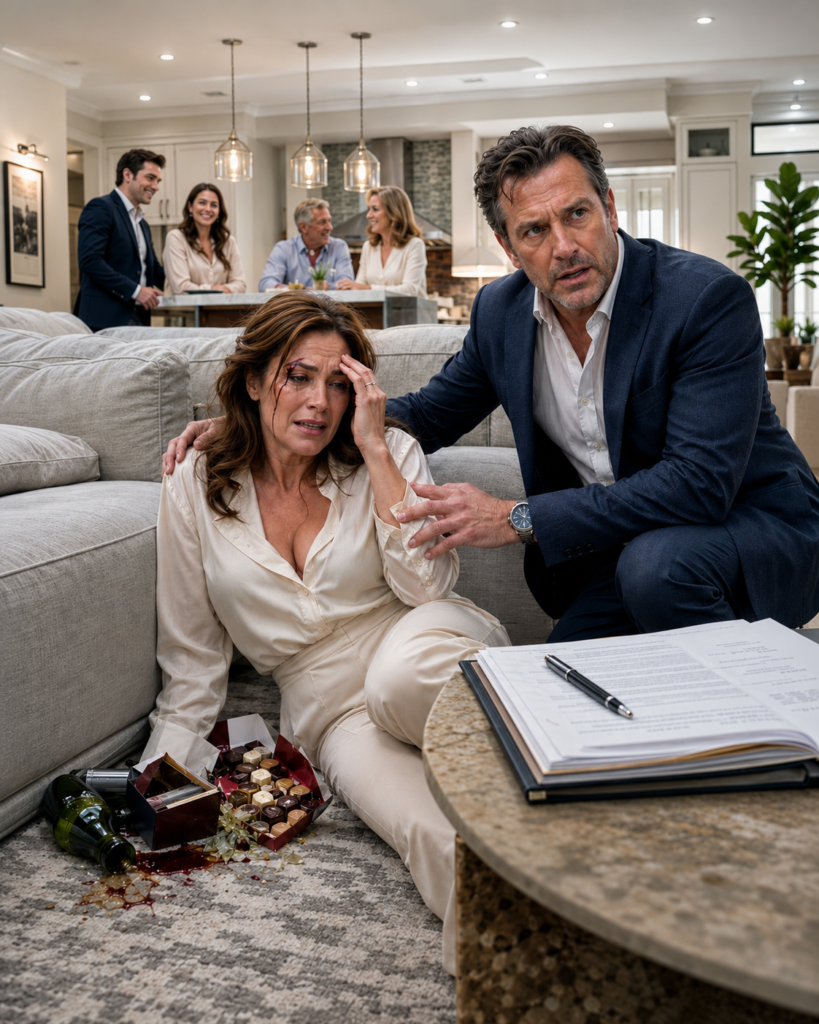
Elena was sprawled next to the sofa, her back against the wall, a trembling hand pressed against her brow. Blood ran down her temple, trickled to her neck, and stained the blue blouse he had gifted her on their last anniversary.
Her eyes were wide, filled with fear, as if she still couldn’t comprehend how her own son had gone this far.
—Elenita…
Gabriel knelt beside her.
—Who did this to you?
Before Elena could answer, a laugh erupted from the kitchen.
It was Mauricio.
Then came Bruno’s mocking voice:
—Come on, dude, your mom is being dramatic.
Renata let out a nervous, quiet laugh, like someone who didn’t want to be there but felt too intimidated to leave.
Gabriel felt something crack inside him.
His wife was bleeding less than four feet away, and they were seated in the kitchen, sipping coffee as if nothing was wrong.
Elena squeezed his sleeve.
—I didn’t sign —she whispered—. They wanted me to sign the sale of the Veracruz house.
Gabriel turned toward the coffee table.
There was an open black folder, sheets from a supposed notary, copies of deeds, and a ready-to-sign sales contract.
The Veracruz house.
The house that Elena’s mother had left her before dying.
The house where Elena learned to walk, where she kept her mother’s bougainvillea pots, her clay cups, and a rusted swing she never wanted to remove.
Gabriel picked up a sheet.
It wasn’t a proposal.
It was a deception ready to be realized.
The sale was in Elena’s name, but the deposit wouldn’t go to any of her accounts. The money would go directly into a business account for Mauricio and Bruno’s restaurant.
Gabriel felt the blood rush to his head.
—What is this?
From the kitchen, Mauricio appeared with a cup in hand. He turned pale at the sight of his father.
He wasn’t scared of his injured mother.
He was scared because Gabriel had come back early.
—Dad, don’t make a scene. Mom just fell. We were only trying to help her.
Elena shook her head from the floor.
—You grabbed my arm. You pushed me against the table because I wouldn’t sign.
Mauricio clenched his jaw.
—Don’t make stuff up, Mom.
Gabriel pulled out his cell phone. He snapped a photo of Elena’s wound, the blood on the carpet, the documents, the cups on the kitchen table, and the open folder.
Then he dialed 911.
Mauricio took a step toward him.
—Dad, chill. This is a family matter.
Gabriel held up the phone, the call active.
—My wife is bleeding, and you’re laughing. This stopped being family a long time ago.
Bruno walked out of the kitchen trying to smile.
—Mr. Gabriel, really, everything can be fixed through conversation.
Then Elena raised her voice, broken but firm:
—Check the last page.
Gabriel reached into the folder and found a hidden page.
There was another clause.
Elena wouldn’t just sell the house.
She would also waive any claim if the money was used to “settle business debts.”
Mauricio tried to snatch the page from him.
—You weren’t supposed to see that!
But it was too late.
Outside, sirens began to wail.
And just as Mauricio glanced toward the door, Elena looked up from the floor, blood on her face, and asked:
—Son… how long have you been planning to steal from me?
PART 2
Mauricio didn’t answer.
He just pressed the papers against his chest, as if he could still hide what everyone had already seen.
Renata stood up from her chair, her eyes filled with tears.
—I didn’t know they were going to put that clause.
Mauricio turned toward her with rage.
—Shut up.
The word fell like a blow.
Gabriel then looked at his daughter-in-law with new eyes. Renata wasn’t calm. She was pale, her hands cold, and her gaze downcast. She didn’t seem like a proud accomplice, but someone caught in a lie that had spiraled out of control.
The police arrived minutes later. The paramedics followed behind.
While they attended to Elena, Mauricio started speaking first, too fast.
—My mom tripped. She’s nervous. My dad just got here and doesn’t understand anything. We just wanted to convince her to sell a house she doesn’t even use.
Gabriel raised his phone.
—I took photos before anyone touched anything. And the emergency call recorded what they said.
Mauricio’s face changed.
Bruno tried to intervene.
—Officer, the lady had already agreed. She just needed to sign.
Elena, with a gauze on her brow, spoke clearly:
—I never agreed to sell my mother’s house.
One of the officers asked everyone to step aside.
Before they loaded Elena into the ambulance, she took Gabriel’s hand.
—In my knitting bag, there’s a USB drive.
Gabriel went to the sofa. Inside a cloth bag, he found yarn, needles, and a black memory stick.
Mauricio saw it.
—Dad, give me that.
Gabriel tucked it into his pocket.
—Now you’re scared, huh?
At the hospital, Elena received six stitches. The wound wasn’t severe, but what was broken wasn’t her brow.
It was her soul.
—He told me that if the restaurant went under, it would be my fault —Elena said, staring at the ceiling—. That a good mother doesn’t cling to an old house. That I was selfish for preferring memories over my son.
Gabriel didn’t respond. He just held her hand.
That night, back at home, they connected the memory stick to the computer.
There were audios.
Not from that day.
But from weeks.
Elena had started recording when Mauricio began to pressure her.
In the first audio, her son’s voice could be heard:
—Mom, don’t be stubborn. That house doesn’t feed you. It could save me.
In another, Bruno said:
—If she doesn’t understand nicely, we need to wear her down. Women sign when they feel guilty.
Gabriel clenched his fists.
But the last file left them breathless.
It was Mauricio talking on the phone.
—My dad is away. If my mom signs the first page, we’ll slip in the others later. She doesn’t even check, she trusts too much.
Then Renata’s voice came on.
—Mauricio, that’s already fraud.
And he replied:
—Fraud is my own mother letting me lose everything over a dusty house.
Elena brought her hand to her mouth.
She didn’t cry immediately.
At first, she stood still, as if her body needed to accept that voice was truly her son’s.
The next day, they went to a lawyer recommended by a neighbor. She reviewed every document. Elena’s signature wasn’t on any of them. Nothing had gone through a legitimate notary.
The house was still hers.
But the lawyer found something worse.
Mauricio had already pledged that property as collateral for a private lender in Puebla. If Elena didn’t sign within 48 hours, Mauricio would lose the restaurant, his apartment, and would be exposed to people who wouldn’t accept excuses.
That same afternoon, Mauricio arrived at the house.
He wasn’t alone.
He brought the lender.
A man in a gray suit, shiny shoes, and a cold gaze, who looked at Elena as if she were just a transaction.
—Mrs. Salazar —he said—, your son assured us that you had already authorized the sale.
Gabriel stepped in front of his wife.
Mauricio, with deep dark circles under his eyes, uttered the phrase that shattered her completely:
—Mom, sign. Or everyone will know you destroyed your own son.
Elena looked at the folder he was holding.
This time she didn’t tremble.
She didn’t take the pen.
She took her phone.
Mauricio frowned.
—What are you doing?
Elena called the lawyer and turned on the speaker.
—Attorney, my son is here again with a lender. He wants me to sign documents regarding the Veracruz house.
The lawyer’s voice sounded firm.
—Don’t sign anything, Mrs. Elena. This morning we filed a preventive notice. Any sale, transfer, or guarantee on that property is halted while the documents are investigated.
The lender looked at Mauricio.
—Investigation?
Gabriel stepped forward.
—There are audios, photos, a report of injuries, and possible fraud attempts.
Mauricio lost all color.
—Dad, please…
—Don’t ask me for what you didn’t ask your mother when she was bleeding on the floor.
Renata, who had stayed by the door, broke down in tears.
—I told him not to do it. I told him it was wrong. But Bruno convinced him that if his mom signed, everything would be fine in six months.
The lender looked at Mauricio with a dangerous calm.
—Did you offer me a guarantee that wasn’t yours?
Mauricio swallowed hard.
Bruno didn’t appear.
As always, he had pushed others into the fire and hidden before getting burned.
But this time it didn’t work.
With the audios, documents, and Renata’s statement, the lawyer filed a formal complaint. The supposed notary denied having authorized any transaction. The logo was fake. The business account existed, and was in Mauricio and Bruno’s name.
In the following days, Mauricio called 31 times.
First, he apologized.
Then he cried.
Later, he insulted her.
Afterward, he sent messages claiming Elena was cruel, that a mother shouldn’t ruin her son, that a mistake didn’t justify destroying a family.
Elena read everything in silence.
Gabriel wanted to block him, but she shook her head.
—I need to see if he’s really sorry or just scared.
The remorse didn’t come.
Another voice message arrived.
—If I lose everything, remember you could have prevented it.
Elena replied only once:
—I can’t call desperation a plan that needed my silence.
Then she left the phone on the table.
That night, she cried like she hadn’t cried even in the hospital. She cried for the boy who ran barefoot in Veracruz. For the teenager who asked for quesadillas at midnight. For the son who once promised to buy her a huge house when he became rich.
And she cried because that same son wanted to take away the only house her mother left her.
Weeks later, the restaurant closed.
Bruno disappeared with part of the money. Mauricio sold his truck. Renata went to Querétaro with her sister and filed for divorce. In her statement, she said Mauricio had been pressuring Elena for months and that that afternoon he grabbed her arm to force her to sit in front of the documents.
—I didn’t push her —Mauricio kept repeating.
Maybe not.
But he cornered her.
He humiliated her.
He left her bleeding while he laughed in the kitchen.
And sometimes a family doesn’t break from a single blow, but from all the seconds when no one helps.
One Thursday afternoon, Gabriel changed the locks.
When he removed Mauricio’s old key from the keychain, Elena broke down.
—Here, he learned to walk —she said, looking at the door—. Here, I made his cakes. Here, I took care of him when he had a fever.
Gabriel hugged her.
—He can still be your son without having permission to hurt you.
That phrase lingered in the house.
Months later, Elena traveled to Veracruz. The house was full of dust, the plants dry, and the rusted swing was still in the yard. In the kitchen, a blue cup from her mother still hung.
She opened the windows.
The salty air came in like an answer.
She walked through each room, touching the walls. For years, she thought that house was just an inheritance.
That day, she understood it was also a border.
A line that no one had the right to cross, not even a son.
Over time, Mauricio sent a handwritten letter. He asked for no money. He asked for no house. For the first time, he didn’t blame Bruno, or Renata, or bad luck.
He wrote that he had lost his business, his marriage, and his mother’s trust for believing his problems were worth more than her dignity.
Elena read the letter three times.
Then she put it in a drawer.
She didn’t rush to forgive him.
Nor did she hate him.
She just decided not to confuse herself again.
Because forgiveness, if it ever came, wouldn’t be a key. It wouldn’t be a signature. It wouldn’t be an open door to repeat the harm.
One night, sitting on the porch of her house in Del Valle, Elena looked at the closed door and took a deep breath.
—I’m not going to sign anything I don’t want to sign —she said—. Not out of guilt. Not out of fear. Not for being a mother.
Gabriel took her hand.
And in that house, the laughter from the kitchen was no longer heard, nor the breaking glass, nor the sirens.
Only Elena’s voice remained.
Clear.
Serene.
Final.
Because sometimes justice doesn’t start in a courthouse.
It starts the day a mother stops asking for permission to protect herself.





