PART 1
— Your grandmother is in a special care facility, Mateo. Stop asking or you're going to cause a serious problem.
Rogelio Salgado uttered those words without raising his voice. He didn’t need to. A single cold glance was enough for everyone in that house in Puebla to understand that the conversation was over.
Mateo was 16 and still believed his parents could be strict, but not cruel. From the outside, they seemed like an exemplary family: Rogelio was an accountant for several companies; Verónica participated in parish activities and boasted on Facebook that "the family must always stay united."
But the truth was, the one who had really raised Mateo was his grandmother, Elena.
Doña Elena smelled of cinnamon, rose cream, and tortillas fresh off the comal. When Rogelio came home in a bad mood or Verónica criticized every move her son made, the old woman would climb the stairs to the boy’s room with rice pudding in her hands.
— Don’t let anyone make you feel small, mijo —she would say—. Not even someone who shares your last name.
Over time, Elena began to forget simple details. She kept the sugar in the refrigerator, asked several times what day it was, or left an empty pot on the stove.
But she still recognized Mateo, prepared his favorite dishes, and could tell complete stories from his childhood.
One night in December, Elena was knitting a blue scarf for him. It was too thick, with uneven stitches, and looked more like a narrow blanket than a garment.
— It looks kind of ugly, Grandma —Mateo joked.
— I made it with love, not talent —she replied, bursting into laughter.
The next morning, her chair was empty.
Verónica insisted she had been taken to a private residence because she needed 24-hour nursing care. When Mateo asked for the address, his mother said visits were restricted.
When he wanted to call her, Rogelio said hearing his voice might upset her.
From that day on, the basement door appeared locked with a new padlock.
For the next three years, Mateo received the same explanation. His grandmother was stable. His grandmother needed peace. His grandmother hardly recognized anyone anymore.
They never showed him a photograph.
They never allowed him to send her a letter.
On his birthdays, Verónica would put a photo of Elena next to the cake and say she was surely thinking of him too. Rogelio even toasted to her health.
But some nights, Mateo heard noises from beneath the kitchen.
At first, he thought it was pipes. Then he believed he could hear a cough.
Whenever he asked, his father would appear immediately.
— Are you at it again with your nonsense, güey?
When he turned 19, Mateo stopped believing the explanations. The opportunity came when his parents announced they would spend the weekend in Veracruz.
— Don’t go into the study or cause any trouble —Rogelio warned before leaving.
Mateo waited until the truck disappeared. Then he searched through the kitchen drawers until he found a bunch of old keys.
The fourth one opened the padlock.
The smell hit him before he even descended.
It was a mix of dampness, urine, rotten food, and confinement.
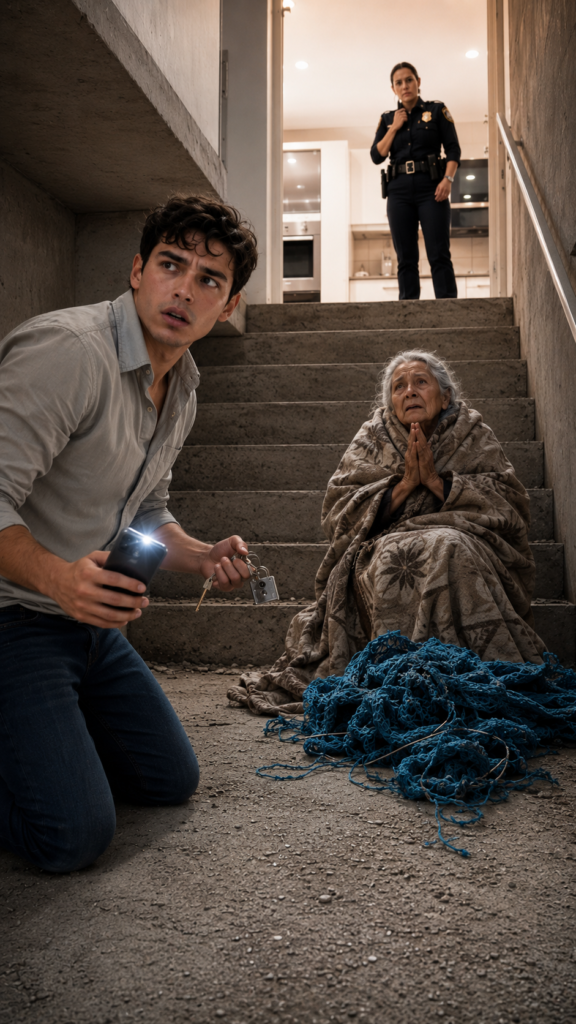
He illuminated the concrete steps with his cellphone. Down below were boxes, a dirty bucket, Styrofoam plates, and a thin mattress on the floor.
Then he saw a woman sitting against the wall.
She was covered in stained blankets. Her white hair clung to her face, and her arms were so thin they looked like twigs.
In her hands, she held an incomplete blue scarf.
— Grandma? —Mateo whispered.
The old woman slowly lifted her gaze.
Her lips were cracked, but her eyes recognized him immediately.
— I knew you would come, my boy.
Mateo ran to her, realizing that his parents hadn’t just lied about a facility.
They had kept Doña Elena locked up beneath their feet for three years... and the reason they did it was far more monstrous than he could imagine.
PART 2
Mateo tried to lift her, but Elena let out a groan. Her legs were stiff and she had several wounds on her back. He took off his sweatshirt, wrapped her gently, and cradled her against his chest.
The woman hardly weighed anything.
As he climbed the steps, Mateo felt her bones under the blankets. With each step, a mix of rage, guilt, and fear ripped through him.
He laid her on the couch where Verónica received her friends for coffee and gossip about the neighbors. Elena trembled without letting go of the blue scarf.
— I’m going to call an ambulance —he said.
She gripped his wrist with the little strength she had left.
— Don’t tell them. They’ll get angry.
That phrase broke him completely.
After three years without a bathroom, without medical attention, and with only scraps of food, his grandmother still feared inconveniencing those who had locked her away.
Mateo dialed 911.
The operator asked him to speak slowly. He repeated the address, explained he had just found an elderly woman locked up, and insisted his parents were responsible.
While help arrived, he gave her water with a spoon. Elena sipped a few drops and closed her eyes as if even swallowing hurt.
The sirens arrived 12 minutes later.
First came a patrol car. Then an ambulance and another municipal police unit. The red and blue lights illuminated family photographs, the altar to the Virgin of Guadalupe, and a wooden sign Verónica had placed in the living room:
“In this house, love reigns.”
Officer Jimena Cortés entered with the paramedics. Upon seeing Elena, her expression changed.
— Who did this to her?
Mateo pointed to the open basement door.
— My parents.
While the paramedics examined the old woman, Jimena went downstairs with other officers. They found the mattress, the bucket, containers of dry food, and a rusty chain fixed to the wall.
They also found a small camera pointing at the spot where Elena slept.
— What was that for? —Mateo asked, horrified.
The officer didn’t answer. She ordered everything secured as evidence.
The paramedics had just finished placing an IV in Elena when a truck parked in front of the house.
Rogelio and Verónica had returned early.
Verónica got out with a box of traditional sweets. Upon seeing the patrol cars, she dropped the box. Then she looked into the living room and found Elena on the couch.
She didn’t scream out of concern.
She screamed because she had been discovered.
Rogelio entered behind her and saw the padlock on the table.
— What did you do, Mateo? —he roared.
Jimena stepped in.
— Don’t come any closer.
— This is my house.
— And that woman is a victim.
Rogelio’s tone changed in seconds. He straightened his shirt and pretended to be calm.
— My mother has dementia. She was aggressive and could escape. We were just trying to protect her.
Elena opened her eyes.
— Don’t let them send me back down.
The silence was brutal.
Verónica began to cry, insisting that at first, it would only be a temporary measure. She said hiring nurses was too expensive and that no one understood the pressure of caring for a sick elderly woman.
— One difficulty doesn’t justify locking a person up without a bathroom or food —Jimena replied.
Rogelio tried to approach his son.
— You don’t know the damage you’ve just done to this family.
Mateo stared at him.
— The damage was done by you. I just opened the door.
The officers handcuffed both of them.
Verónica kept repeating that she was not to blame, that her husband made the decisions and had threatened her. Rogelio, on the other hand, insulted Mateo and swore he would regret it.
Before getting into the patrol car, he turned to his mother.
— All this happened because you never knew when to stop getting in our way.
Mateo wanted to hit him.
Officer Jimena stopped him by gripping his shoulder.
— Don’t give him the opportunity to play the victim.
In the ambulance, Elena remained clinging to the blue scarf.
— They told me you didn’t want to see me anymore —she murmured.
— I never stopped looking for you.
A tear rolled down the old woman’s cheek.
— Then you must know the rest.
At the General Hospital of Puebla, doctors confirmed severe dehydration, advanced malnutrition, respiratory infection, and injuries caused by remaining immobile for too long.
Mateo waited for hours in a plastic chair. He still smelled like the basement.
Officer Jimena sat across from him.
— I need you to remember anything strange from these years.
Mateo talked about the disappearing soup cans, the new buckets, the smell in the kitchen, and how his father watched the door. He also recalled that Verónica would come down some nights with a tray and return without it.
— I should have opened it sooner —he said, his voice breaking.
— You were 16 when it started —Jimena replied—. They used fear and their authority to control you.
— I turned 18 after.
— Turning a year older doesn’t erase the damage of growing up under threats.
When Mateo was allowed in, Elena was connected to a monitor. She looked fragile but more at peace.
— Your dad started with some papers —she explained—. He said they were to pay the property taxes, insurance, and my medications.
Rogelio had taken her bank card, her ID, and the house documents. Then he took her to a notary to sign a power of attorney.
— I asked what I was signing —she continued—, but Verónica squeezed my shoulder. Rogelio said that if I didn’t obey, you would have to leave school.
Mateo felt a void in his stomach.
His parents had used his future to manipulate her.
Elena signed because she believed she was protecting her grandson. Shortly after, Rogelio took control of her pension and requested loans in her name.
When she discovered suspicious transactions and threatened to report him, they locked her up.
At first, they left her in a room on the ground floor. Then, when a neighbor asked about her, Rogelio decided to move her to the basement.
The supposed dementia was also an exaggerated lie.
Elena had mild cognitive decline, but doctors stated that before confinement, she could make decisions with support and lead a relatively independent life.
The prosecution opened an investigation for illegal deprivation of liberty, domestic violence, abandonment, fraud, and property exploitation.
However, the most disturbing discovery came from the basement camera.
Rogelio hadn’t installed it to watch over his mother.
He used it to ensure Verónica didn’t give her more food than allowed or help Elena escape.
In several videos, Verónica could be seen coming down with a tray. Sometimes she left food. Other times, upon hearing Rogelio's voice through a small speaker, she would pick up the plate and return upstairs.
— Don’t give her too much —he ordered—. If she regains her strength, she’ll cause trouble again.
The revelation divided the family.
Aunt Mercedes, Rogelio’s sister, arrived at the hospital insisting everything must be an exaggeration.
— Your dad is strict, but he’s always been a proper man —she told Mateo—. Reporting your parents is a grave sin.
Mateo didn’t argue.
He led her to the room.
When Mercedes saw Elena’s arms, her sunken cheeks, and the fear with which she reacted to the sound of a door, she stopped talking.
She approached the bed and began to cry.
— I’m so sorry, sister. Rogelio said you didn’t want visitors.
Other relatives didn’t react the same way.
A cousin wrote that "dirty laundry should be washed at home." A woman from the parish defended Verónica because she always helped with the collections. Several neighbors insisted Rogelio was incapable of such a thing because he greeted every morning and paid his bills on time.
Mateo understood then that many people confused good manners with kindness.
Four days later, Jimena returned with a transparent bag.
Inside was the blue scarf.
They had found it under the mattress. It was dirty, incomplete, and had some frayed threads.
When Elena saw it, she smiled faintly.
— I hid it so your dad wouldn’t throw it away.
— Why did you keep it for so long?
— Because I had to finish it when you came back.
Mateo bent over the bed and cried.
He cried for every birthday when his parents assured him Elena didn’t remember his name. For the Christmas dinners when Verónica placed a candle in her honor while the old woman remained locked up just a few feet below.
— I should have listened to her —he sobbed—. I should have known she was there.
Elena stroked his hair.
— You were a child surrounded by adults who lied with calm faces.
The banking investigations revealed that Rogelio had collected his mother’s pension for three years. He sold her jewelry, took out two loans, and forged documents to try to keep the house.
Verónica had also used part of the money to pay for trips, clothes, and club fees.
Her defense claimed she acted under threats. However, the prosecution found messages where she complained that Elena "was taking too long to die" and asked when they could sell the property.
That was the twist that destroyed her version of a submissive wife.
Verónica was indeed afraid of Rogelio.
But she also participated because she wanted the money.
At the first hearing, Rogelio insisted that everything had spiraled out of control due to financial stress. His lawyer spoke of a desperate family and a woman with mental issues.
The prosecutor displayed photographs of the basement.
She then played a video where Rogelio watched Elena through the camera, mocking her for not being able to get up.
No one spoke again of a simple misunderstanding.
When the injuries were mentioned, Rogelio remained still.
When hunger was described, he didn’t react.
But when it was announced that the house and accounts would be secured, he lifted his head sharply.
— That property belongs to me —he protested.
Mateo understood that his father had never seen Elena as a mother.
Only as an obstacle between him and an inheritance.
Recovery was slow. Elena had to relearn how to hold a spoon, sit without getting dizzy, and walk with assistance.
The day she took her first four steps, Mateo was by her side.
Later, they brought her to a window. When the sun touched her face, Elena closed her eyes.
— I had forgotten how warm it was.
Months later, she was transferred to a worthy rehabilitation center, temporarily funded by the recovered assets. Mateo visited her every day. He brought her broth, played songs by Los Panchos, and sat with her under the bougainvillea in the patio.
One afternoon, Elena asked for the scarf.
— It’s very worn out —he warned.
— So am I, and here I am.
She began to knit slowly. Her hands trembled and the stitches continued to come out crooked.
— You don’t have to finish it quickly, Grandma.
Elena lifted her gaze.
— For the first time in three years, hearing that I’m not in a hurry feels nice.
The judicial process was still ongoing. Rogelio continued insisting he had done what was necessary. Verónica sent letters asking for forgiveness and claiming she was also a victim.
Mateo never denied that his mother had been scared.
But he didn’t forget that she would go down the stairs, lock the padlock, and then get ready to go to mass.
Fear could explain her silence.
It couldn’t erase her choices.
Some relatives stopped speaking to Mateo for "destroying the family." Others finally accepted that the family had been destroyed long before, when they preferred a respectable façade over the life of an elderly woman.
One morning, after a heavy rain, Elena went out to the patio with her cane. She sat under a tree and took out the blue scarf.
It was finally finished.
It was long, uneven, and had several different shades because they hadn’t found the same yarn.
Mateo wrapped it around his neck.
— It’s still kind of ugly.
— Ungrateful —Elena replied, laughing.
Her laughter was weak, but she was still alive.
Mateo then realized that telling the truth hadn’t destroyed his family. The truth had only turned on the light to something that had been rotting in the darkness for years.
Rogelio and Verónica closed a door believing they could erase a woman and keep everything that belonged to her.
They were wrong.
Because true love can spend years waiting with a scarf in its hands, but when it finally finds someone to open the door, it becomes a force that neither fear, nor money, nor lies can ever lock away again.





