PART 1
—Another tortilla, Doña Amalia? Come on, and then they say money doesn’t stretch because of inflation.
Esteban's laughter echoed through the dining room like he had just told the joke of the year.
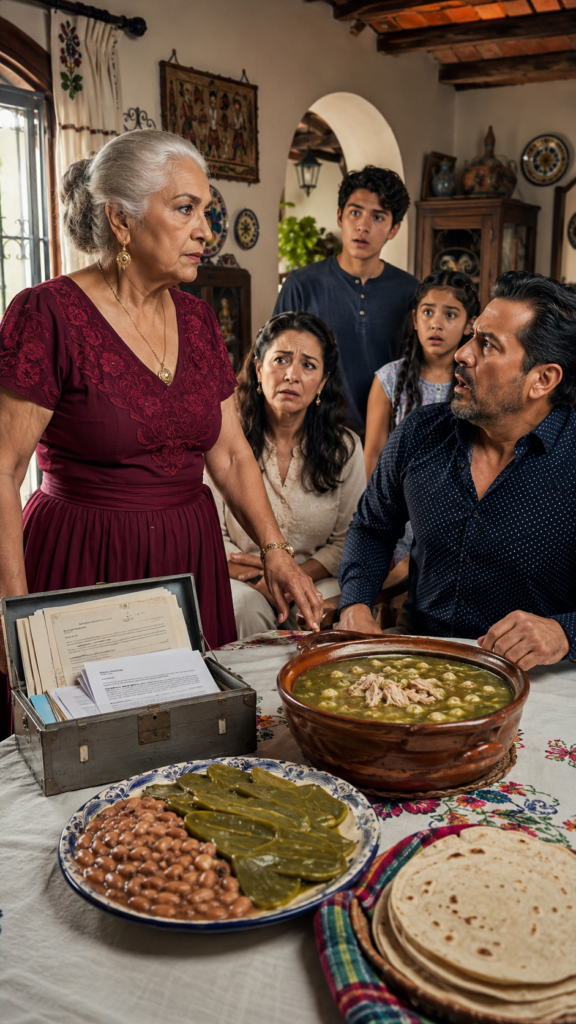
Amalia Robles, 71 years old, stood frozen with her hand on the tortilla warmer. She only wanted to accompany her plate of beans with pasilla chili. Nothing more.
The house was in San Andrés Cholula, Puebla. She and her late husband, Don Mateo, had built it brick by brick when they still sold carnitas on weekends and slept in a room with a tin roof.
But that night, Esteban occupied the head of the table, barking orders and speaking of “his house” in front of the guests.
Claudia, Amalia's only daughter, lowered her gaze.
Her grandchildren, Mauro, 16, and Renata, 13, let out an uncomfortable laugh. It wasn’t a malicious laugh. It was worse: it was a learned laugh.
Amalia set the tortilla back in the basket.
Since Mateo's death five years ago, Claudia had promised her that she would move in with her to keep her company.
—You won’t be alone, Mom. We will take care of you.
At first, Amalia believed that the house would come alive again. She liked the backpacks in the hallway, the cartoons blaring, and the smell of coffee every morning.
Then the changes began.
Claudia and Esteban took the master bedroom because “they were a married couple.” Amalia ended up in the back room, next to the boiler and the Christmas boxes.
Then Claudia took her bank card “to organize the expenses.”
Esteban started to decide what she could buy, when she could go to the doctor, and even how many times she could turn on the TV.
—At your age, you should be saving on medication, Doña Amalia. Miracles don’t happen after all.
She stayed silent to avoid losing her daughter.
She stayed silent because she feared losing her grandchildren.
She stayed silent because they had convinced her that enduring humiliation was the price of belonging to a family.
That night, she had prepared mole poblano for Esteban’s friends. She had been cooking since 6 in the morning, but no one thanked her.
When she stood up from the table, Esteban added:
—Don’t take offense. It was just a joke. But honestly, you eat more than Mauro.
Amalia took a deep breath.
She climbed up to the small back room, closed the door, and pulled out a metal box hidden behind some blankets.
Inside were the deeds to the house, the documents for three commercial properties, bank statements, and the power of attorney she had signed years ago in favor of Claudia.
She took out her cell phone and called Attorney Verónica Salas, the notary who had worked with Mateo.
—Attorney, I need to see you tomorrow. I’m tired of asking for permission to live in what is mine.
Downstairs, Esteban kept laughing.
No one imagined that tortilla was about to uncover five years of theft, lies, and a betrayal far more painful than any insult.
PART 2
The next morning, Amalia woke up before the garbage truck passed.
She made coffee, but for the first time, she didn’t leave breakfast for anyone. She showered calmly, arranged her white hair, and put on a navy blue dress that Mateo had given her for their 45th anniversary.
She tucked the metal box into a market bag.
When Claudia saw her leave, she frowned.
—Where are you going all dressed up, Mom?
—To resolve something I should have resolved a long time ago.
Esteban appeared with a cup in hand.
—Just don’t get lost, Doña Amalia. Going downtown is extreme tourism for you.
Amalia didn’t respond.
She closed the door gently. She didn’t leave like someone escaping but like a woman who finally remembered who she was.
The notary’s office was near the historic center of Puebla, in a large house with an interior patio and Talavera tiles.
Verónica Salas had known the family for over twenty years. She had seen Mateo sign the purchase of the properties and knew that this heritage hadn’t fallen from the sky.
Amalia laid the documents on the desk.
The notary reviewed the deeds, the power of attorney, and the bank statements. Her expression gradually changed.
—Doña Amalia, there are some very significant movements here.
—Claudia said it was for the property tax, the electricity, my medicines, and the groceries.
—Some are. But there are also payments for a truck, trips, gym memberships, purchases at department stores, and transfers to Esteban’s account.
—How much?
—In five years, over $1,800,000. And we still need to check the rent payments.
Amalia felt a chill in her hands.
—And my properties?
—They are still in your name, but for the past three years, the rents have been deposited into a joint account of Claudia and Esteban. Your daughter signed letters to authorize the collection, even though they had no right to keep the money.
The betrayal from Esteban hurt.
Claudia’s signature hurt more.
A daughter could make a mistake once. Allowing her mother to live like a guest for years while financing her lifestyle was no longer a mistake.
—Can I take back control?
—You can revoke the power today, change the accounts, block cards, demand receipts, and file a complaint. And regarding the house, there’s no doubt: you are the sole owner.
Amalia took a deep breath.
She signed the revocation, opened a new account, and notified the tenants of the three properties that no one else was authorized to collect.
She also requested a complete audit.
Before leaving, Verónica showed her a request made eight months ago to sell one property. It hadn’t progressed because Amalia’s physical signature was missing, but it carried a copy of her identification.
Amalia remembered that Claudia had asked her for it to “update the bank file.”
It was no longer just about expenses.
They had tried to turn her into a useful signature and erase her from the decisions.
She returned home as dusk fell.
She placed the metal box in the center of the dining room and waited.
Esteban came in talking on the phone, sat at the head of the table, and asked:
—What’s up? What do we need to buy now?
Amalia looked at him directly.
—Get up from that chair.
Esteban laughed.
—Excuse me?
—That was Mateo's chair. And as long as I’m alive, no one will ever sit there to humiliate me again.
Claudia paled.
Mauro put down his cellphone.
Renata looked at her grandmother as if she were seeing her for the first time.
Esteban leaned back in the chair.
—Oh, Doña Amalia, don’t start with the dramas. You get confused easily.
Amalia placed the deeds, the revocation, and the bank statements on the table.
—Today I revoked Claudia’s power. I blocked my card. I changed the rent account and ordered an audit.
Claudia covered her mouth with one hand.
—Mom, how could you do it without talking to us?
—I’ve been trying to talk for five years. You only listened when you needed my signature.
Esteban slammed the table.
—We live here. We’re family.
—Family doesn’t take away a widow’s room. Doesn’t control her medicine. Doesn’t mock what she eats. Doesn’t use her money to travel.
Then Amalia pulled out the sale request.
—And I also understand that someone tried to sell my property using a copy of my identification.
Silence grew heavy.
Esteban glanced at Claudia for one second.
That was enough.
—Tell me the truth, daughter.
Claudia began to tremble.
—Esteban said it was to get a loan. That we’d explain it to you later.
—You were going to mortgage my property?
—It was just a guarantee.
—For what?
Esteban replied:
—For my business. Everything was going to stay in the family.
Amalia let out a bitter laugh.
—My money is family, my house is family, and my properties are family. But my food, my bed, and my dignity count as expenses.
Claudia broke down in tears.
—Mom, I didn’t want to hurt you.
—Then why did you sign?
—Because he said it was fair. That we were taking care of you.
—He didn’t come to take care of me. He came to settle in. And you opened every door for him.
Esteban pointed at the papers.
—I also have rights. I’ve lived here for five years.
—The repairs you brag about came out of my account.
—Then sue me. Let’s see who believes an old lady who can’t even remember where she puts her keys.
Amalia took out her cell phone.
—I’m recording you. Repeat what you just said.
Esteban fell silent.
—you have thirty days to leave my house. Claudia can stay temporarily with the kids if she respects my rules. You are leaving.
—Are you going to separate a family?
—You separated it when you taught my grandchildren to laugh at me.
Mauro lowered his head.
Esteban stormed out, slamming the door.
That night, Renata found Amalia packing clothes in a suitcase.
—Are you leaving, Grandma?
—No. I’m going back to my room.
The girl helped her.
Inside the master bedroom, they had taken down Mateo’s photos and stored his rosaries in a box. The closet was full of expensive clothing bought with Amalia’s money.
Renata found an old photograph. Amalia and Mateo stood in front of the house when it didn’t yet have a second floor.
—Did you do all this?
—With 24 years of work.
—Dad says the house was abandoned when they arrived.
Amalia closed her eyes.
The lie hadn’t just occupied her rooms. It had also erased her story.
In the following days, Esteban yelled, threatened with lawyers, and accused Claudia of not defending him.
But when he received the formal notification, his courage began to shrink.
The audit found something worse.
In addition to the $1,800,000, $640,000 was missing from the rents. Part of the money had paid off a personal debt of Esteban’s.
There was also a contract to use one property as collateral for a loan.
Amalia’s signature was forged.
Verónica was clear:
—This is no longer just a breach of trust. It could be fraud.
Amalia filed a complaint.
Claudia begged her to remove Esteban’s name.
—He’s the father of my children.
—And I’m your mother.
—He could go to jail.
—He should have thought about that before forging my signature.
—Doesn’t it hurt you to destroy us?
Amalia felt that question was the final trap.
—I’m not destroying what you built. I’m stopping the protection of what you did.
One week later, Verónica called Amalia.
She had found an envelope inside Mateo’s file.
The handwriting was her husband’s.
Mateo had written that he had distrusted Esteban for years. He had heard questions about deeds, rents, and accounts. That’s why he left instructions that the three properties could never be sold without Amalia's physical presence and an independent verification.
The last line made her cry:
“Amalia, do not let anyone make you feel like a guest where you laid the foundations.”
For five years, she had thought that enduring was a way to honor her family.
The letter reminded her that Mateo had loved her with respect, not pity.
When she returned home, she found Mauro in the kitchen with a bag of hot tortillas.
—Grandma, I bought these for you.
The boy seemed smaller than his 16 years.
—I laughed —he confessed—. I was afraid my dad would get mad if I didn’t. I’m sorry.
Amalia held his face with both hands.
—Don’t become a man who needs to humiliate someone to feel big. Cruelty is learned, son, but it can also be unlearned.
Mauro began to cry.
—I don’t want to be like him.
—Then don’t stay silent when you see something unjust.
Renata started spending afternoons with her grandmother. She asked about Mateo, the carnitas, and the nights they slept on the floor because there were still no furniture.
Little by little, the grandchildren understood that each wall held weariness and each property represented years of work.
Esteban left before the thirty days were up.
He tried to take a television and two paintings that belonged to Mateo.
Mauro stood in front of the door.
—That’s not yours.
Amalia appeared behind him, recording with her cell phone.
—Take what’s yours. Not one more spoon.
Esteban clenched his jaw.
—Ridiculous old lady. No one is going to put up with you.
—I don’t need anyone to put up with me. I need them to respect me.
He left with two suitcases.
Weeks later, he returned the truck as part of a repair agreement. He also waived any claims on the house and had to sell several assets to cover part of the debt.
The complaint continued.
For the first time, the consequences didn’t fall on Amalia.
They fell on the one who had abused her trust.
Claudia moved with Mauro and Renata to a small apartment.
Before leaving, she entered the back room where her mother had slept for years. She saw the narrow bed, the stacked boxes, and the dampness in one corner.
She sat down and cried.
—Mom, forgive me. I was afraid Esteban would leave me.
Amalia stood at the door.
She felt no hatred.
That was the most painful part.
Because when a daughter hurts, a mother still remembers the little girl who learned to walk holding onto her skirt.
—To keep him from leaving, you allowed me to disappear.
Claudia covered her face.
—I don’t know how to fix this.
—Start by not asking me to forget. Start by accepting what you did.
Amalia didn’t close the door on her daughter.
Nor did she return control.
She established clear rules: notified visits, separate accounts, no signatures, no loans, and no decisions regarding her house.
Claudia got a job at a dental clinic. For the first time in years, she paid rent, transportation, and groceries with her own salary.
Mauro began working Saturdays in one of the properties to learn where the wealth came from.
Renata embroidered a napkin with a phrase:
“This table remembers too.”
The first night that Amalia returned to sleep in the master bedroom, she lay down on the side where Mateo used to read the newspaper.
She cried until she fell asleep.
Not only out of sadness.
But also out of relief.
The next day, she opened the windows, washed the curtains, and placed yellow flowers in the dining room.
She prepared beans, pasilla chili, and fresh cheese.
She took three tortillas.
She ate them slowly.
Without shame.
Without asking for permission.
Without anyone looking at her as if being alive were a cost.
Over time, Claudia began visiting her on Sundays. Sometimes she brought fruit. Other times she helped wash the dishes.
Not everything healed.
There were apologies that couldn’t erase five years and a trust that would have to be rebuilt with actions.
But at least no one was pretending nothing had happened anymore.
Amalia understood something many Mexican families prefer not to hear: enduring doesn’t always keep the family together.
Sometimes it only teaches others how much they can tread on you without losing the roof, the food, and your silence.
For five years, she believed that silence was love.
But that night, when she asked Esteban to get up from the head of the table, she didn’t just reclaim a house or three properties.
She reclaimed her chair.
She reclaimed her voice.
She reclaimed the right to decide.
And above all, she reclaimed the dignity to eat another tortilla without asking for forgiveness for staying alive.





