PART 1
At 10:03 a.m., Jimena Solórzano signed the divorce without shedding a single tear.
Her hand didn’t tremble.
There was no drama.
She simply breathed like a woman who finally understands that a beautiful house can also be a prison.
The office in Polanco smelled of reheated coffee, freshly printed pages, and icy air conditioning. On the other side of the door, her two children waited with tiny backpacks, a dinosaur notebook, and an old teddy bear.
Mateo was seven.
Camila was five.
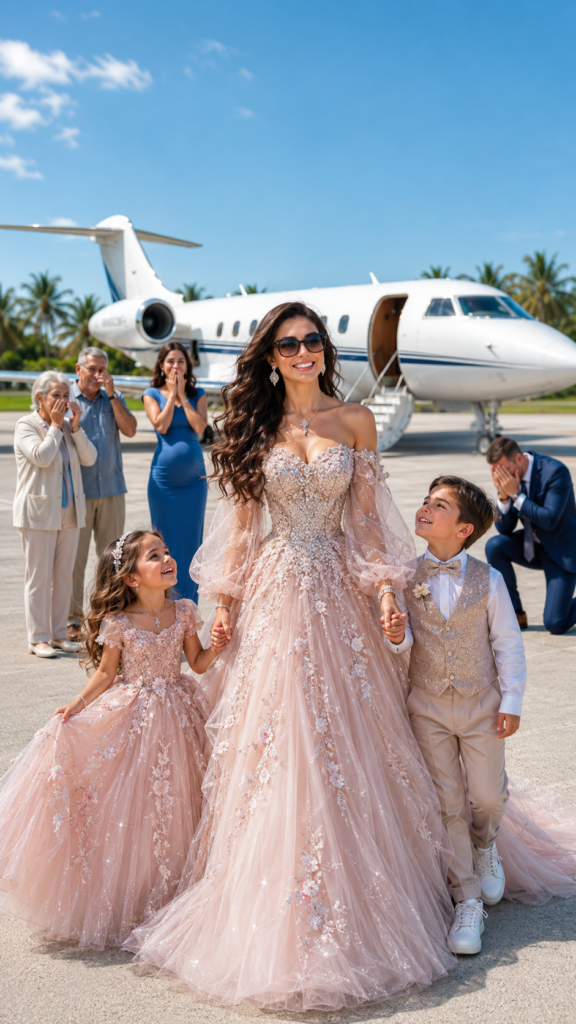
Neither knew that in less than two hours, they would be on a plane to Spain, with one-way tickets and a blue folder where Jimena kept passports, birth certificates, custody agreements, and a truth that no one in the Altamirano family had bothered to ask about.
Ricardo Altamirano, her now ex-husband, signed with a huge grin.
It wasn’t relief.
It was triumph.
As soon as he finished, he pulled out his phone in front of her and called Pamela, his mistress.
"It's done," he said, walking toward the window. "I’m heading to the clinic. Today everyone will meet the future of this family. Don’t worry, my love, our son will carry the Altamirano surname as he should."
Our son.
The phrase fell on the table as if Mateo and Camila didn’t exist.
As if those two children, sitting a few meters away, had been erased with a call.
Jimena didn’t respond.
For nine years, she had learned that arguing with Ricardo was like throwing words at a marble wall: cold, expensive, and soulless.
He had humiliated her at family dinners.
Called her useless for not working outside, even though she managed the household, cared for the children, and covered up his lies.
She had allowed her mother to scrutinize her shopping.
She had allowed her sister Roxana to mock her body after the second pregnancy.
She had allowed too much.
Until that day.
Ricardo tossed the pen onto the desk.
"The apartment and the truck stay with me," he spat out. "And if you want to take the kids, take them. Honestly, they were just going to be a nuisance in my new life."
Jimena's lawyer looked up, serious.
Everything was recorded.
Everything had a date.
Everything was on paper.
Roxana, Ricardo's sister, leaned against the wall with an expensive bag on her arm and a venomous smile.
"Finally," she said. "My brother deserves a real woman, not a worn-out lady dragging two kids. Pamela will give him a child that matters."
Jimena slid the apartment keys across the table.
The sound was small.
But Ricardo heard it as a threat.
Then she spoke for the first time:
"What was never truly yours always finds its way back."
Roxana let out a giggle.
"Oh, how intense."
Jimena grabbed her blue folder and walked out.
Mateo and Camila stood up when they saw her. She adjusted their jackets and led them to the sidewalk.
There, a black Mercedes GLS with a driver was waiting.
The man got out, opened the door, and said respectfully:
"Miss Jimena, the car is ready."
Ricardo stepped out behind her and froze.
He looked at the vehicle.
Looked at the driver.
Looked at her.
"Since when can you afford something like this?" he spat.
Jimena didn’t respond.
She got in with her children.
At 10:27 a.m., the car pulled away.
At 11:46 a.m., they passed through security at the airport.
At 12:18 p.m., the plane began to move.
While her children gazed at the clouds, the entire Altamirano family filled a private clinic in Santa Fe to celebrate Pamela's ultrasound.
Ricardo's mother brought flowers.
Roxana had her phone ready to record.
The father asked if they could hear the heartbeat.
Pamela smiled on the examination table, one hand on her belly, as if she already wore a crown.
Ricardo walked in, puffed up with pride.
"Doctor, how is my son? Strong, right?"
Doctor Varela moved the transducer over Pamela's belly.
At first, he smiled out of courtesy.
Then he stopped smiling.
He checked the screen.
Checked the file.
Asked for a second folder.
Pamela turned pale.
And when the doctor opened the sealed envelope, he looked at Ricardo and said:
"Before we talk about an heir, I need you to explain why this pregnancy doesn’t match what you declared…"
PART 2
Silence fell in the room like a slab.
Roxana lowered her phone.
Ricardo's mother squeezed the bouquet so tightly that the gold paper crumpled between her fingers.
Pamela tried to sit up, but the paper on the exam table crinkled beneath her, making her look more fragile than she wanted to appear.
"What do you mean it doesn’t match?" Ricardo asked.
His voice no longer sounded proud.
It sounded sharp.
Doctor Varela maintained the calm of someone who has seen many lies disguised as a happy family.
"According to the patient’s declaration, this pregnancy would be 14 weeks along," he said. "But the ultrasound indicates a much shorter gestation period."
Pamela closed her eyes.
That gesture was enough.
Ricardo looked at her with rage.
"Pamela..."
She didn’t respond.
Ricardo’s father slowly sat down in a chair, as if his legs had failed him.
"Tell me you didn’t bring the whole family to make a fool of yourself," he murmured.
The doctor took another sheet from the envelope.
"Additionally," he continued, "a request for prenatal review was received with cross-referenced compatibility data. The preliminary test does not confirm Mr. Altamirano as the biological father."
Ricardo's mother dropped the flowers.
No one picked them up.
Roxana, who two hours earlier had called Mateo and Camila "little creatures," stood with her mouth agape, with not a single venomous phrase to say.
Ricardo yanked the sheet from the doctor’s hands.
He read it once.
Then again.
His face went from red to gray.
"This is a lie," he shouted. "It’s a trap!"
Pamela began to cry.
"I was going to tell you..."
That phrase shattered everything.
Ricardo turned to her with a mix of disgust and panic.
"Whose is it?"
Pamela covered her face.
Roxana stepped back.
Ricardo's mother whispered a prayer.
The doctor did not intervene. He just closed the file and let the truth do what it always does when it arrives late: destroy more than necessary.
"Whose is it?" Ricardo repeated, now in a lower voice.
Pamela cried harder.
"It’s Mauricio’s."
Roxana let out a barely audible "no way."
Mauricio was Ricardo’s junior partner in a family construction business.
The man who had sat at his barbecues.
The one who called him "compadre."
The one who had toasted with him on New Year’s.
Ricardo let out a dry, horrible laugh, devoid of joy.
Then he began calling Jimena.
Once.
Again.
Ten times.
But Jimena's phone was on airplane mode, tucked away in her bag with the blue folder.
On the flight, Mateo drew a house with three windows.
Camila slept with her head resting on her mother’s lap.
Jimena looked at the clouds without crying.
For the first time in years, she wasn’t calculating the next insult, the next mockery, the next family dinner where she’d have to fake that it didn’t hurt.
Upon landing in Madrid, her phone vibrated non-stop.
There were 18 missed calls.
Messages from Ricardo.
"Answer."
"We need to talk."
"Don’t take my kids like this."
"I didn’t mean to say that."
The last one read:
"Mateo and Camila are mine too."
Jimena read it slowly.
Not because she doubted.
But because she wanted to remember the exact audacity of a man who, in front of witnesses, had said that his children were a nuisance.
In the small apartment her uncle Julián had prepared for her in Lavapiés, Jimena sat the children down to eat hot soup.
Then she opened the blue folder.
She took out the custody agreement.
She took out the transcript of the divorce.
She took out the audio clip where Ricardo clearly stated she could take the kids.
She also took out another manila envelope.
That one was the heaviest.
Not because of the paper.
But because of the story.
There were the deeds to the Polanco apartment.
The original invoice for the truck.
The bank transactions.
And the document proving that Ricardo had never owned anything.
The apartment belonged to a trust created by Jimena's grandfather before he died.
The truck had been bought with money from the Solórzano family, although Ricardo flaunted it at meetings as if it were his trophy.
For years, he had lived in a life he didn’t build.
And he still had the nerve to say he was keeping everything.
Jimena sent the documents to her attorney in Mexico.
She wrote no insults.
No pleas.
Just put:
"We are safe now. Proceed."
Ricardo’s downfall wasn’t immediate.
It was worse.
It was documented.
First, his lawyer received notification that he had to vacate the apartment in 15 days because it never formed part of the marital community.
Then came the order to return the truck.
After that, the bank froze an account where he had moved money from the trust using expired authorizations.
Ricardo tried to call his mother.
She didn’t answer.
Tried to call Roxana.
Roxana was too busy deleting stories, posts, and videos from the clinic.
Tried to reach Pamela.
Pamela had already left her apartment, leaving behind a bag with clothes and a medical test on the table.
Mauricio also vanished.
The family construction company began receiving calls from clients.
Then from lawyers.
Then from suppliers.
The Altamirano surname, which they had flaunted in expensive restaurants and garden weddings, became a hallway gossip.
But the hardest blow wasn’t economic.
It was when Ricardo asked to talk to Mateo and Camila.
The response arrived in writing, sent by Jimena’s lawyer.
All communication had to go through the agreed legal channel.
No private calls.
No manipulative messages.
No showing up at schools.
No using the children to wash away guilt.
Ricardo hated that.
Men like him always prefer conversations without witnesses, because there they can deny, twist, and rewrite the story.
But this time there were documents.
There were audios.
There was a mother who was no longer alone.
Weeks later, Jimena received a call from her ex-mother-in-law.
She didn’t answer.
Then came an audio message.
"Jimena... I didn’t know Ricardo had said that about the kids. I’m sorry. The family is destroyed."
Jimena listened to the audio only once.
She deleted it.
Not out of cruelty.
But for peace.
Because for nine years that woman had known.
She knew when Roxana humiliated Jimena in the kitchen.
She knew when Ricardo came home smelling of another woman's perfume.
She knew when Mateo hid under the table because he didn’t want to hear shouting.
To know late is not always ignorance.
Sometimes it’s convenience expired.
In Spain, life didn’t become perfect.
But it became peaceful.
Mateo entered a school where no one called him a nuisance.
Camila began to sleep through the night.
Jimena got a remote job at a publishing design company, and for the first time, her money carried her name without needing permission.
One afternoon, while organizing books in the living room, Mateo found an old photo of Ricardo holding him as a baby.
He stared at it for a while.
"Does Dad miss us?" he asked.
Jimena didn’t lie.
She sat beside him and stroked his hair.
"Maybe he misses what he had," she said. "But missing doesn’t always mean loving well."
Mateo fell silent.
Camila, from the table, raised her pink crayon.
"Are we going to go back?"
Jimena looked out the window.
Outside, it was gently raining.
Inside, there were two backpacks hanging, a soup heating, and a small house where no one yelled.
"No," she replied.
And this time her voice didn’t tremble.
Months later, Ricardo delivered the apartment.
He did it without cameras.
Without flowers.
Without family.
Without Pamela.
The same room where he had humiliated Jimena was left empty, with marks on the wall and dust in the corners.
When the manager received the keys, he found a crumpled note in the kitchen that Ricardo had accidentally left behind.
It read:
"I didn’t lose Jimena. I lost the life she was lending me."
But it was too late.
Because there are people who only value a table when they no longer have anywhere to sit.
And there are mothers who one day stop asking for respect, take their children by the hand, and leave before contempt becomes inheritance.
Jimena didn’t take revenge.
She took Mateo.
She took Camila.
She took peace.
And that, for the Altamirano family, was the greatest punishment of all.





