PART 1
Eight minutes after signing the divorce, Julián Escobedo smiled from across the table and said there was nothing of value to divide.
He said it with that calm of a man used to everyone believing him.
As if ten years of marriage, two children, and a whole life built in his shadow were mere paperwork.
Mariana didn’t respond.
Her throat was tight, her hands cold, and Sofía, her lawyer, looked at her with that serious expression that said: don’t cry yet.
Julián closed his black leather folder, adjusted his expensive watch, and stood up.
—I gave you more than you deserved —he said—. The house in Cuernavaca doesn’t count. It was in my family before you.
Mariana only thought of Emilio and Lucía, her children, waiting for her with the nanny in the car.
That very afternoon they were supposed to take a flight from the airport to Madrid.
It wasn’t a vacation.
It was an escape.
An opportunity for her children to breathe far from Las Lomas, far from the Escobedos, far from Grandma Regina, who always said with false sweetness:
—Poor Mariana, she wasn’t even good enough to give him another heir.
Julián left without looking back.
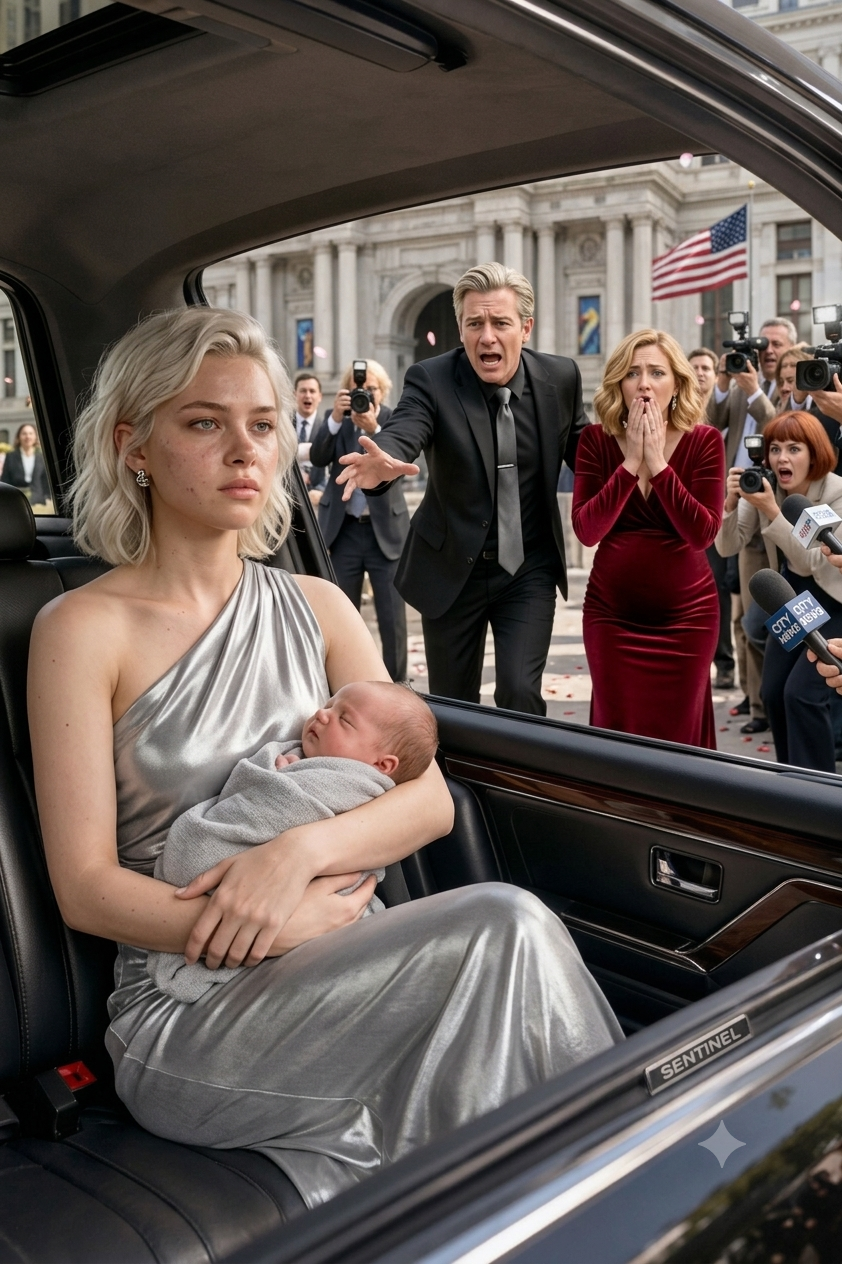
He was headed straight to the family estate in Morelos, where Renata, his new fiancée, was already waiting, dressed in white, pregnant, and ready to be introduced to businessmen, journalists, and relatives as the woman who would finally give the Escobedo family a male heir.
Mariana got into the Mercedes with the kids.
Emilio was nine and pretended to look out the window, though he was listening to everything.
Lucía, six, clutched a stuffed bunny.
—Are we going to the airport, Mommy? —she asked.
—Yes, my love —Mariana replied.
But before the driver started the engine, she opened the folder that Sofía had handed her when they parted.
Inside were bank statements, deeds, strange deposits, ghost companies in Monterrey and Cancún, and apartments bought in Renata’s name with money that supposedly didn’t exist.
For years, Julián had told her to tighten their belts.
That the family business was struggling.
That she didn’t understand numbers.
Not to be dramatic.
Mariana flipped through the pages with her heart pounding in her chest.
Then she found a sealed medical envelope.
She opened it.
And there, in cold, clear language, impossible to misinterpret, was the truth.
Julián had known for almost two years that he couldn’t have children naturally.
Not without advanced treatment.
Not without a procedure he had never initiated.
Mariana felt the air leave her.
All that time, he allowed his mother to humiliate her.
He allowed his cousins to whisper during family meals.
He allowed Renata to enter that family as a miracle, as a blessing, as living proof that the problem had always been Mariana.
Her cell phone vibrated.
An alert appeared on the screen:
“The Escobedo family will celebrate today the pregnancy of Renata Salcedo, future wife of Julián Escobedo.”
Then a message from Sofía arrived.
Don’t leave the country yet. They just requested an urgent measure to retain the children’s passports. They know the medical file is missing, but they don’t know who has it.
Mariana closed the folder slowly.
The driver looked at her through the rearview mirror.
—Ma'am, to the airport?
She took a deep breath.
—No. Take us first to Sofía Rivas’s office.
Emilio leaned forward.
—Is Dad mad?
Mariana swallowed hard.
—Yes, son. But none of this is your fault.
The boy looked down.
—Grandma Regina said that now Dad would have a real family.
Mariana felt something break inside her.
She unbuckled her seatbelt, turned toward her children, and took Emilio’s hands.
—You and Lucía are my real family. No one, not your dad, not your grandma, and no one with a fancy surname can change that.
In the office, the television showed live images of the Escobedo estate.
White tents.
Flowers.
Mariachis.
Champagne glasses.
Reporters.
Julián didn’t throw parties.
He staged coronations.
Sofía explained what was really at stake.
Grandpa Escobedo had left a clause: Julián would have more control over the family trust when he presented a publicly recognized biological heir.
Renata’s pregnancy wasn’t love.
It was power.
Then Sofía showed her another document.
Renata had signed a private agreement with Regina.
If she delivered a child accepted as Julián’s biological heir, she would receive 20 million pesos, a house in Polanco, and indirect control over part of the baby’s trust.
She was delivering a child.
She didn’t love Julián.
She wasn’t forming a family.
She was delivering.
Then Mariana’s phone rang.
It was Julián.
She activated the speaker.
—Return those papers —he ordered, without greeting.
—No.
—Listen carefully, Mariana. If you open your mouth, I’ll bury you in lawsuits until Emilio is of age and Lucía barely remembers your face.
Sofía was already recording.
Mariana closed her eyes.
—Thanks for being so clear.
And hung up.
On the screen, Julián had just taken Renata’s hand in front of everyone.
He smiled as if he had won.
But at that very moment, Mariana understood that the fall was just beginning.
PART 2
At 5 PM, Julián stepped onto the platform at the estate, surrounded by white flowers, cameras, and family dressed as if attending a royal wedding.
Renata was by his side, one hand on her belly and a rehearsed smile plastered on her face.
Regina cried in the front row, but not out of joy.
She cried out of pride.
—Today the Escobedo family receives the blessing they have long awaited —Julián said before the guests—. A new beginning. An heir.
The applause thundered.
The mariachis played louder.
The glasses clinked.
And six minutes later, everything came crashing down.
Sofía Rivas's office presented the legal response to Julián’s urgent request.
It attached the medical report.
The proof that Julián had received it two years prior.
The agreement between Regina and Renata.
The hidden transfers.
The properties bought with marital money.
And the transcription where Julián threatened to use his children as punishment.
The news exploded on social media.
In the broadcast, Julián looked at his cellphone.
First, he frowned.
Then he went pale.
Renata read something on her phone and let go of Julián’s hand as if it burned.
Regina stood up abruptly.
The reporters stopped filming the decorations and started rushing toward them.
—Is it true that you can’t have children, Mr. Escobedo?
—Is the baby not yours?
—Did you hide money during the divorce?
Julián’s face, so confident just minutes earlier, fell apart before all of Mexico.
By nightfall, the board of Grupo Escobedo had suspended a multi-million dollar merger.
Renata slipped out through a side door, hiding her face behind dark glasses.
Julián’s lawyers called Sofía to negotiate.
She responded with a single phrase:
—I’ll see you in court.
The next day, Mariana arrived at the hearing with Emilio and Lucía in a private room, protected by a social worker.
She didn’t want them to hear how their father was trying to turn them into bargaining chips.
Julián appeared in a wrinkled suit and a crooked tie.
He still pretended to have control, but his eyes were red.
Renata arrived dressed in light pink, with a victim’s face, as if she too had been deceived by everyone.
Julián’s lawyer requested that Mariana hand over the children’s passports and return the documents.
—My client fears that the lady will irresponsibly take the minors out of the country —he said.
Sofía barely smiled.
—How curious. Mr. Escobedo signed the travel permit yesterday morning and 20 minutes later organized a public party to announce a pregnancy that, according to the medical documents, he couldn’t have caused naturally.
Judge Cárdenas looked up.
—No one is here to put on a soap opera. Bring the facts.
Sofía brought them.
She showed the transfers to accounts in Nuevo León.
The companies without employees.
Renata’s apartment in Polanco.
A house in Valle de Bravo bought in the name of a cousin of Julián’s.
And withdrawals made while Mariana sold family jewelry to pay for the children’s schooling.
Julián denied everything.
—That doesn’t prove anything.
Then Renata made the mistake that changed the case.
—Are you going to check my apartment too? —she asked, nervously.
The courtroom fell silent.
The judge looked at her.
—If it was acquired with hidden resources from the marriage, of course.
Renata turned pale, looking at Julián.
—You said that money was clean, dude.
No one breathed.
Not even Regina, who had sat in the back like an offended queen.
The judge suspended the financial portion of the divorce.
Ordered five years of accounting records to be delivered.
Frozen major transactions.
And prohibited Julián from interfering with the passports of Emilio and Lucía while investigating the custody threat.
That night, Mariana thought she could finally sleep.
But at 11:43, she received a message from an unknown number.
Ask who the real father of the baby is.
Below was a photo.
Renata was entering a private clinic in Santa Fe.
Next to her was Arturo Escobedo.
Julián’s father.
Mariana looked at the image three times.
Arturo, the silent patriarch.
The man everyone obeyed.
The one who never raised his voice because he didn’t need to.
The private investigation revealed payments from Arturo to Renata months before the pregnancy.
Julián had hidden marital money.
But Arturo had spent years hiding family money, manipulating inheritances, buying silence, and moving pieces as if everyone were mere pawns.
In the next hearing, Sofía presented the payments.
She also presented clinic cameras.
Records of visits.
Deleted messages recovered from an old phone that a former employee of Renata had delivered.
Renata could no longer maintain the act.
She cried.
But not like a victim.
She cried like someone who understood the deal was over.
—I didn’t know it was going to get out of control —she said.
Regina stood up.
—Shut up!
The judge banged the gavel.
—If you interrupt again, I will remove you from the room.
Renata trembled.
Then confessed.
Arturo had offered her money to present the baby as Julián’s.
He knew Julián couldn’t be the father because he had access to the medical file.
According to Arturo, the family needed a “clean” heir, someone who could be molded from the cradle.
Emilio and Lucía wouldn’t do.
They were too attached to Mariana.
Too full of questions.
Too free.
Julián looked at his father like an abandoned child.
—Dad?
Arturo didn’t respond.
He didn’t even look at him.
That silence destroyed Julián more than any insult.
Mariana felt no pleasure.
She felt disgust.
Because for years, they made her believe she was the obstacle, the defective one, the woman who couldn’t measure up.
And in the end, all of them were capable of buying a baby, fabricating a story, and destroying two children to keep a business.
The judge ordered a forensic audit, subpoenas, freezing of trusts, safeguarding of medical records, and supervised contact between Julián and the children.
Outside the courthouse, Regina approached Mariana.
She no longer looked powerful.
She looked old.
—Mariana... I didn’t know everything.
Mariana looked at her without hatred.
That was what hurt Regina the most.
—No —Mariana replied—. You didn’t know because you never asked. You preferred to humiliate me. It was easier.
Regina looked down.
For the first time, she didn’t have an elegant phrase to defend herself.
Three weeks later, Grupo Escobedo removed Julián from management.
The accounts were under review.
Arturo was summoned for financial fraud.
Renata agreed to testify with legal protection.
And then Valeria, Julián’s younger sister, appeared in Sofía’s office.
She arrived without makeup, with a canvas bag and swollen eyes.
—I’m not doing this for you —she told Mariana—. I’m doing it for Emilio and Lucía. They don’t deserve to grow up thinking this was normal.
Inside the bag were old cell phones, printed emails, USB drives, and a black notebook with Julián’s initials.
On the first page, it read:
Exit strategy for Mariana.
Mariana felt the floor move.
Sofía wanted to take the notebook away, but she shook her head.
She had to read.
“Minimize assets.”
“Make her accept custody as a burden.”
“Convince her that Madrid is escape, not advantage.”
“Use travel threats if things get complicated.”
“Pregnancy announcement the same day. Control narrative.”
“Regina must reinforce the idea that Mariana failed as a wife.”
Mariana didn’t cry.
That was what was strange.
She read each line with a calm that frightened.
Her pain hadn’t been an accident.
It had been a calendar.
Her sleepless nights, her apologies, her guilt, her children asking why Grandma treated them like unwelcome guests…
It had all been part of a plan.
In the final hearing, Judge Cárdenas spoke with a sternness no one expected.
He said the Escobedo family had used motherhood, money, emotional dependency, and minors as tools of coercion.
He said one thing was a difficult divorce.
And another, very different, was to build a financial and familial lie around two children.
Mariana obtained primary custody.
Julián would have supervised visits and mandatory therapy.
The division of assets was reopened.
Untouchable education funds were created for Emilio and Lucía.
And after 30 days, Mariana could legally move with them to Madrid.
When they left, reporters surrounded Mariana.
—What’s next?
She took Emilio’s hand.
Lucía hid against her coat.
Mariana looked at the cameras.
—My children are going to be kids. That’s what’s next.
Thirty days later, they arrived at the airport before dawn.
There were no escorts.
No elegant driver.
No heavy surname behind them.
Just three suitcases, two children’s backpacks, and a mother who finally walked without asking for permission.
Before boarding, Sofía sent her a message.
Arturo was arrested this morning. Julián is cooperating. Renata confirmed the baby isn’t his.
Mariana read the message.
She waited to feel triumphant.
But what came was something else.
A small peace.
Like when a noise that had been ringing for years finally stopped.
In Madrid, they rented a simple apartment with a balcony.
Lucía placed her stuffed bunny on the bed and said that this room smelled like a new beginning.
Emilio took longer.
For weeks, he asked if his dad could show up unannounced.
Mariana always answered the same:
—No one barges into your life.
Little by little, the boy began to laugh again.
He started playing soccer in the park.
Lucía learned to say “vale” with a funny accent, and Mariana cried the first time she heard them fight over who washed the dishes.
Because it was a normal fight.
Of normal children.
In a house without threats.
Two years later, Mariana returned to Mexico for one last hearing.
Julián was thin, gray-haired, almost unrecognizable.
He no longer smelled of power.
He smelled of a man who had lost more than he understood.
—I thought losing the company would be the worst —he said softly—. But the worst was hearing Emilio say he sleeps better far from me.
Mariana looked at him.
There was no vengeance in her eyes.
Only weariness.
—Then become someone secure —she replied—. Even if they choose to see you from afar.
Julián lowered his head.
For the first time, he didn’t argue.
That night, Mariana returned to Madrid.
When she opened the apartment door, Lucía ran to hug her.
Emilio appeared behind her, taller, trying to act serious.
—You said you would come back —he murmured.
—And I did.
Dinner was served.
A bit burnt, to be honest.
But it was hers.
No lies.
No blackmail.
No family deciding how much a mother was worth.
Mariana understood then that justice doesn’t always come as a shout.
Sometimes it arrives as a small table.
Two children laughing.
A door closing from within.
And the certainty that no one will take your peace away again when you finally learned to defend it.