PART 1
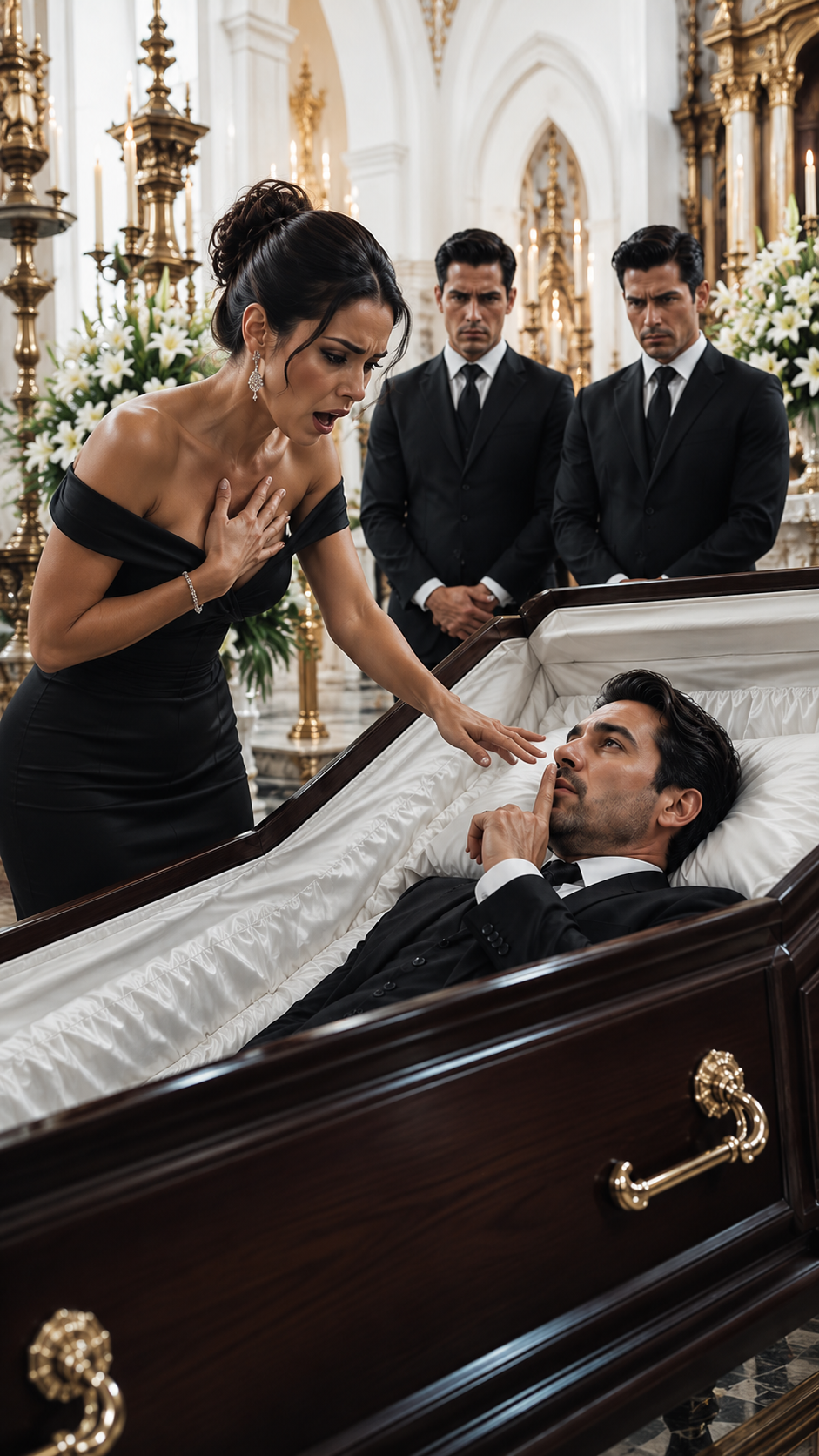
—My mom isn’t signing anything today. She’s too upset… we’re making the decisions for her —Ramiro said in front of his father’s coffin, as if Doña Elvira were no longer there.
Elvira Paredes felt her spine turn to ice.
The San Felipe chapel was filled with white wreaths and neighbors murmuring: “Poor lady, thank goodness she has her children.”
But Elvira was no longer sure.
At the center lay Don Tomás Villalba, her husband of 46 years. A hardware store owner since he was a kid, with three shops and an old house in Coyoacán.
Tomás was stubborn, but not distracted.
For months, he had been telling her that Ramiro and Iván were too interested in “taking care of her.”
First, they took away her card. Then they changed the lock on the gate. After that, Ramiro started answering her phone when the bank called.
—Taking care of you isn’t locking you up, Vira —Tomás told her—. When a son treats you like a burden, he’s no longer thinking like a son.
Elvira asked him not to exaggerate.
Three days later, Tomás collapsed next to the dining table, the coffee cup knocked over at his side.
Doctor Horacio Quesada arrived way too quickly.
He barely examined him for four minutes before he pronounced:
—Sudden heart attack. There was nothing to be done.
Ramiro organized the funeral home and cremation before Elvira could even catch her breath. Iván called lawyer Ochoa. They were already talking about selling “things that would only cause problems.”
—Dad always said he didn’t want to be displayed —Ramiro insisted.
Elvira didn’t remember that. Tomás said many foolish things, but never that.
When the rosary ended, she approached the coffin. The glass covered her husband’s pale face, his hands crossed, and the gray suit he hated.
Elvira rested her fingers on the wood.
—Stubborn old man… you promised we’d go together.
Then Tomás opened his eyes.
It wasn’t a shadow or the imagination of a sleepless widow.
He looked at her with fear and barely lifted a finger to his lips.
Silence.
Elvira felt her soul exiting her body. Ramiro appeared behind her.
—What’s wrong, Mom?
She swallowed the scream.
—I’m dizzy.
Iván grabbed her arm too tightly.
—Don’t get close. You’re feeling unwell.
That night, they took the wake to the house. Between prayers and sweet bread, Elvira never left the coffin’s side.
Around 1:00 AM, Ramiro gave her a tea.
—Drink it all.
The chamomile had something bitter underneath, metallic, just like the smell of Tomás’s coffee.
Elvira pretended to drink. She let the liquid fall onto a hidden napkin on her lap.
Then Iván placed a white pill in her hand.
—The doctor said this will help you rest, Mom.
She popped it in her mouth, took a sip of water, and waited. When her sons left, she rushed to the bathroom and spat it into an empty jar.
She tiptoed down when she heard Ramiro on the stairs.
—Quesada arrives at 6:00. Ochoa has the guardianship papers. If Mom signs, we sell the house before Friday.
Iván whispered:
—What if Dad wakes up before the cremation?
Elvira froze.
Ramiro answered without flinching:
—That’s why we have to burn him early.
At that moment, from the living room, three faint knocks echoed from inside the coffin.
And then a nearly dead voice murmured:
—Elvira… open slowly.
PART 2
Elvira didn’t scream. She walked toward the coffin with a kitchen knife hidden under her shawl, her eyes fixed on the stairs.
The room smelled of wilted flowers, hot wax, and betrayal.
She slipped the knife between the latches and opened a tiny crack. A heavy air escaped from inside. Tomás had purple lips, cold skin, and trembling eyelids.
—Don’t turn on the light —he whispered.
—Holy God, Tomás… they put you in here alive.
—They gave me something in the coffee. Quesada knows. Ramiro paid. Iván listened.
She wanted to pull him out, but Tomás tightened his grip on her fingers.
—If you call now, they’ll say you’re crazy. They’ve already prepared papers to take your assets. We need proof.
—Proof? They’re burying you alive!
—In my study, behind the picture of the Virgin. Safe. Code: 12-09-78.
The date of their wedding.
—There are audios, transfers, copies of the real will, and the number for Celia Mendoza, my lawyer. Not Ochoa. That guy sold out.
Elvira cried silently.
She wasn’t crying just for Tomás. She cried for the two children she had raised, the same ones now arguing about what time it was convenient to burn their father.
—The coffee. The cup. The tea. The pill. Keep everything —Tomás murmured.
A floor creaked above.
Elvira closed the lid, leaving a crack beneath the flowers. She wrapped the cup, stored the napkin, and hid the jar with the pill in her bra.
Then she went upstairs.
The safe opened with a dry click.
Inside, she found a blue memory stick, account statements, and a letter:
“Vira, if you’re reading this, I’m sorry for not telling you before. Our children don’t want inheritance, they want control. And not everything that runs in our blood deserves our trust.”
At 5:15, she knocked on the service door.
It was Nacho, the family driver for 29 years.
—Doña Elvira, Don Tomás told me that if anything strange happened, to get you out back.
—He’s alive, Nacho.
The driver crossed himself.
—Then let’s go, because the funeral home is already on its way.
While Ramiro and Iván believed their mother was sedated, Nacho took her to Celia Mendoza, the criminal lawyer, who already had two experts, a notary, and an agent from the Public Ministry.
Elvira laid it all on the table.
—I don’t want a scandal. I want to save my husband.
Celia examined the blue memory stick.
—You’re going to save him. And then we’ll see if your children still call you exaggerated.
Nacho and a doctor would pull Tomás out before entering the crematory. Elvira had to return and let Ramiro take her to the study to sign.
—Let them talk —Celia said—. The greedy betray themselves when they think they’ve won.
At 6:40, Elvira returned through the garden.
Ramiro was waiting for her in the kitchen.
—Where were you?
—Throwing up. Your tea didn’t sit well with me.
Iván looked down.
Doctor Quesada arrived at 7:00. Ochoa followed with a brown briefcase and a smile that said “it’s all for your good.”
—Doña Elvira —the lawyer said—, your children wish to protect you legally.
—How considerate —she replied.
Ramiro didn’t catch the edge.
—Just sign the temporary guardianship. We’ll handle the accounts, properties, and procedures. You rest.
—And the cremation?
—In an hour —Iván said, almost in a whisper.
Elvira looked at him.
—What a hurry, son. Not even tamales reheat that quickly.
Ramiro slammed the table.
—Don’t start! Dad is dead, and you’re not well.
Quesada pulled out a sheet.
—Last night, she exhibited delirium. It’s normal in grief.
Elvira smiled.
—Is delirium seeing a dead man open his eyes? Or giving bitter tea to a widow so she signs while asleep?
The silence grew heavy.
Ochoa intervened quickly.
—I suggest we proceed in the study. There, Doña Elvira can feel more at ease.
Right where Tomás’s cameras were.
Ramiro agreed because greed also makes one foolish.
In the study, Elvira sat in front of the document: “temporary incapacity” and “family administration.” Polished words to rob her of life.
Ramiro placed the pen in her hand.
—Sign, Mom.
She looked at him.
—First tell me something. When someone puts their father alive in a coffin, do they also expect the mother to sign nicely?
Quesada dropped the briefcase.
Iván started to cry.
—Mom, I didn’t want to…
Ramiro lunged at him.
—Shut up, idiot!
The door burst open.
Celia Mendoza entered with two agents, the notary, the experts, and Nacho. On the computer, a video from the same study appeared, recorded two weeks earlier.
Ramiro spoke with Quesada:
—It has to look like a heart attack. No autopsy. We cremate him, and that’s that.
Quesada replied:
—The substance lowers the pulse and cools the body. At first glance, it looks dead. But there’s a risk if he wakes up.
Ramiro shrugged:
—Let him wake up in the oven.
Elvira felt those four words break something inside her forever.
Then Ochoa appeared explaining the guardianship.
—With a complicated grief ruling, the lady will be left out. The children sell Coyoacán, liquidate the warehouses, and divide before the real will comes to light.
The expert raised the samples.
—There are residues in the cup, the tea, and the pill. Also transfers from Ramiro to Doctor Quesada.
Iván fell to his knees.
—I didn’t put anything in the coffee. Ramiro said they were just going to sedate him to scare him, to make him give up the deeds. When I heard about the cremation, it was already too late.
Elvira lowered her gaze to him.
—Too late was when you stayed silent.
Ramiro still tried to hold his act.
—My mother is being manipulated. My father is dead.
Celia stepped aside.
Down the hall, a wheelchair appeared.
Tomás entered covered with a gray blanket, pale, with an IV in his hand and alive eyes. Nacho pushed him slowly.
Ramiro stepped back.
—No… it can't be.
Tomás looked at him without shouting.
—I thought the same when I heard my son wanted me to wake up in the oven.
Iván crawled towards him.
—Dad, forgive me...
Tomás raised a hand.
—Don’t use that word like it’s a band-aid.
The agents handcuffed Quesada, Ochoa, and then Ramiro.
When it was his turn, Ramiro looked at his mother.
—Mom, you’re not going to let them take me away.
Elvira saw the child who cried for a lost balloon and the man who wanted to make her invalid to rob her.
—I gave you life —she said—. But I won’t lend you my silence to destroy ours.
Ramiro gritted his teeth.
—It was all for the family.
Tomás took a deep breath.
—A family isn’t built by burning the one who’s in the way.
The trial revealed the whole truth: Ramiro had been siphoning money for three years, Iván signed false sales, Quesada collected four deposits, and Ochoa had prepared Elvira’s incapacity long before the supposed heart attack.
The real will protected Elvira and demanded five years of auditing. Ramiro discovered it. That’s why Tomás had to disappear.
Ramiro was sentenced for attempted murder, fraud, and forgery. He never apologized. Iván confessed and received a lesser sentence, but lost the right to approach his parents for years.
Elvira didn’t celebrate. Justice didn’t return her trust or the Sundays without poison behind them.
Months later, Tomás and Elvira created “Casa Vira,” a legal center for elderly people threatened by their own families. At the entrance, they placed a phrase:
“Don’t sign out of fear. Don’t give away your house out of guilt. And if they tell you it’s for your good, ask first who benefits.”
Years later, Iván was released from prison. He didn’t return as an heir. He arrived at “Casa Vira” repairing windows. No one said “all forgotten.”
Tomás watched him sand a crooked table.
—It’s turning out ugly —the old man said.
Iván let out a broken laugh.
—Yeah, Dad. But hang in there.
Tomás ran his hand over the wood.
—Then it still holds value.
It wasn’t a complete forgiveness. It was an opportunity without erasing the wound.
Ramiro, on the other hand, never wrote. In six years, he only sent one request to review the will. Sometimes absence confesses too.
One night, under a jacaranda, Tomás sipped olla coffee while Elvira watched him from the corner of her eye.
—Are you going to smell the cup your whole life? —he asked.
—All the life you have left, stubborn old man.
He smiled.
—Then let it be a lot.
Elvira looked at the crooked table, the patio lights, and her husband alive, breathing slowly, as stubborn as always.
She understood that a mother can love her children and still denounce harm. A wife can be afraid and still open a coffin. And a family, when it rots from within, only starts to heal when someone dares to say: “no more.”
From then on, when someone arrived at “Casa Vira” with hidden documents and tears of shame, Elvira served them coffee, took their hand, and said:
—Don’t feel guilty for defending yourself. If they love you, they won’t destroy you. And if they try to destroy you, your duty is to stay alive.





