PART 1
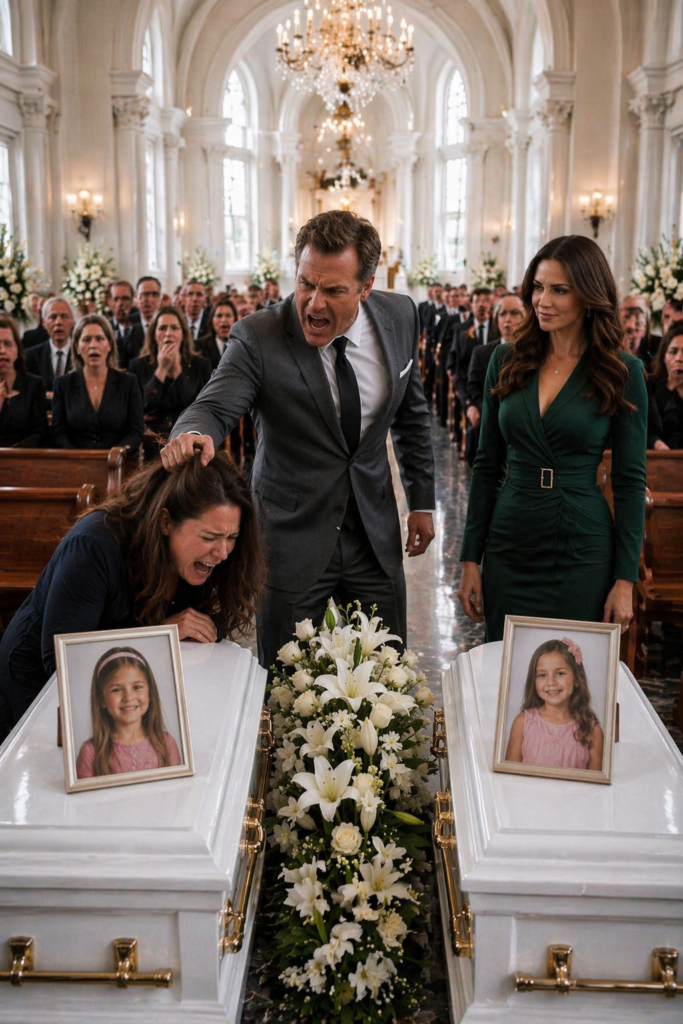
—Don’t make such a scene, Mariana. God took those kids because they were never going to be alright with you.
Esteban Rivas’s words hit the chapel like a stone thrown against glass.
Mariana didn’t respond.
Her hands rested on two small, white caskets—absurdly small. In one lay Santiago, his favorite red cart tucked among the flowers. In the other, Emilia, surrounded by daisies and a lilac bow tied by her grandmother through tears.
The funeral home was in Coyoacán, close to an avenue where trucks continued to pass as if the world hadn’t just shattered into two.
It smelled of reheated coffee, candles, expensive perfume, and fresh pain.
The twins were six years old.
They had died seventeen days earlier when the van they were riding in with their nanny veered off the road on the way to Valle de Bravo.
That’s what everyone said.
Rain.
Wet brakes.
Bad luck.
But Mariana had stopped believing in bad luck long ago.
Esteban entered dressed in black, his hair slicked back, a shiny watch on his wrist, and a calm that made her sick.
He didn’t look like a father arriving at his children’s funeral.
He looked like a man annoyed that he had been interrupted during a business lunch.
And he was with Renata.
His mistress.
Form-fitting black dress, red lips, dark glasses even though it was already late. She walked linked arm-in-arm with Esteban, as if that chapel were a restaurant in Roma, not the place where two children were being bid farewell forever.
A cousin murmured:
—What a terrible mother, seriously.
Esteban stood before Mariana.
He smelled of tequila, expensive cologne, and audacity.
—Look at yourself —he said in a low voice—. You can’t even suffer properly. That’s why the kids always preferred to be with me.
Mariana clenched her fingers against Emilia’s coffin.
She hadn’t slept in days. Her throat was raw from crying silently. Still, she barely lifted her face.
—Esteban, not today —she whispered—. Show some respect for your children, even if they’re dead.
The slap sounded dry.
Mariana turned with the blow, her eyebrow hitting the corner of the coffin. Several women screamed. Her mother tried to rush to her, but an uncle stopped her.
A trickle of blood ran down Mariana’s forehead.
Esteban grabbed her arm tightly, digging his fingers into her skin.
He leaned closer to her ear and murmured:
—You try to act dignified again, and you’ll end up just like them.
Renata was unbothered.
On the contrary.
She smiled.
A small, venomous smile, like a woman finally watching the downfall of someone she had always wanted to erase.
Then the chapel doors swung open violently.
Two ministerial agents, five investigation police officers, and Commander Isabel Trejo from the Mexico City Prosecutor’s Office entered.
Behind them was attorney Julián Meza, carrying a black box sealed with red tape.
The murmur turned into a shout.
Esteban released Mariana.
—What the hell is this?
The commander displayed her badge.
—Esteban Rivas Alcocer and Renata Molina, you are under arrest for the qualified homicide of two minors, insurance fraud, forgery of documents, and organized crime.
The chapel exploded.
Renata recoiled as if the floor had opened beneath her.
Esteban turned pale.
—What did you do, Mariana?
She wiped the blood with the back of her hand and looked at the two caskets.
—What you never thought —she said, her voice broken—. I stopped asking for explanations and started gathering evidence.
PART 2
For seventeen days, Esteban had acted as if the pain belonged to him.
He hugged Mariana in front of the neighbors. He cried when the bodies arrived. He posted a photo of Santiago and Emilia on Facebook with a phrase about “little angels who fly too soon.”
But that very night, he slept in an apartment in Del Valle with Renata.
Mariana knew because her sadness didn’t make her stupid, even if he had been telling her otherwise for months.
Just three days after the accident, Esteban started telling the family that Mariana was losing her mind.
He said she talked to herself, mixed up dates, and could no longer manage bills or documents.
He even tried to convince Mariana’s mother to hand over the house keys “to take care of it.”
And then he wanted to move a family account with nine million pesos.
That’s where he made his first mistake.
Before marrying, Mariana had not been the quiet wife Esteban boasted about at dinners. She had worked for eight years reviewing insurance claims for a company in Santa Fe.
She knew how to recognize forged signatures.
She knew how to read policies.
She knew how to detect lies hidden among numbers.
The pain took her breath away, but it didn’t take her mind.
The first sign appeared in an email Esteban thought he had deleted.
The life insurance policies for Santiago and Emilia had been raised from 250 thousand pesos to 12 million each, just ten days before the accident.
The digital signature read Mariana Beltrán.
But Mariana had never signed that.
The second mistake was darker.
Esteban had purchased additional coverage for accidental death and had listed a company called Horizonte Azul Consultores as a partial beneficiary.
The company had no real office.
No employees.
No active website.
It only had a bank account.
And that account was linked to Renata Molina.
Attorney Julián Meza was the one who asked Mariana not to blow things up just yet.
—If you confront him now, he’ll cover his tracks —he said—. We need him to believe he’s already broken you.
Mariana agreed.
And she swallowed each humiliation like it was glass.
When Esteban called her crazy in front of her in-laws, she lowered her gaze.
When Renata sent a flower arrangement with a card that read “for the little angels,” Mariana felt like ripping her skin off but tucked the card away in an evidence bag.
When they told her she had to forgive because “a man suffers differently,” she didn’t respond.
Because there was something else.
The van involved in the accident belonged to Mariana.
Months earlier, she had installed a hidden camera on the dashboard because Santiago got car sick and she wanted to check if the nanny was driving too fast.
After the crash, the van was wrecked at the bottom of a ravine.
The camera seemed useless.
The memory card didn’t show up.
Local police closed the case too quickly.
But Julián insisted on having a private expert check the internal system.
What they recovered wasn’t complete video.
It was audio fragments among rain, crashes, and screams.
First, the nanny’s voice, Lupita, telling the children not to unbuckle their seatbelts.
Then Emilia’s cries.
Then Santiago screaming:
—Lupita, there’s a black van behind us!
Then a distant male voice, over the phone:
—On the curve. Hit them there. They won’t get up.
Mariana listened to that audio just once.
Then she vomited in the bathroom of the Prosecutor’s Office.
Lupita had survived.
She was 23 years old, studying early childhood education at UPN, and had been hospitalized for weeks, with a broken leg, cracked ribs, and a shattered memory.
Esteban visited her twice.
The first time he brought flowers.
The second time he entered unannounced.
A nurse reported that after that visit, Lupita woke up crying and repeating:
—I didn’t kill them. I didn’t kill them.
Mariana went to see her with Commander Isabel.
Lupita could barely open her eyes when she recognized her.
—I’m so sorry, Mrs. Mariana —she said, trembling—. I promised I would take care of them.
Mariana took her hand carefully.
—you were there too, Lupita. You’re a victim too.
The girl cried in silence.
Several minutes passed before she could speak again.
Then she released a sentence that shattered everything.
—Before we left, Mr. Esteban gave them juice. He said he wanted to say goodbye because he couldn’t go on the trip.
Mariana felt the room turn cold.
—Juice?
Lupita nodded.
—Emilia fell asleep very quickly. Santiago said his stomach hurt. I thought it was just nerves.
The commander ordered a re-examination of the toxicology reports.
The kids had traces of sedatives.
Not enough to kill them.
But enough to make them sluggish, sleepy, unable to react, scream, or unbuckle their seatbelts if something went wrong.
That was the discovery that turned pain into rage.
Esteban not only wanted to cash in on his children’s deaths.
He had also ensured they couldn’t defend themselves.
The third mistake came from the person she least expected: her own brother-in-law.
Fabián, Renata’s brother, had a mechanic shop in Iztapalapa and too many debts with loan sharks.
He had checked the van two days before the trip.
In the initial report, everything seemed normal.
But the forensic experts found a rear valve manipulated with a clean, almost invisible cut.
The tire was supposed to lose air gradually on the road.
It wasn’t rain.
It wasn’t a curve.
It wasn’t fate.
It was a trap.
Fabián was arrested at 6:15 in the morning as he tried to hide at an aunt’s house in Nezahualcóyotl.
At first, he acted brave.
He said he didn’t know anything.
That the Prosecutor’s Office was making it up.
That Mariana was crazy with grief.
He lasted 18 minutes.
Then he asked for water, a lawyer, and protection.
He confessed that Esteban had promised him 700 thousand pesos to “fix a mechanical detail.”
Renata transferred him 300 thousand from Horizonte Azul.
The rest would come when the insurance paid.
But Fabián, distrustful, recorded a meeting in a parking lot in Santa Fe.
In the audio, Renata asked:
—What if Mariana suspects?
Esteban replied:
—We’ll make her seem unstable. A mother burying two children will sign anything to stop suffering.
Fabián asked:
—What if the nanny survives?
Esteban let out a dry laugh.
—Then she can have another accident too.
When Mariana listened to that recording, she didn’t scream.
She didn’t cry.
She stared at the wall, her hands still on her legs.
She had just understood that she had slept nine years next to a man who kissed her children on the forehead while calculating how much they were worth dead.
The Prosecutor’s Office already had enough to arrest them before the funeral.
But Mariana asked for one thing.
Julián initially refused.
—It’s dangerous. That man has already threatened Lupita. He can do something to you too.
Mariana looked at her children’s backpacks still hanging by the entrance. Santiago’s had a green dinosaur. Emilia’s had a purple star.
—I want them arrested in front of my children —she said—. I want their father’s last lie to fall before them.
So when Esteban hit her in the chapel, he didn’t find a defenseless widow.
He found a mother who had already decided not to suffer in silence.
Preventive detention was immediate.
Esteban’s lawyers tried everything.
They said Fabián was lying to save himself.
That Lupita was confused from the trauma.
That Mariana had manipulated evidence because she knew about insurance.
One even dared to say before the judge:
—Mrs. Beltrán is acting out of the resentment of a cheated wife.
Mariana lifted her gaze.
For the first time in weeks, she spoke without trembling.
—I’m not here because my husband cheated on me. I’m here because I buried my two children in white caskets while he arrived with the woman who helped kill them.
The courtroom fell silent.
The trial lasted seven months.
Forensic experts, nurses, neighbors, digital technicians, bank employees, and a toll booth worker recognized the black van following closely behind the vehicle carrying the children.
Lupita testified in a wheelchair.
When she saw Esteban, her hands trembled.
—He went to the hospital —she said—. He squeezed my shoulder and whispered: “The children can no longer speak. You shouldn’t either.”
Renata pretended to pray with a rosary between her fingers.
Esteban didn’t look at her.
But everything shattered when they played the parking lot audio.
Esteban’s voice filled the room:
—A mother who loses two children signs anything.
Then Renata’s voice:
—What if she doesn’t sign?
And Esteban replied:
—Then we’ll make it look like she took her own life.
Mariana’s mother let out a cry that froze everyone.
The judge called for order.
But the damage was already done.
Renata turned to Esteban, her face twisted.
—You said they would never find that!
Esteban clenched his jaw.
—Shut up.
—I’m not going to shut up! You prepared the juices! You said they had to be asleep so they wouldn’t scream!
The room exploded with murmurs.
The lawyers tried to stop her, but Renata was already speaking out of fear, not guilt.
—you forged the signature! You wanted the house, the money, and to leave with me!
Esteban stood up, furious.
—Because you pressured me! You wanted to live like a lady from Polanco!
Renata screamed:
—But you decided to kill your own children!
That sentence split the trial in two.
Mariana closed her eyes.
Not because she couldn’t bear it.
But because the truth had finally come out of the mouths of those who tried to bury it with her children.
The sentence came four weeks later.
Esteban Rivas and Renata Molina were found guilty of qualified homicide, insurance fraud, forgery of documents, threats, and organized crime.
They received the maximum cumulative sentence allowed.
Their accounts were frozen.
The policies were annulled.
Horizonte Azul was intervened.
Fabián received a lesser sentence for collaborating, but he would still spend many years in prison.
Esteban’s house was sold.
Part of the money went to Lupita’s rehabilitation and the rest to a foundation in the names of Santiago and Emilia, dedicated to supporting mothers who are victims of economic violence and family threats.
From prison, Esteban sent 11 letters.
Mariana didn’t open any.
A year later, she walked through Chapultepec with two small jacaranda trees.
She planted them near the lake, where her children had once fed the ducks on a Sunday afternoon.
Lupita arrived with a cane.
She cried as she touched the plaque with the children’s names.
—I should have protected them —she said.
Mariana embraced her.
—No, Lupita. Monsters don’t always enter through the window. Sometimes they have a key to the house.
A journalist published that phrase, and it went viral.
Some said Mariana had been cold for planning the arrest at the funeral.
Others said a mother has the right to choose the exact moment when the truth kneels before her children.
Mariana didn’t argue with anyone.
That afternoon she left two white flowers on the damp earth.
She watched the young branches sway in the wind, as if two little hands were waving at her from afar.
She no longer carried Esteban’s last name.
She no longer lived in the house where he had rehearsed his lies.
She no longer lowered her voice to survive.
Before leaving, she whispered:
—I couldn’t save them from their father. But I made sure their father could never hide from you.
Then she walked toward the park exit without looking back.
Because some pains never heal.
But there are also truths that, when brought to light, forever bury those who believed a broken mother could no longer fight.





