PART 1
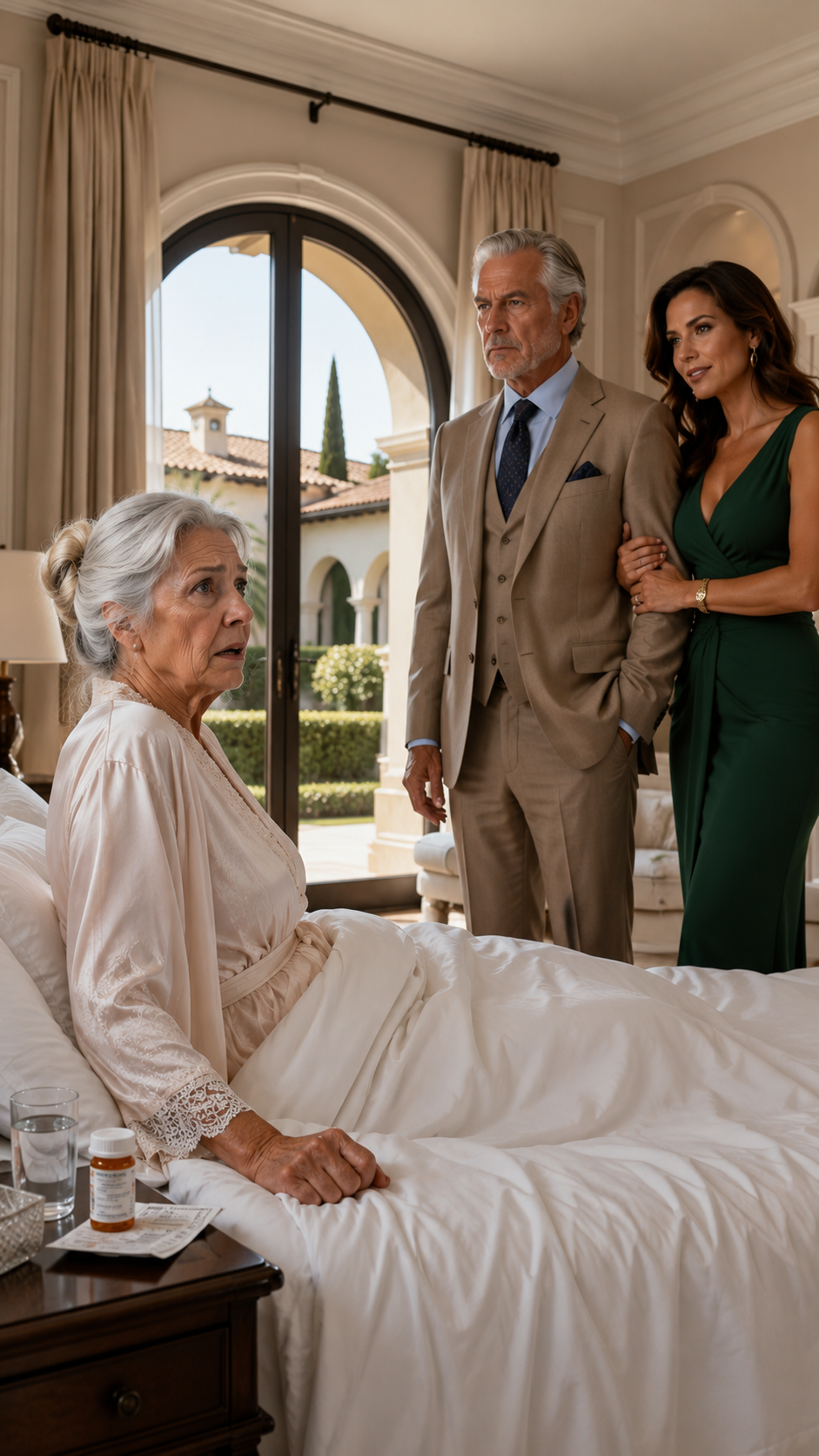
At 73, Elena Robles sat in the living room of her home in Lomas de Chapultepec, a blanket across her legs and a recent scar hidden under her blouse, when her husband looked at her as if she were an old piece of furniture.
Tomás Arriaga didn’t seem sad.
He wore a navy blue jacket, Italian shoes, and that expression of an important man he had flashed for 48 years to convince bankers, politicians, and even his own children that he was always right.
Next to him was Brenda Cárdenas.
35 years old, straight hair, a fitted red dress, perfectly manicured nails, and a smile so fake that even the housekeeper lowered her gaze in anger.
On her wrist was a diamond bracelet.
Elena's bracelet.
The very one Tomás had given her decades ago when they sealed their first big deal with a hotel chain in Cancun, and he told her, tears of joy in his eyes, that everything they had was theirs.
Brenda crossed her legs as if that house were hers, too.
“Mrs. Elena, Tomás and I have already spoken with your children,” she said softly. “We will decide where you will live.”
Elena raised her eyes.
She didn’t scream.
She didn’t cry.
She only looked at the bracelet.
“Do my children know about this?”
Tomás sighed, irritated.
“Don’t start with the drama. Mariana, Andrés, and Javier are worried. We all see that you can’t manage on your own anymore. You had surgery two months ago, you forget things, you tire easily.”
“I don’t forget the important things,” Elena replied.
Brenda let out a giggle.
“With all due respect, ma’am, sometimes one doesn’t realize when they need help.”
Tomás walked to the fine wood bar, poured himself whiskey without asking, and gestured toward the room with his hand.
“The house is big. The staff costs money. You need a quiet place. A nice residence, one of those in Cuernavaca, with a garden and nurses.”
“And you?”
“I’m going to rebuild my life.”
Elena tightened her fingers around her cane.
For almost half a century, she had organized dinners for partners, signed loans, raised three children, endured discreet humiliations, and smiled in magazine photos where Tomás appeared as “the visionary founder of Grupo Arriaga.”
But Grupo Arriaga hadn’t been born from Tomás.
It had been born from the ranch that Elena's parents sold in Querétaro.
It had been born from her pawned jewelry.
It had been born from her nights spent tallying accounts while Tomás bragged about connections in restaurants in Polanco.
Over the years, he learned to tell the story without her.
And everyone believed him.
Even their children.
Mariana had called that morning to say that perhaps a place with medical attention wasn’t such a bad idea.
Andrés asked her not to fight.
Javier didn’t even answer.
Tomás placed the glass on the table.
“I won’t leave you on the street. I will give you what you need. But you can no longer interfere in decisions regarding the company or the family.”
Brenda smiled.
“Besides, the lady needs to rest. She has done what she had to do.”
That phrase crossed the room like a slap.
She has done what she had to do.
As if Elena had been a luxury maid.
As if her life had an expiration date.
Tomás took two leather suitcases from by the door. One held watches. The other, documents. He also took a framed photo of the house in Valle de Bravo.
Before leaving, he leaned in front of Elena.
“You don’t know how alone you’re going to be.”
She looked at him with a calmness that made him uneasy.
“Your father once told me you were charming but dangerous when you were hungry.”
Tomás’s jaw tightened.
“My father never loved you as much as you think.”
“I’m not so sure.”
Brenda stood up, impatient.
“Come on, love. It’s not worth arguing with someone who no longer understands.”
Tomás opened the door.
Elena’s bracelet shone one last time on Brenda’s wrist before disappearing down the hallway.
When the gate closed, the house fell silent.
Elena waited one minute.
Then she opened the secret drawer of the side table, took out a black cell phone her lawyer had given her two years before, and dialed.
“Diana,” she said firmly. “He did it.”
On the other end, Diana Montes didn’t ask anything.
“Then we start.”
Elena hung up, walked slowly to the library, and opened a safe hidden behind an old painting of her mother.
Inside were contracts, records, recordings, bank statements, and a yellowed letter with her name handwritten.
A letter her mother had left before dying.
And when Elena read the first line, she understood that Tomás hadn’t betrayed her that morning.
The betrayal had begun 48 years earlier.
PART 2
Diana Montes arrived before dawn, without makeup, wearing a gray coat and carrying a black folder under her arm.
At 68, she walked like a judge even though she never was one, and in Mexico City, many businessmen feared her silence more than a subpoena.
She walked into the library and found Elena sitting in front of the open safe.
On the table lay old papers, photographs, notarized copies, and her mother’s letter.
“What did he take?” Diana asked.
“My bracelet. Watches. Documents. The photo from Valle de Bravo.”
“Also dignity?”
Elena barely smiled.
“I left that so he thinks he won.”
Diana opened the folder.
For two years, they had worked in secret.
It all began when Elena fainted at a charity dinner in Las Lomas. Tomás said in front of everyone that his wife was already “delicate in the head.” After that, he began talking to their children behind her back, taking away invitations, excluding her from meetings, and asking for her signatures under medical pretexts.
But Elena wasn’t lost.
She was watching.
While Tomás took Brenda out to restaurants in Santa Fe and bought her bags, trips, and an apartment in Interlomas, Elena reviewed every old contract from Grupo Arriaga.
And found what he never believed she would.
The first warehouse in Naucalpan was bought with her inheritance money.
The initial line of credit bore her signature as the primary guarantee.
The land where they later built the metal plant in Tlalnepantla came from the sale of her parents' ranch.
Tomás had built an empire on a stolen story.
Diana pointed at several documents.
“The house is already in the Elena Robles Trust. The family accounts are protected. The board removed Tomás on Friday for misappropriation of funds. And Brenda appears as a beneficiary of false payments totaling over 82 million pesos.”
Elena looked at her mother’s letter.
“This is still missing.”
Diana took the paper carefully.
The letter was dated four days before Elena’s mother died.
It said her father had distrusted Tomás from the start. That he saw him as ambitious, charming, and capable of smiling while hiding a knife. It also said that he had left a special clause in his will: if Tomás tried to intern, abandon, strip, or declare Elena incapacitated to take her assets, all control of the original assets would pass to her and her children.
But that clause had never appeared.
“Your mom knew,” Diana whispered.
“And someone silenced her.”
Diana lifted her gaze.
“We need to find the notary.”
“He died 20 years ago.”
“Then the accountant.”
Elena took a moment to respond.
“Víctor Salcedo.”
Víctor had been her father’s accountant. He disappeared after the funerals. Tomás always said he went to Mérida out of shame over some debts.
Diana made three calls.
By 10 in the morning, they had an address.
Víctor wasn’t in Mérida.
He was in a simple nursing home on the outskirts of Toluca.
Elena insisted on going that same day.
The place smelled of reheated coffee, bleach, and old sweet bread. Víctor Salcedo was 91 years old, skin clinging to his bones, and his eyes filled with guilt.
When he saw Elena, he cried.
“Elena…”
No one had called her that since she was a child.
She sat beside his bed.
“Víctor, I need to know what happened to my father’s papers.”
The old man closed his eyes.
“Your father made everything clear. Tomás was never to control your money. Never. But after the funeral, he came to see me.”
Diana turned on a recorder.
“Did he threaten you?”
Víctor swallowed hard.
“At first, he begged me. Then he offered me money. Afterward, he said that if I spoke, he would destroy my family. I was a coward. I accepted.”
Elena didn’t move.
The pain was so deep that she couldn’t even cry.
Víctor fumbled a shaky hand under the pillow and pulled out a sealed envelope.
“I couldn’t burn it. I kept it all these years. Your mother also left me a copy of her letter.”
Diana opened the envelope.
Inside was the original codicil.
Signed.
Sealed.
Notarized.
Hidden for 48 years.
The hearing was nine days later.
Tomás arrived at court with Brenda on his arm and Elena’s bracelet gleaming on her wrist, as if he wanted to humiliate Elena in front of everyone. Outside, reporters gathered because he himself leaked that he would request the administration of the assets due to his wife’s “incapacity.”
Their three children were there.
Mariana avoided looking at her mother. Andrés seemed uncomfortable. Javier remained serious, caught between shame and doubt.
Tomás’s lawyer spoke first.
He said Elena was a sick, vulnerable, and confused woman.
He said Tomás only wanted to protect the family’s wealth.
He said the residence was an act of love.
Then Diana stood up.
She didn’t shout.
That made it more brutal.
“Your Honor, Mr. Arriaga is not trying to protect his wife. He is trying to take what belongs to her before it is discovered that he built his fortune on deliberately concealed assets.”
Tomás blinked.
Brenda stopped smiling.
Diana presented the trust, the transfers, the internal audit, and the payments to Brenda’s phantom consulting firm.
Then she requested the immediate recovery of a jewel unlawfully taken.
“The diamond bracelet currently worn by Ms. Cárdenas belongs to my client.”
All eyes turned to Brenda.
She tried to cover her wrist.
“Tomás told me it was his,” she whispered.
“Take it off,” Tomás ordered through clenched teeth.
“But you gave it to me.”
Elena looked at him for the first time.
“It was never yours.”
The judge ordered the bracelet to be handed over right then and there.
Brenda took it off with trembling fingers and left it on the secretary’s desk, red with shame.
But the real blow came afterward.
Diana presented the codicil.
Then Elena’s mother’s letter.
And finally, Víctor Salcedo’s recorded statement.
The courtroom fell silent.
Tomás turned pale.
His lawyer requested a recess.
The judge denied it.
“Mr. Arriaga, this describes decades of asset concealment, document manipulation, and possible economic violence against your wife.”
Tomás tried to stand up.
“That’s a lie. That woman is sick.”
“Sit down,” the judge said.
And for the first time in 48 years, Tomás obeyed without a prepared speech.
The provisional resolution was immediate.
Elena would keep the house, control of the trust, and rights over the original assets. Tomás was formally removed from the administration of Grupo Arriaga while investigations progressed. It was also ordered to review payments made to Brenda and recover properties bought with company money.
When they exited, reporters surrounded Tomás.
Brenda was no longer on his arm.
She was three steps behind, crying and talking on her cell phone.
That night, Elena's children arrived at the house.
Mariana brought chicken soup in a baking dish, as if food could erase years of doubt.
Andrés brought flowers.
Javier stood at the entrance, his eyes red.
“Forgive me, Mom,” he said.
Elena didn’t respond immediately.
She looked at all three of them.
Yes, they were her children.
But they had also too easily believed that an aging woman had no voice.
“It hurt you to discover that your father lied,” she said. “It hurt me that you needed proof to believe me.”
Mariana broke down.
“He told us you forgot things, that you exaggerated, that Diana manipulated you.”
“Of course,” Elena replied. “When a man wants to erase a woman, he first convinces everyone that she no longer understands.”
All three cried.
Elena did too, but only a little.
Not out of weakness.
Out of relief.
Three weeks later, Brenda disappeared.
She emptied the Interlomas apartment, sold two of Tomás’s watches, withdrew money from an account he opened in her name, and left with a businessman from Monterrey.
Tomás called Elena at 11:40 PM.
“I have nowhere to go,” he said, his voice broken.
Elena was in her bedroom, the diamond bracelet on the nightstand and her mother’s letter in hand.
“That’s not my problem.”
“I was your husband for 48 years.”
“And yet you planned to send me to a nursing home to take my house.”
There was silence.
Then Tomás whispered:
“Did you ever love me?”
Elena closed her eyes.
That question was not regret.
It was another way of asking for pity.
“Yes, Tomás. That was never the problem.”
“Then how can you do this to me?”
She breathed slowly.
“I didn’t do this to you. I just stopped protecting you from what you did.”
Tomás didn’t apologize.
He only said, with the cruelty still left in him:
“You’re going to die alone.”
Elena looked toward the door of her bedroom.
Mariana was in the hallway. Andrés was serving tea in the kitchen. Javier was arranging boxes of documents with Diana in the library.
“No,” she replied. “That was your plan for me. Not my destiny.”
She hung up.
A year later, the mansion in Lomas de Chapultepec reopened under another name.
Elena Robles Center for the Independence and Defense of Older Women’s Assets.
The dining room where Elena once served wine to Tomás’s partners became a free legal clinic.
The library where she often felt invisible now held workshops on bank accounts, wills, divorce, inheritances, and economic violence.
The guest room was adapted as a psychological consulting room.
Brenda’s apartment was sold by court order, and with that money, they financed a temporary shelter for women over 60 abandoned by husbands, children, or families who treated them like burdens.
On the day of the inauguration, Elena appeared in a light blue suit, her white hair loose, and her diamond bracelet on her wrist.
A reporter asked her what she wanted to say to other women.
Elena looked at the house that had once been her elegant prison.
Then she looked at her children, Diana, and the women waiting at the entrance.
“That being underestimated doesn’t mean you’re defeated,” she said. “Sometimes, they’re just giving you time to prepare your comeback.”
The phrase went viral that very night.
But what spread the most wasn’t Tomás’s downfall or Brenda’s escape.
It was the image of Elena opening the doors of her house for other women.
Because in Mexico, everyone knows someone who was erased in silence.
A mother.
A grandmother.
A wife who signed papers without anyone explaining.
A woman who built a family and later heard that she was no longer useful.
Months later, Elena received an anonymous letter from Nayarit.
It only had four words written in trembling handwriting:
“You mattered first.”
There was no signature.
It wasn’t necessary.
Elena folded the letter and placed it in the same drawer where she kept her mother’s.
Then she walked out to the garden, where several volunteers were planting red roses by the entrance of the center.
“Mrs. Elena, is this okay?” asked a young woman.
Elena looked at the open earth, the clear sky, and the house that finally bore her name.
“Yes,” she replied. “Let them be the first thing they see upon arriving.”
That spring, the roses bloomed strong.
And every woman who crossed that threshold understood something Tomás never wanted to accept:
a life doesn’t end when someone stops valuing you.
Sometimes, it begins the very day you stop asking for permission to exist.





