PART 1
—If you’re going to lower that box without letting me see my son, you’ll have to go through me first.
Doña Socorro’s voice echoed in the funeral home like a church bell tolling.
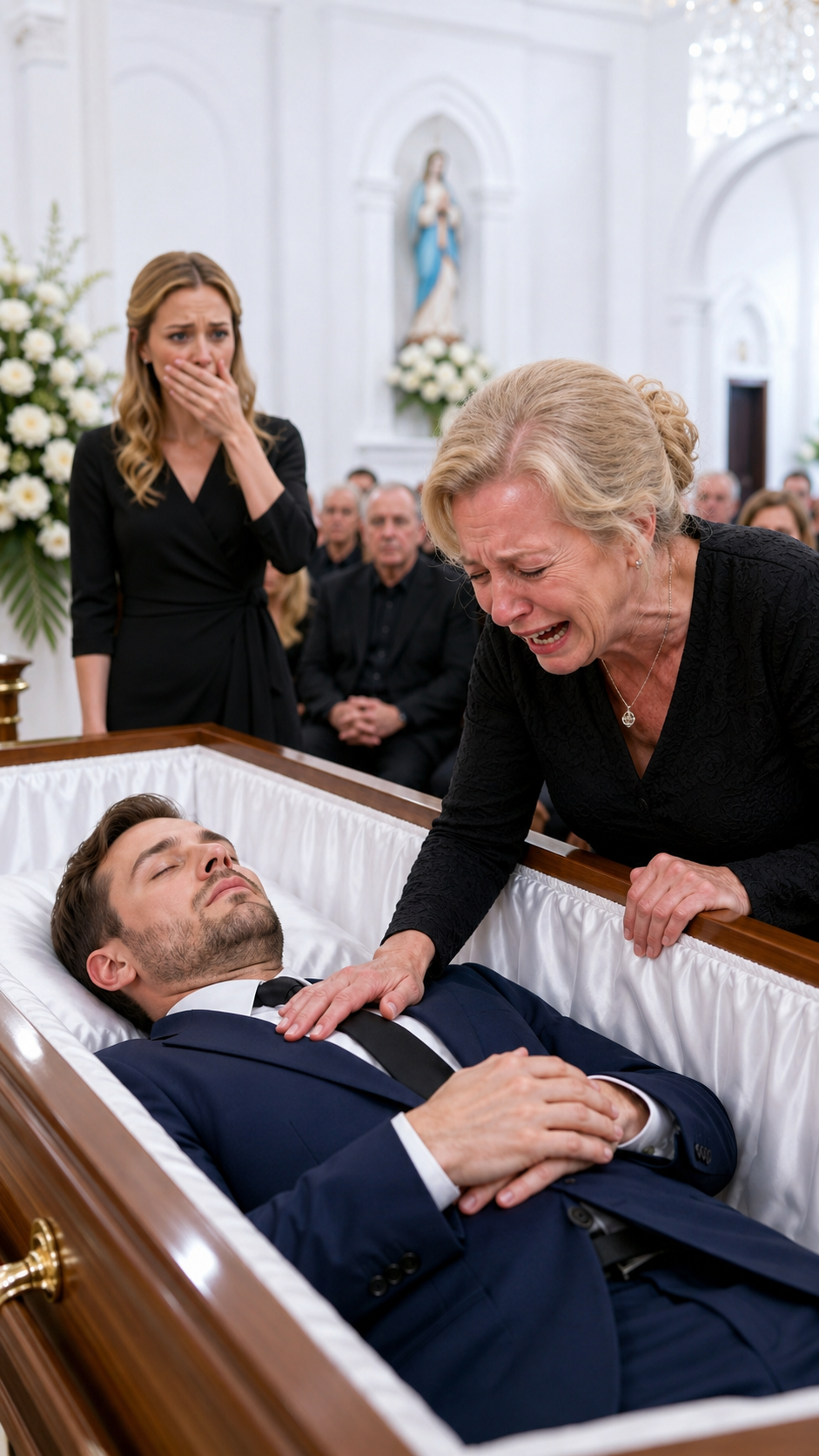
She was 68 years old, her hair disheveled from the journey, shoes caked in dirt, and a brown rebozo pressed tightly against her chest. She had left early from Lagos de Moreno to Guadalajara after receiving a message that froze her blood.
“Doña Socorro, I’m sorry to bother you... did you have a chance to say goodbye to Julián?”
Julián was her only son.
And no one had told her they were holding a wake for him.
In front of her stood the closed casket, surrounded by white floral arrangements, elegant candles, and wreaths with golden ribbons. Everything smelled of expensive flowers and deceit.
Beside her, impeccably dressed in black, was Valeria, Julián’s wife. She wasn’t crying. She didn’t tremble. She merely pressed her lips together, as if her mother-in-law’s presence was an annoyance.
—Ma’am, please —Valeria said quietly—. Julián asked not to be seen this way.
Doña Socorro looked at her with red eyes.
—My son called me even to ask how much garlic was in the pozole. Don’t you dare tell me what he wanted.
The attendees froze. There were Julián’s colleagues, two partners with scared faces, a lawyer sweating profusely, and several relatives of Valeria staring at the floor.
No one dared to approach.
Doña Socorro had raised Julián alone, selling gorditas outside a high school, washing other people’s clothes, and saving coins in jars to pay for his college tuition.
The father left before the child turned one. She never remarried.
—My son won’t feel abandoned as long as I breathe —she always said.
But since Julián married Valeria, everything changed.
First came the short phone calls. Then the canceled Sundays. After that, the messages answered by Valeria herself.
“Julián is busy.”
“Julián is tired.”
“Julián doesn’t want any problems.”
Doña Socorro felt like they were tearing him away from her piece by piece.
—That woman doesn’t love you, son —she once told him—. She manages you.
Julián got so angry he stopped visiting her for months.
But a fight couldn’t erase blood.
So when Valeria stood in front of the casket to prevent her from getting closer, doña Socorro felt something fierce rising from her chest.
—Open it.
—No.
—I told you to open it.
Valeria stiffened her voice.
—You weren’t there in his last days. Don’t come now to play the role of the suffering mother.
The blow hurt because it carried poison and truth.
Doña Socorro took a deep breath, stepped forward, and pushed her.
Two employees tried to stop her, but she broke free with a strength no one expected from such a tired woman.
She placed her trembling hands on the casket lid.
And she lifted it.
Julián was there, pale, motionless, with purple lips and cold hands resting on his chest.
Doña Socorro let out a choked scream and leaned down to kiss his forehead.
Then she saw it.
A minimal movement.
Barely a blink.
Then Julián’s chest rose just a little, like an ember that hadn’t quite extinguished.
Doña Socorro gasped for air.
—He’s alive —she whispered.
No one responded.
She spun around to everyone, shaking with rage.
—My son is alive! He’s breathing!
Valeria stepped back, pale as paper.
—It can’t be… —she said, not thinking.
And there, amid the white flowers and feigned prayers, everyone understood that this was no mistake.
PART 2
—Call an ambulance, damn it! —shouted doña Socorro, cradling Julián’s cold body—. Don’t just stand there like this is a movie!
An employee ran out. Another dialed 911 with a trembling hand.
Valeria clung to the wall, staring at the open casket as if she had seen a ghost she had ordered killed.
Doña Socorro didn’t take her hand off her son’s face.
—You knew —she said, her calm terrifying—. You knew he wasn’t dead.
—Don’t say nonsense —Valeria replied—. I followed medical instructions.
—Which doctor?
Valeria didn’t answer.
The paramedics arrived within minutes. They checked Julián right there, among the wreaths and murmurs.
One of them looked up.
—He has a pulse. Very weak, but he has a pulse.
The entire funeral home fell silent.
—What do you mean, he has a pulse? —asked one of the partners.
—As you heard —the paramedic said—. If you bury him, you kill him.
Doña Socorro felt her legs buckle, but she didn’t let go of her son.
She climbed into the ambulance without asking for permission. She took his icy hand and pressed it to her cheek.
—I’m here, my son. Hold on a little longer. Don’t leave me. You still owe me many meals, do you hear?
At the Civil Hospital of Guadalajara, the doctors rushed Julián into emergency.
Doña Socorro sat in the waiting room, clutching her rebozo between her fingers, praying silently. Beside her was Bruno, an old college friend of Julián, who had arrived at the funeral with a face full of suspicion.
—Doña Socorro —Bruno said—, Julián texted me four days ago.
She looked up.
—What did he say?
Bruno hesitated, as if he knew those words would shatter her.
He pulled out his phone and showed her the message.
“Bruno, I found suspicious activity in the company. Valeria doesn’t know I’ve copied everything. If something happens to me, look for my mom. Don’t let her sign anything.”
Doña Socorro covered her mouth.
—My son wanted to call me…
—Yes —Bruno said—. And that’s why I believe this wasn’t a natural death.
Before dawn, Commander Ramiro Ibarra from the Prosecutor’s Office arrived. He had been Julián’s classmate in high school and knew doña Socorro since she sold gorditas outside the school.
—Socorrito —he said respectfully—, this is no longer a funeral. It’s a crime scene.
She looked down the hall where Valeria was talking to an expensive lawyer.
—Then start with the woman who was in such a rush to bury him.
The first pieces of evidence fell into place.
The death certificate had a forged signature. The doctor who supposedly checked Julián denied ever going to his house. The funeral home admitted that Valeria paid in cash for an urgent service, with a closed casket and burial the same day.
But the most serious evidence appeared in Julián’s office.
Forty-eight hours before the funeral, someone had modified legal powers so that Valeria would take complete control of the company if he died.
There were also transfers to phantom accounts, altered contracts, and a life insurance policy raised from 5,000,000 to 35,000,000 pesos.
Doña Socorro listened to everything without crying.
She had already cried too much in her life.
—She never loved my son —she murmured—. She wanted him as an inheritance.
Meanwhile, Julián remained in intensive care.
The doctors explained that he had received a substance capable of lowering his vital signs to the point of making him appear dead. It wasn’t common. It wasn’t an accident. Someone knew exactly what they were doing.
Valeria was brought in to testify that same afternoon.
She walked in with her head held high, as if she still believed that her last name, her fine clothes, and her lawyer could cover an open casket.
—My husband was sick —she said—. He decompensated. I only did what I was told.
Commander Ibarra laid the evidence on the table: the bogus certificate, the funeral home videos, the power changes, the transfers, the insurance, and Julián’s message.
Valeria stopped blinking.
—What did you give him? —the commander asked.
She clenched her jaw.
—I don’t know what you’re talking about.
—Your husband was alive inside a casket.
—That was a medical failure.
The commander leaned towards her.
—No, ma’am. A medical failure is making a mistake with a dosage. What you did was plan a burial.
Valeria fell silent.
Until Bruno handed over a recording that changed everything.
Julián, suspicious, had installed a backup app on his phone. The microphone activated during an argument at his house.
In the audio, Valeria’s voice was heard.
—If you report this, we’re all sunk.
Then Julián’s weak voice.
—I’m not signing anything. Tomorrow I’m going to the Prosecutor’s Office.
Then a cup hitting the table.
—Drink the tea —she said—. It’ll calm you.
Doña Socorro listened to that recording sitting on a bench in the hospital. She closed her eyes and clutched the rosary until it marked her fingers.
—I taught him not to distrust the food from his home —she whispered—. And it was there he was betrayed.
Valeria couldn’t take it much longer.
When she learned that the private doctor was already in custody and had confessed to signing the death without checking Julián, she broke down.
But not from guilt.
From anger.
—Julián was a fool —she spat—. Always thinking of employees, scholarships, his mother, doing things “right.” I built that company too. I closed deals. I endured meetings. I deserved more.
—And so you decided to kill him? —Ibarra asked.
—He wasn’t going to die —she said—. I just needed a few hours. With the closed burial, everything would be resolved.
The commander looked at her with disgust.
—They were going to lower him alive into the ground.
Valeria looked down.
—I never thought that woman would dare to open the casket.
When the commander left, doña Socorro was standing in the hallway.
—She confessed —he said.
She didn’t smile. She didn’t celebrate.
She only asked:
—My son?
At that moment, a doctor came out of intensive care.
—Mrs. Socorro… Julián has awakened.
The woman took a step and nearly fell. Bruno caught her.
She entered the room with fear, as if her heart couldn’t fit in her chest.
Julián was surrounded by wires, with oxygen, his face gray and lips cracked. But his eyes were open.
When he saw her, he cried.
—Mom…
Doña Socorro approached slowly. She took his hand and kissed it many times.
—I’m here, my son. I won’t move again.
Julián tried to speak, but his voice came out broken.
—Forgive me.
—Don’t say that.
—I pushed you away. I left you alone. I believed her when she said you wanted to control me.
Doña Socorro caressed his hair as she did when he was a child.
—a child can get lost, but a mother never stops recognizing him.
Julián closed his eyes.
—I heard your voice.
She froze.
—What?
—In the casket. I couldn’t move. I couldn’t scream. I felt cold. I heard people praying. I thought they were going to bury me. Then I heard your voice saying not to bury me until you saw me.
Doña Socorro began to cry silently.
—I scared you, kid.
He barely tightened his fingers.
—you saved me again.
In the following days, the story exploded across Mexico.
“Mother opens casket and finds her son alive.”
“Wife planned fake funeral to take over millionaire company.”
“Businessman from Guadalajara almost buried alive.”
But doña Socorro didn’t want cameras. She wanted her son to breathe without fear.
Julián would wake up screaming in the early morning. He couldn’t stand the door to his room being closed. He panicked being alone. Every time he heard wood knocking, he would clutch his chest.
Doña Socorro slept sitting next to him.
She brought him chicken broth in a thermos, lemon gelatin, and warm tortillas wrapped in a napkin.
—you’re going to get better —she told him—. Even if it’s just broth, you’re going to get better.
One day, Julián cried when he saw her arranging his medicines.
—I wanted to be big so you would never lack for anything. And I ended up leaving you outside my life.
She sighed.
—Being big doesn’t mean forgetting who carried you when you couldn’t walk. They don’t teach that in fancy universities, my son.
The trial began two months later.
The courtroom was filled with reporters, employees, onlookers, and Valeria’s relatives who no longer dared to look at her.
She arrived handcuffed, in a gray suit and a hard face. She didn’t seem remorseful. She seemed offended for having lost.
The prosecutor presented each piece of evidence: fake documents, transfers, emails with the doctor, messages with the lawyer, cash payments to the funeral home, and the recording of the tea.
Then Julián took the stand.
He walked slowly, still weak, but spoke clearly.
—I trusted Valeria with my home, my company, and my life. She didn’t want to walk with me. She wanted to replace me. When she discovered I was going to report her, she decided to erase me.
Then he looked at his mother.
—for a long time, I thought my mom was exaggerating. I believed her love was pressure. I thought growing up meant not needing her. I was wrong. Growing up is knowing who was with you when you had nothing.
Doña Socorro cried without hiding.
When it was her turn to testify, everyone expected to see her broken.
But she sat up straight.
She told how she raised Julián alone. How she sold food from five in the morning. How she washed uniforms by hand. How she pretended not to be hungry so he could have seconds. How she saved coins to buy him used books.
Then she looked at Valeria.
—you thought I was a nosy old woman. You thought that with expensive flowers and a closed casket, you could silence me. But a mother recognizes her son even if everyone tells her it’s over. I saw him breathe once. That was enough for me to fight against everyone.
The courtroom fell silent.
Valeria, when she spoke, only said:
—I also built that company. I deserved a part.
The judge looked at her coldly.
—Deserving money doesn’t give you the right to bury a man alive.
The sentence was severe: 18 years in prison for attempted homicide, fraud, forgery, and criminal association. Additionally, she lost any rights over Julián’s company, accounts, and assets.
As she left the courthouse, reporters surrounded doña Socorro.
—What would you say to mothers whose children drift away?
She hugged Julián’s arm.
—that they don’t always drift away because they don’t love. Sometimes they get lost trying to prove they can do it alone. But if a mother feels something is wrong, she shouldn’t stay silent. The pain can be endured. The guilt can’t.
Julián hung his head.
—And what did you learn? —they asked.
He looked at his mother.
—that no success is worth more than the hand of the one who held you when you were nobody.
Over time, Julián rebuilt his company. He fired the corrupt, reviewed contracts, returned money to affected clients, and created a fund to support underprivileged youth wanting to study technology.
He named it Raíces.
At the inauguration, he asked doña Socorro to cut the ribbon.
—This is yours too, mom.
She became nervous.
—Oh no, I don’t even know about those modern things.
Julián smiled.
—you taught me the only thing that matters: not to betray those who trust you.
Since then, every Friday they had dinner together. Sometimes at a small eatery, sometimes at the old house in Lagos, with beans, rice, tortillas, and salsa from a molcajete.
It no longer mattered where.
What mattered was arriving.
A year later, Julián returned with his mother to the market where she had sold food for so many years. On a wall, there were still pencil marks where she measured her height when she was a child.
He ran his fingers over those lines.
—I used to want to go so far that I was embarrassed to look back.
Doña Socorro adjusted his collar.
—Leaving isn’t bad, son. What’s wrong is believing that roots get in the way.
The story didn’t go viral just because a mother opened a casket and found her son alive.
It went viral because thousands understood something uncomfortable: sometimes we ignore the voice that loves us the most until life forces us to hear it from the bottom of a closed box.
Valeria lost her freedom for turning love into business.
Julián lost his naivety, but he regained his mother.
And doña Socorro, the woman who arrived late, disheveled, tired, and with a broken soul, proved that true love doesn’t always ask for permission.
Sometimes it pushes a door.
Sometimes it challenges a whole family.
And sometimes it opens a casket even when everyone says there’s nothing to be done.
Because a mother can make many mistakes.
But when she feels her son still breathes, not even death dares to oppose her.





